Recently in FeaturedOperas
Mozart and Salieri, an opera in one act consisting of two scenes.
Nicolai Rimsky-Korsakov (1844-1908), composer. Libretto derived from Alexander Puskhin's play of the same name.
First performance: 7 December 1898 in Moscow.
Ariadne auf Naxos, Oper with a prologue and one act.
Music composed by Richard Strauss. Libretto by Hugo von Hofmannsthal.
La Vestale, a tragédie lyrique in three acts.
Boris Godunov, an opera in four acts with prologue
Modest Mussorgsky, composer. Libretto by the composer, based on Alexander Pushkin's drama Boris Godunov and Nikolai Karamazin's History of the Russian Empire
First performance: 8 February 1874 at the Mariinsky Theatre, St. Petersburg
Il Trovatore, dramma in four parts.
Only a few months following the premiere of Der Rosenkavalier, Hugo von Hofmannsthal proposed a new opera to Richard Strauss based on Molière’s comedy-ballet, Le Bourgeois gentilhomme (in German, Der Bürger als Edelmann).
Die Entführung aus dem Serail, Singspiel in 3 Acts.
Music composed by Wolfgang Amadeus Mozart (1756–1791). Libretto by Johann Gottlieb Stephanie the Younger, based on an earlier libretto by
Christoph Friedrich Bretzner.
Die Entführung aus dem Serail, Singspiel in 3 Acts.
Music composed by Wolfgang Amadeus Mozart (1756–1791). Libretto by Johann Gottlieb Stephanie the Younger, based on an earlier libretto by
Christoph Friedrich Bretzner.
Arabella: Lyrische Komödie in three acts
Die Entführung aus dem Serail, Singspiel in 3 Acts.
Music composed by Wolfgang Amadeus Mozart (1756–1791). Libretto by Johann Gottlieb Stephanie the Younger, based on an earlier libretto by
Christoph Friedrich Bretzner.
La Gioconda, dramma lirico in four acts.
Music composed by Amilcare Ponchielli (1834–1886). Libretto by Arrigo Boito (under the pseudonym Tobia Gorrio), based upon Victor Hugo's Angelo, Tyrant of Padua (1835).
Don Carlo, an opera in four acts. Music composed by Giuseppe Verdi (1813–1901). Libretto by Joseph Méry and Camille Du Locle after Friedrich von Schiller’s dramatic poem Don Carlos, Infant von Spanien. Revised version in four acts (French text revised by Du Locle, Italian translation by Achille de Lauzières and Angelo Zanardini).
Un ballo in maschera, a melodramma in three acts.
Music composed by Giuseppe Verdi. Libretto by Antonio Somma, based upon the work of Eugène Scribe Gustave III ou Le bal masqué (1833)
Medea: Melodramma tragico in three acts.
Die Tote Stadt, an opera in three acts.
Music composed by Erich Wolfgang Korngold (1897-1957). Libretto by Paul Schott (Julius and E. W. Korngold) after the novel Bruges la morte by Georges Rodenbach.
Manon Lescaut, dramma lirico in quattro atti
Elektra: Tragedy in one act.
Una cosa rara, ossia Bellezza ed onestà. Dramma giocoso in two acts.
Music composed by Vicente Martín y Soler (1754–1806). Libretto by Lorenzo Da Ponte from the comedy La luna de la Sierra by Luis Vélez de Guevara.
Hamlet: Opéra in five acts. Music composed by Ambroise Thomas. Libretto by Michel Carré and Jules Barbier after The Tragedy of Hamlet, Prince of Denmark by William Shakespeare.
Das Liebesverbot: Grosse komische Oper in two acts.
FeaturedOperas
29 Oct 2005
GIORDANO: Fedora
Fedora, a melodrama in three acts.
Umberto Giordano, composer. Arturo Colautti, librettist, based on the play with the same name by Victorien Sardou
First performance: 17 November 1898 at Teatro Lirico Internazionale, Milan
Principal Characters:
| Princess Fedora Romazov |
Soprano |
| Countess Olga Sukarev |
Soprano |
| Count Loris Ipanov |
Tenor |
| De Siriex |
Baritone |
Synopsis
Act One
Setting: A winter night, 1881. The salon of Vladimiro Andrejevich in St. Petersburg.
Princess Fedora is waiting for Vladimiro, whom she is to marry that day. A police officer and De Siriex suddenly appear carrying Vladimiro. He has been shot. The police officer, Inspector Gretch, questions the servants. Fedora learns that Vladimiro was found wounded in a pavillion and that a man had been seen running away after the shots. The pavillion had been rented by an old woman who delivered a letter to Vladimiro earlier in the day. But that letter is nowhere to be found. Fedora swears to avenge Vladimiro’s death. Suspicions turn to Loris Ipanov, a friend of the nihilists (anarchists) and whose apartment is near the place of the shooting.
Act Two
Setting: Paris
Fedora follows Loris Ipanov to Paris to avenge Vladimiro. She holds a reception in her home, which Loris attends. Loris declares his love to Fedora; but, she appears to reject him. She informs him that she intends to return to Russia. Having been exiled, Loris cannot return with her. Desperate, Loris admits that he killed Vladimiro. She begs him to return after the reception to tell her the entire story. In the meantime, she writes a letter to Vladimiro’s father, the Russian Imperial Chief of Police, accusing Loris of the murder of Vladimiro. Loris returns later and explains that he had caught Vladimiro having an affair with his wife. Vladimiro shot him and Loris returned fire, mortally wounding Vladimiro. Fedora realizes that he was defending his honor and that Vladimiro was a cad. She convinces Loris to remain with her that night.
Act Three
Setting: A villa in the Bernese Oberland, Switzerland.
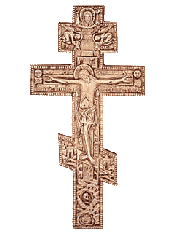
Loris and Fedora are happily in love. De Siriex arrives and informs Fedora that the brother of Loris had been arrested as a result of her letter. He dies in prison and, after hearing of his death, his mother dies of heartbreak. Stunned, Fedora realizes that she is the cause of their deaths. Loris receives letters from Russia with news of his brother and mother. A woman in Paris had apparently reported him. Fedora confesses her guilt and begs his forgiveness. He curses her. Fedora ingests poison hidden in her Byzantine cross. She dies in his arms.
Click here for the complete libretto.