Subscribe to
Opera Today

Receive articles and news via RSS feeds or email subscription.


twitter_logo[1].gif


UCP_9780226043425.gif

Recently in Recordings

Ariane et Barbe-Bleue on Blu-Ray

Paul Dukas’ Ariane et Barbe-Bleue, first heard in 1907, once seemed important. Arturo Toscanini conducted the Met premiere in 1911 with Farrar and later arranged some of its music for a 1947 recording with his NBC Symphony.

Kaufmann Wagner

The economics of the recording companies dictate much that is not ideal. Wagner’s operas were not composed as they were in order to permit the extraction of bleeding chunks, even on those occasions when strophic song forms do occur.

Mahler: Symphony No. 8

Among the recent recordings of Mahler’s Eighth Symphony, Valery Gergiev’s release on the LSO Live label is an excellent addition to the discography of this work.

Songs by Zemlinsky

While not unknown, the songs of Alexander von Zemlinsky (1871-1942) deserve to be heard more frequently.

Gustav Mahler: Lieder eines fahrenden Gesellen, Rückert-Lieder, Kindertotenlieder.

Recorded on 5 and 6 May 2008 and 17 and 18 January 2009 at the Lisztzentrum (Raiding, Austria), this recent Bridge release makes available the piano-vocal versions of three song cycles by Gustav Mahler, Lieder eines fahrenden Gesellen, Rückert-Lieder, and Kindertotenlieder performed by mezzo-soprano Hermine Haselböck, accompanied by Russell Ryan.

Kathleen Ferrier: A Film by Diane Perelsztejn

Contraltos rarely achieve the acclaim and renown of sopranos. Assigned few leading roles in opera, they are condemned to playing the villain or the grandmother, or to stealing the castrati’s trousers in en travesti roles.

1612 Italian Vespers

Following their 2011 Decca recording of Striggio’s Mass in 40 Parts (1566), I Fagiolini continue their quest to unearth lost treasures of the High Renaissance and early Baroque, with this collection of world-premiere recordings, ‘reconstructions’ and ‘reconstitutions’ of music by Giovanni and Andrea Gabrieli, Monteverdi, Palestrina, and their less well-known compatriots Viadana, Barbarino and Soriano.

Eternal Echoes: Songs and Dances for the Soul

Eternal Echoes is an album of khazones [Jewish cantorial music] for cantorial soloist, solo violin and a blended instrumental ensemble comprising a small orchestra and the Klezmer Conservatory Band.

Mahler: Symphony no. 3 / Kindertotenlieder

Michael Tilson Thomas’s recording of Mahler’s Third Symphony is an outstanding contribution to the composer’s discography.

Oliver Knussen’s Symphonies from NMC

Oliver Knussen burst into British music with an unprecedented flourish. In 1967, the London Symphony Orchestra premiered Knussen’s First Symphony, with István Kertész scheduled to conduct.

Ludwig van Beethoven: Fidelio

Based on performances given in Summer 2010 at the Lucerne Festival, this recording of Beethoven’s Fidelio is an admirable recording that captures the vitality of the work as conducted by Claudio Abbado.

Stanisław Moniuszko: Flis

Stanisław Moniuszko (1819-1872) was one of the most popular composers of his day in Poland, and of the many works he wrote for the stage, two are performed from time to time, Halka (1848) and Strazny dwór [The Haunted Manor] (1865).

Stanisław Moniuszko: Pieśni Songs

The Polish alto Jadwiga Rappé is a familiar voice in various stage and concert works, and the recent release of a selection of songs by Stanisław Moniuszko (1819-1872) is an opportunity to hear her performing artsongs.

Joan Sutherland and Richard Bonynge: Serate Musicali

Originally released on multiple discs in 1981 this reissue on two CDs is a comprehensive collection of art songs by Italian and French composers from the nineteenth and early twentieth centuries.

Richard Strauss: Salome

An exciting contribution to the discography of this popular opera, the live performance of Richard Strauss’s Salome from the Festspielhaus at Baden-Baden is a compelling DVD.

Lulu by Gran Teatro del Liceu, Barcelona

Released in late 2011, Deutsche Grammophon’s DVD of the new staging of Berg’s Lulu at the Gran Teatro del Liceu, Barcelona is an excellent contribution to the discography of this fascinating opera.

Lulu by the Metropolitan Opera

A recent release by the Metropolitan Opera, this two-disc set makes available on DVD the famous performance of Berg’s Lulu that was broadcast on 20 December 1980 as part of the PBS series “Live from the Met.”

Elmer Gantry the Opera

The novels of Sinclair Lewis once shot across the American literary skies like comets, alarming and fascinating readers of that era, but their tails didn’t extend far behind them.

Historical Performances from Covent Garden: Barbiere, La traviata and Tosca

Once the province of only the most dedicated opera fanatics, mid-20th century recordings of privately taped live performances have become more widely available.

Lucia and the glass harmonica

Flute players in opera orchestra around the world must look forward to the frequent appearances of Donizetti’s Lucia di Lammermoor, knowing that while the stage spotlight in the mad scene will be on the soprano, the orchestral spotlight will be on their instrument.

OPERA TODAY ARCHIVES »

Recordings

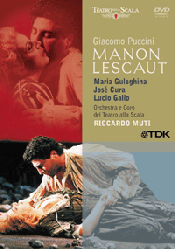
Giacomo Puccini: Manon Lescaut
30 Oct 2005

PUCCINI: Manon Lescaut

Manon Lescaut was Puccini’s first big success, and his first contribution to the repertory. Yet it’s popularity has always lagged behind that of the composer’s following three mega-hits La Boheme, Tosca, and Madama Butterfly, as well as some later successes such as Turandot and even Gianni Schicchi.

Giacomo Puccini: Manon Lescaut

Maria Guleghina, José Cura, Lucio Gallo, Orchestra e Coro del Teatro alla Scala, Riccardo Muti (cond.).

TDK DVWW-OPMLES [DVD}


The opera had a somewhat tortured genesis, with five librettists eventually having a hand in it, including composer Ruggiero Leoncavallo and Puccini’s team-of-the-future Giuseppe Giacosa and Luigi Illica. Perhaps there are hints of this in the final product which stand between Manon Lescaut and warhorse status. Yet watching the opera from beginning to end in this handsome production from La Scala with its pair of charismatic leads, I couldn’t help but see in this opera the very same Puccini that we know and love.

There are departures. Some feel that the final act is dramatically weak by Puccinian standards. The composer nakedly stakes out “modern” territory by borrowing the musical language of Tristan und Isolde for his Intermezzo, while some of the big choral moments in the first act have a distinctly old-fashioned feel about them. And even though it is no longer than several of the other Puccini operas, Manon Lescaut has a bit of a sprawling feel to it which separates it from the laser-like focus Puccini exhibits in later titles.

Yet when the muse strikes, Puccini is as potent as anywhere. Des Grieux’s wooing of the lovely Manon in act one, the lover’s exchanges in act two, the gorgeous Intermezzo, the stunning parade of fallen women in act three, and the pair’s cries of desperation in the final act are all as affecting as any such passages in the Puccini canon.

But maybe the biggest departure is in the title character herself. Mimi, Tosca, Butterfly, Minnie, Angelica, and Liu are all easy to love. They themselves love with selfless devotion. They are simple and good. They don’t deserve the cruel hand which fate deals them. Not so with Manon. Our heroine is immature, selfish, and unfaithful. Even after being given a second chance by the heartbroken Des Grieux, when they desperately need to flee from her wealthy, elderly lover’s estate, she takes extra time to gather up jewelry and various treasures with which she cannot bear to part.

But for me, all these faults in some ways makes Manon all the more compelling, because they make her seem real. I love Cio-cio-san, but how many fifteen year-olds do you know with that amazing level of maturity? The teenaged girls I know are a lot closer to Manon!

This particular representation of the opera has just about everything going for it. The production, filmed at La Scala in 1998, is a lavish period staging with costumes as beautiful as museum pieces, and sets which bring the story vividly to life.

But even more important are the leads. One could hardly imagine a more handsome Des Grieux than Jose Cura or a more beautiful Manon that Maria Guleghina. They are picture-book leads. Neither gives a cookie-cutter performance, and these are not cookie-cutter voices. Cura’s tenor sounds more like a baritone with (great) high notes, and his vocal mannerisms—most which don’t bother me—are very much in evidence. Guleghina is shown at her best here. She is a singer with a huge voice, but one which, at times, can seem to spin out of control. Here she keeps it tamed for the most part. It is always a voice which sounded mature in comparison with her youthful appearance, with a fairly wide vibrato, especially in loud passages. Maybe that angelic face here distracted me. But if it did, so be it! Marco Berti, now a regular lead at the Metropolitan Opera, sings the small role of Edmondo in the first act. Lescaut is sung by Lucio Gallo, and Geronte is well sung and acted by Luigi Roni. Riccardo Muti leads the orchestra in a very fine reading of the score.

The DVD’s presentation is stylish and useful. The menu is very attractive, with a montage of scenes from the opera being acted out accompanied by music from the Intermezzo. One may select subtitles in English, German, French, Spanish, and Italian, and may select a particular act, or go directly to specific scenes within that act which are all labeled with titles from the Italian text.

I have no doubt that when Puccini sat down at his desk to write Manon Lescaut and pictured the scenes of the opera, he must have imagined them very much like this.


Eric D. Anderson
Send to a friend

Send a link to this article to a friend with an optional message.

Friend's Email Address: (required)

Your Email Address: (required)

Message (optional):