Recently in Recordings
The Sixteen continues its exploration of Henry Purcell’s Welcome Songs for Charles II. As with Robert King’s pioneering Purcell series begun over thirty years ago for Hyperion, Harry Christophers is recording two Welcome Songs per disc.
In February this year, Albanian soprano Ermonela Jaho made a highly lauded debut recital at Wigmore Hall - a concert which both celebrated Opera Rara’s 50th anniversary and honoured the career of the Italian soprano Rosina Storchio (1872-1945), the star of verismo who created the title roles in Leoncavallo’s La bohème and Zazà, Mascagni’s Lodoletta and Puccini’s Madama Butterfly.
Collapsology. Or, perhaps we should use the French word ‘Collapsologie’ because this is a transdisciplinary idea pretty much advocated by a series of French theorists - and apparently, mostly French theorists. It in essence focuses on the imminent collapse of modern society and all its layers - a series of escalating crises on a global scale: environmental, economic, geopolitical, governmental; the list is extensive.
Amongst an avalanche of new Mahler recordings appearing at the moment (Das Lied von der Erde seems to be the most favoured, with three) this 1991 Mahler Second from the 2nd Kassel MahlerFest is one of the more interesting releases.
If there is one myth, it seems believed by some people today, that probably needs shattering it is that post-war recordings or performances of Wagner operas were always of exceptional quality. This 1949 Hamburg Tristan und Isolde is one of those recordings - though quite who is to blame for its many problems takes quite some unearthing.
The voices of six women composers are celebrated by baritone Jeremy Huw Williams and soprano Yunah Lee on this characteristically ambitious and valuable release by Lontano Records Ltd (Lorelt).
As Paul Spicer, conductor of the Royal Birmingham Conservatoire Chamber Choir, observes, the worship of the Blessed Virgin Mary is as ‘old as Christianity itself’, and programmes devoted to settings of texts which venerate the Virgin Mary are commonplace.
Ethel Smyth’s last large-scale work, written in 1930 by the then 72-year-old composer who was increasingly afflicted and depressed by her worsening deafness, was The Prison – a ‘symphony’ for soprano and bass-baritone soloists, chorus and orchestra.
‘Hamilton Harty is Irish to the core, but he is not a musical nationalist.’
‘After silence, that which comes closest to expressing the inexpressible is music.’ Aldous Huxley’s words have inspired VOCES8’s new disc, After Silence, a ‘double album in four chapters’ which marks the ensemble’s 15th anniversary.
A song-cycle is a narrative, a journey, not necessarily literal or linear, but one which carries performer and listener through time and across an emotional terrain. Through complement and contrast, poetry and music crystallise diverse sentiments and somehow cohere variability into an aesthetic unity.
One of the nicest things about being lucky enough to enjoy opera, music and theatre, week in week out, in London’s fringe theatres, music conservatoires, and international concert halls and opera houses, is the opportunity to encounter striking performances by young talented musicians and then watch with pleasure as they fulfil those sparks of promise.
“It’s forbidden, and where’s the art in that?”
Dublin-born John F. Larchet (1884-1967) might well be described as the father of post-Independence Irish music, given the immense influenced that he had upon Irish musical life during the first half of the 20th century - as a composer, musician, administrator and teacher.
The English Civil War is raging. The daughter of a Puritan aristocrat has fallen in love with the son of a Royalist supporter of the House of Stuart. Will love triumph over political expediency and religious dogma?
Beethoven Symphony no 9 (the Choral Symphony) in D minor, Op. 125, and the Choral Fantasy in C minor, Op. 80 with soloist Kristian Bezuidenhout, Pablo Heras-Casado conducting the Freiburger Barockorchester, new from Harmonia Mundi.
A Louise Brooks look-a-like, in bobbed black wig and floor-sweeping leather trench-coat, cheeks purple-rouged and eyes shadowed in black, Barbara Hannigan issues taut gestures which elicit fire-cracker punch from the Mahler Chamber Orchestra.
‘Signor Piatti in a fantasia on themes from Beatrice di Tenda had also his triumph. Difficulties, declared to be insuperable, were vanquished by him with consummate skill and precision. He certainly is amazing, his tone magnificent, and his style excellent. His resources appear to be inexhaustible; and altogether for variety, it is the greatest specimen of violoncello playing that has been heard in this country.’
Baritone Roderick Williams seems to have been a pretty constant ‘companion’, on my laptop screen and through my stereo speakers, during the past few ‘lock-down’ months.
Melodramas can be a difficult genre for composers. Before Richard Strauss’s Enoch Arden the concept of the melodrama was its compact size – Weber’s Wolf’s Glen scene in Der Freischütz, Georg Benda’s Ariadne auf Naxos and Medea or even Leonore’s grave scene in Beethoven’s Fidelio.
Recordings
19 Nov 2005
Heroic Tenors
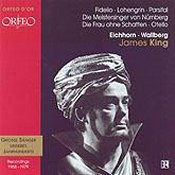
A happy feature of the King CD is the booklet in German and English: at least 7 pages full of information on the tenor. Then there is the pristine sound of the recordings. Though there is no mention of a concert source I’m fairly sure all the pieces (always followed by generous applause), are derived from the famous Münchner Sonntag Konzerte.
During the sixties and seventies they were regularly broadcasted and duly taped by German collectors who send them to their foreign correspondents. The concerts were proof of the German ‘Wirtschafswunder’ (Economic miracle) when money started to flow once more and they were generous indeed. Some of them found their way unto CD like the Olivero-Labo evening and the Bergonzi-Kabaivanska-Cappuccilli gala. James King was a regular who participated for many years.
The recordings on this CD were broadcast between 1968 and 1979 and are therefore testimony to the tenor’s stamina and vocal longevity; but they also show the slow deterioration of the voice. As is normal, the 1968-1970 recordings (Lohengrin, Parsifal, Frau) are the best. The raw power of the voice is there and tells us why people were stunned when he made his Met début in 1966 and his first “Gott” shook the walls. There was never great love between him and the Met (he was rejected five times during auditions) and after some good initial seasons he would only return in the eighties. King was a real heroic tenor in the old-fashioned way Melchior so much liked: he started as a baritone before becoming a heldentenor. He shows off a good stylish big voice majestically rolling along with a good free top. There is bronze in the sound and his legato is exemplary in the difficult Frau aria. A real beautiful pianissimo he hasn’t which is obvious in his Lohengrin aria where it’s remarkable how he has copied his interpretation from Konya’s classic performance (No coincidence. His career took off while substituting time and again for the Hungarian tenor). The difference with the 1977 and 1979-pieces however is striking. By that time the 54 year old tenor still had an awful amount of voice left, though there were now some chinks in his vocal harness. In the Fidelio aria the top sounds more constricted and he uses a lot of glottal attacks. He also cuts some corners by eschewing consonants. The Prize Song which was never meant to be sung by a baritonal tenor lies clearly somewhat too high. One hears him using great gulps of air and pushing the voice. The four big Otello pieces are sung well; indeed very well for a man his age but he cannot compete with another Konzert given ten years earlier (which appeared on Bella Voce 107.107) where he sings exactly the same Otello extracts with fresher tone and a more free top. Anyway this is a worthy testimony of the now 80-year old tenor who was much underrated during his best days. Time too to celebrate him by publishing his lieder- and especially his operetta-recital.
There is a marked difference with the Botha recital. The South-African tenor is not a Heldentenor but a big lirico; maybe a shade too light for Die Walküre (though Georges Thill is one of the best and most musical Siegmunds on record). I fear the recording doesn’t help either. I’ve heard Botha in the flesh and he sings broader and more voluminous in reality than in this piece where the voice sounds a bit too slender, without heft. In all the other arias and duets he is splendid, using his means for the best. He has made formidable progress since his first recordings 10 years ago. His Wagner singing is much helped by the many hours of work he put into his Italian roles. I heard him sing an exquisite messa di voce in Celeste Aida (he had worked on it for years, he told me) and this pays off. Take his Am stillen Herd: very sensitive singing and no barking. Both the Meistersinger Prize Song and the Lohengrin narrative start with a soft lovely tone spinning out the music in a very poetic manner. The way he caresses “eine Taube” equals Konya’s classic recording. Botha even adds the coda to the aria, cut by Wagner though reinstated on the Konya-Amara-recording. Here too it only proves that Wagner knew this was worthless and I’d much have preferred Botha recording “Ein Schwert verhiess mir der Vater”. So what is the catch? Well there is one and it’s something Botha cannot do much about. The basic material of the voice is not very rich, not very distinguished, not very personal. In the house this may pass but on record one is too much aware of his lack of outstanding God-given means. Nevertheless I and a lot of other people would be mighty happy to have him in a house-performance of one of the more lyrical Wagner parts as he has so improved musically. Compared with his Italian recital of four years ago (on Arte Nova, which he financed half himself he said) he has once more markedly refined his art and there are few tenors who can boast about such a feat once they have scored their first big successes. Botha is ably partnered by his sopranos and the orchestra, though I don’t like Simone Young sometimes stopping for a second to make a musical point.
Jan Neckers