Recently in Repertoire
Guglielmo Tell: Melodramma tragico in four acts
Mefistofele, Opera in un prologo, quattro atti e un epilogo
Music and libretto by Arrigo Boito (1842-1918), based on Faust: Eine Tragödie by Johann Wolfgang von Goethe
La Forza del Destino, a melodramma in quattro atti
Music composed by Giuseppe Verdi. Libretto by Francesco Maria Piave based on the drama Don Alvaro o La fuerza del sino by Angel Perez de Saavedra
Martha, an opera in four acts.
Music composed by Friedrich von Flotow. Libretto by Wilhelm Friedrich.
First performance: 25 November 1847 at Theater an der Wien, Vienna.
La serva padrona, intermezzo in two parts
Music composed by Giovanni Battista Pergolesi. Libretto by Gennar'antonio Frederico.
First performance: 28 August 1733, Teatro San Bartolomeo, Naples.
Fidelio, an opera in two acts
VERDI: Macbeth, melodramma in quattro parti.
Music composed by Giuseppe Verdi. Libretto by Francesco Maria Piave, based on the play by William Shakespeare.
Music composed by Johann Strauss II.
Libretto by Richard Genée based on Henri Meilhac and Ludovic Halévy/Karl Haffner.
First performance: 5 April 1874 at the Theater an der Wien, Vienna.
Die lustigen Weiber von Windsor (The Merry Wives of Windsor), a comical-fantastical opera in three acts with dance.
Fedora, a melodrama in three acts.
Umberto Giordano, composer. Arturo Colautti, librettist, based on the play with the same name by Victorien Sardou
First performance: 17 November 1898 at Teatro Lirico Internazionale, Milan
Tosca, a melodrama in three acts
Giacomo Puccini, composer. Libretto by Luigi Illica and Giuseppe Giacosa, based on the play La Tosca by Victorien Sardou.
First performance: 14 January 1900 at Teatro Costanzi, Rome
Victorien Sardou (1831-1908) was a popular French dramatist during the later half of the 19th Century. He, along with Eugène Scribe, combined melodrama and realism to a produce a more serious form of drama that emphasized careful plot construction.
A few years ago, I had the rare experience of attending a performance of Tosca in a small farm community where opera was a fairly new commodity. After the second act ended, with Scarpia's corpse lying center stage, I happened to overhear a young, wide-eyed woman say to her companion, "I knew she was upset, but I didn't think she'd KILL him!"
Mozart and Salieri, an opera in one act consisting of two scenes.
Nicolai Rimsky-Korsakov (1844-1908), composer. Libretto derived from Alexander Puskhin's play of the same name.
First performance: 7 December 1898 in Moscow.
Boris Godunov, an opera in four acts with prologue
Modest Mussorgsky, composer. Libretto by the composer, based on Alexander Pushkin's drama Boris Godunov and Nikolai Karamazin's History of the Russian Empire
First performance: 8 February 1874 at the Mariinsky Theatre, St. Petersburg
Eugene Onegin, lyrical scenes in three acts and seven tableaux.
Pyotr Il’yich Tchaikovsky, composer. Libretto by the composer, based on the verse novel by Aleksandr Sergeevich Pushkin.
First performance: 29 March 1879 at the Maliy Theatre, Moscow.
Aleksandr Sergeevich Pushkin (1799-1837) is generally considered Russia’s greatest poet. According to Andrew Kahn, his contemporaries held him “above all the master of the lyric poem, verse that is famous for its formal perfection and its reticent lyric persona, and infamous for its resistance to translation.” [Alexander Pushkin, The Queen of Spades and Other Stories, trans. Alan Myers, Oxford and New York: Oxford University Press, 1997]
The Queen of Spades (Pique Dame), an opera in three acts.
Pyotr Il’yich Tchaikovsky, composer. Modest Tchaikovsky and composer, librettists.
First performance: 19 December 1890 at the Mariinsky Theatre, St. Petersburg.
Manon Lescaut, dramma lirico in quattro atti
Giacomo Puccini (1858-1924), composer. Luigi Illica and Domenico Oliva, librettists.
First performance: 1 February 1893 at Teatro Regio, Turin.
The Story of the Chevalier Des Grieux and Manon Lescaut by Abbé Prévost stands as one of the great works of French literature. It first appeared in 1731 as an appendix to the series, Memoirs and Adventures of a Man of Quality. It was later revised in 1753 for independent publication under the title Les Aventures du chevalier Des Grieux et Manon Lescaut with illustrations by Pasquier and Gravelot.
Repertoire
24 Nov 2005
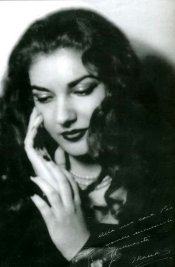
Maria Callas Performs Lady Macbeth
Here we offer three selections from Macbeth with Maria Callas performing the role of Lady Macbeth. These are from a live performance given on 7 December 1952 at La Scala. Victor de Sabata conducts the Orchestra del Teatro alla Scala, Milano.
1. "Nel dì della vittoria . . . Vien! t'Affretta! . . . Or tutti sorgete" from Act I, Scene 2:
(Atrio nel castello di Macbeth che mette in altre stanze. Lady Macbeth leggendo una lettera.)
LADY
"Nel dì della vittoria io le incontrai...
Stupito io n'era per le udite cose;
Quando i nunzi del Re mi salutaro
Sir di Caudore, vaticinio uscito
Dalle veggenti stesse
Che predissero un serto al capo mio.
Racchiudi in cor questo segreto. Addio."
Ambizioso spirto
Tu sei Macbetto... Alla grandezza aneli,
Ma sarai tu malvagio?
Pien di misfatti È il calle
Della potenza, e mal per lui che il piede
Dubitoso vi pone, e retrocede!
Vieni t'affretta! Accendere
Ti vo' quel freddo core!
L'audace impresa a compiere
Io ti darò valore;
Di Scozia a te promettono
Le profetesse il trono...
Che tardi? Accetta il dono,
Ascendivi a regnar. . . . .
(Un servo e la precedente.)
SERVO
Al cader della sera il Re qui giunge.
LADY
Che di'? Macbetto È seco?
SERVO
Ei l'accompagna.
La nuova, o donna, è certa.
LADY
Trovi accoglienza quale un re si merta.
(Il servo parte)
LADY
Duncano sarà qui?...qui? qui la notte?...
Or tutti sorgete, - ministri infernali,
Che al sangue incorate,- spingete i mortali!
Tu, notte, ne avvolgi - di tenebre immota;
Qual petto percota - non vegga il pugnal.
2. "La luce langue" from Act II, Scene 1 (1865 version):
LADY
La luce langue, il faro spegnesi
Ch'eterno corre per gli ampi cieli!
Notte desiata provvida veli
La man colpevole che ferirà.
Nuovo delitto! E' necessario!
Compiersi debbe l'opra fatale.
Ai trapassati regnar non cale;
A loro un requiem, l'eternità.
(con trasporto)
O voluttà del soglio!
O scettro, alfin sei mio!
Ogni mortal desio
Tace e s'acqueta in te.
Cadrà fra poco esanime
Chi fu predetto re.
3. "Una macchia è qui tuttora" from Act IV, Scene 2:
(Lady depone il lume e si frega le mani, facendo l'atto di cancellare qulche cosa.)
MEDICO
Perch‚ sfrega le man?
DAMA
Lavarsi crede!
LADY
Una macchia è qui tuttora...
Via, ti dico, o maledetta!...
Una... Due... gli è questa l'ora!
Tremi tu?... non osi entrar?
Un guerrier così codardo?
Oh vergogna!... orsù, t'affretta!...
Chi poteva in quel vegiardo
Tanto sangue immaginar?
MEDICO
Che parlò?...
LADY
Di Fiffe il Sire
Sposo e padre or or non era?...
Che n'avvenne?...
(Si guarda le mani.)
E mai pulire queste mani io non saprò?...
DAMA - MEDICO
Oh terror!...
LADY
Di sangue umano
Sa qui sempre... Arabia intera
Rimondar sì piccol mano
Co' suoi balsami non può.
Oimè!...
MEDICO
Geme?
LADY
I panni indossa
Della notte... Or via, ti sbratta!...
Banco è spento, e dalla fossa
Chi morì non surse ancor.
MEDICO
Questo ancor?...
LADY
A letto, a letto...
Sfar non puoi la cosa fatta...
Batte alcuno!... andiam, Macbetto,
Non t'accusi il tuo pallor.
DAMA - MEDICO
Ah, di lei pietà, Signor!
Supporting Cast: Attilio Barbesi (Servo), Dario Caselli (Medico), Angela Vercelli (Dama)