Subscribe to
Opera Today

Receive articles and news via RSS feeds or email subscription.


twitter_logo[1].gif


UCP_9780226043425.gif

Recently in Recordings

Ariane et Barbe-Bleue on Blu-Ray

Paul Dukas’ Ariane et Barbe-Bleue, first heard in 1907, once seemed important. Arturo Toscanini conducted the Met premiere in 1911 with Farrar and later arranged some of its music for a 1947 recording with his NBC Symphony.

Kaufmann Wagner

The economics of the recording companies dictate much that is not ideal. Wagner’s operas were not composed as they were in order to permit the extraction of bleeding chunks, even on those occasions when strophic song forms do occur.

Mahler: Symphony No. 8

Among the recent recordings of Mahler’s Eighth Symphony, Valery Gergiev’s release on the LSO Live label is an excellent addition to the discography of this work.

Songs by Zemlinsky

While not unknown, the songs of Alexander von Zemlinsky (1871-1942) deserve to be heard more frequently.

Gustav Mahler: Lieder eines fahrenden Gesellen, Rückert-Lieder, Kindertotenlieder.

Recorded on 5 and 6 May 2008 and 17 and 18 January 2009 at the Lisztzentrum (Raiding, Austria), this recent Bridge release makes available the piano-vocal versions of three song cycles by Gustav Mahler, Lieder eines fahrenden Gesellen, Rückert-Lieder, and Kindertotenlieder performed by mezzo-soprano Hermine Haselböck, accompanied by Russell Ryan.

Kathleen Ferrier: A Film by Diane Perelsztejn

Contraltos rarely achieve the acclaim and renown of sopranos. Assigned few leading roles in opera, they are condemned to playing the villain or the grandmother, or to stealing the castrati’s trousers in en travesti roles.

1612 Italian Vespers

Following their 2011 Decca recording of Striggio’s Mass in 40 Parts (1566), I Fagiolini continue their quest to unearth lost treasures of the High Renaissance and early Baroque, with this collection of world-premiere recordings, ‘reconstructions’ and ‘reconstitutions’ of music by Giovanni and Andrea Gabrieli, Monteverdi, Palestrina, and their less well-known compatriots Viadana, Barbarino and Soriano.

Eternal Echoes: Songs and Dances for the Soul

Eternal Echoes is an album of khazones [Jewish cantorial music] for cantorial soloist, solo violin and a blended instrumental ensemble comprising a small orchestra and the Klezmer Conservatory Band.

Mahler: Symphony no. 3 / Kindertotenlieder

Michael Tilson Thomas’s recording of Mahler’s Third Symphony is an outstanding contribution to the composer’s discography.

Oliver Knussen’s Symphonies from NMC

Oliver Knussen burst into British music with an unprecedented flourish. In 1967, the London Symphony Orchestra premiered Knussen’s First Symphony, with István Kertész scheduled to conduct.

Ludwig van Beethoven: Fidelio

Based on performances given in Summer 2010 at the Lucerne Festival, this recording of Beethoven’s Fidelio is an admirable recording that captures the vitality of the work as conducted by Claudio Abbado.

Stanisław Moniuszko: Flis

Stanisław Moniuszko (1819-1872) was one of the most popular composers of his day in Poland, and of the many works he wrote for the stage, two are performed from time to time, Halka (1848) and Strazny dwór [The Haunted Manor] (1865).

Stanisław Moniuszko: Pieśni Songs

The Polish alto Jadwiga Rappé is a familiar voice in various stage and concert works, and the recent release of a selection of songs by Stanisław Moniuszko (1819-1872) is an opportunity to hear her performing artsongs.

Joan Sutherland and Richard Bonynge: Serate Musicali

Originally released on multiple discs in 1981 this reissue on two CDs is a comprehensive collection of art songs by Italian and French composers from the nineteenth and early twentieth centuries.

Richard Strauss: Salome

An exciting contribution to the discography of this popular opera, the live performance of Richard Strauss’s Salome from the Festspielhaus at Baden-Baden is a compelling DVD.

Lulu by Gran Teatro del Liceu, Barcelona

Released in late 2011, Deutsche Grammophon’s DVD of the new staging of Berg’s Lulu at the Gran Teatro del Liceu, Barcelona is an excellent contribution to the discography of this fascinating opera.

Lulu by the Metropolitan Opera

A recent release by the Metropolitan Opera, this two-disc set makes available on DVD the famous performance of Berg’s Lulu that was broadcast on 20 December 1980 as part of the PBS series “Live from the Met.”

Elmer Gantry the Opera

The novels of Sinclair Lewis once shot across the American literary skies like comets, alarming and fascinating readers of that era, but their tails didn’t extend far behind them.

Historical Performances from Covent Garden: Barbiere, La traviata and Tosca

Once the province of only the most dedicated opera fanatics, mid-20th century recordings of privately taped live performances have become more widely available.

Lucia and the glass harmonica

Flute players in opera orchestra around the world must look forward to the frequent appearances of Donizetti’s Lucia di Lammermoor, knowing that while the stage spotlight in the mad scene will be on the soprano, the orchestral spotlight will be on their instrument.

OPERA TODAY ARCHIVES »

Recordings

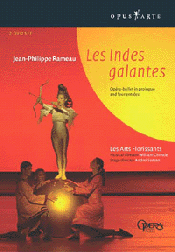
Jean-Philippe Rameau: Les Indes galantes
21 Nov 2005

RAMEAU: Les Indes galantes

Jean-Philippe Rameau is usually remembered today (when he is remembered at all) as an important musical theorist. This limited reputation is unfortunate, because Rameau was a masterful composer known for his sumptuous melodies and colorful harmonies.

Jean-Philippe Rameau: Les Indes galantes
Opera in 5 Acts. Sung in French

Danielle de Niese, Anna Maria Panzarella, Paul Agnew, Nathan Berg, Jaël Azzaretti, Richard Croft, Gaële Le Roi, Malin Hartelius, Nicolas Rivenq, Patricia Petibon. Les Arts Florissants Orchestra and Chorus, William Christie (cond.). From the Opéra National de Paris, 2003

Opus Arte OA 0923 D [DVD]


These qualities are abundant his operas, which transcend stereotypes of static opera seria through their descriptive orchestral writing, their lyrical airs, and a style of recitative that follows the natural flow and music of the French language, without devolving into dry recitation.

Rameau was 50 when his first opéra tragique (tragic opera), Hippolyte et Aricie, debuted on the stage of the Académie Royale de Musique in 1733. With this work, Rameau was treading on familiar operatic ground, but many in the audience were baffled by Rameau’s daring realization of opéra tragique, a genre established by the still-beloved Lully (1632-1687). Les Indes galantes (1735) belongs to a different operatic genre, the opéra-ballet, which featured independent—but loosely connected—plots separated into several entrées. As the genre’s name suggests, dance played an important part in the opéra-ballet, and Les Indes galantes is no exception; each entrée closes with a divertissement, a collection of dance movements and dance songs that tie into the plot of the entrée.

At its premiere in 1735, Les Indes galantes consisted of a prologue and three entrées: “Le Turc généreux” (The Generous Turk), “Les Incas du Pérou” (The Incas of Peru), and “Les Fleurs” (The Flowers); soon after the premiere, Rameau added a fourth entrée, “Les Sauvages” (The Savages). Each entrée is set in a different exotic location—Turkey, Peru, Persia, and America. The librettist, Louis Fuzelier, indicated the sources of inspiration for these locales in his published preface to the libretto: The plot of “Le Turc généreux” was inspired by a news report in the journal Mercure de France, while both “Les Incas du Pérou” and “Les Fleurs” reflect popular contemporary travel literature. The source of the setting of “Les Sauvages” is a 1725 visit to Paris by two native Americans from France’s new colony in Louisiana; Rameau’s set of harpsichord pieces entitled Les Sauvages were inspired by the dances performed by the two visitors, and served as the basis for the divertissement of the final entrée of Les Indes galantes. The entrées are strung loosely together by a common thread introduced in the Prologue, in which the Hébé, the goddess of youth, laments the seduction of idle youths by Bellone, the goddess of war, who promises them glory in battle. Hébé calls on Cupid to send his winged followers throughout the world to search for true love.

The musical performances in this production are superb—everything that one can expect from Les Arts Florissants and its director, William Christie. The soloists all have clear, agile voices, and are accomplished actors. In particular, the air “Viens, hymen, viens m’unir au vainqueur que j’adore” (Come, Hymen, to unite me with the conqueror whom I love) in “Les Incas du Pérou” and the quartet “Tendre amour, que pour nous ta chaîne” (Tender love, may you enchain us) are meltingly lovely.

On the other hand, the staging by Andrei Serban is uneven. Certainly the genre of opéra-ballet is lighter than opéra tragique, but the director seems determined to find humor everywhere, from a “goddess” of war in drag, to a slinky Indian maiden singing of the “innocence” of love. To my mind, only the mistaken identity in the plot of the Persian entrée (“Les Fleurs”) is clearly humorous, as it foreshadows comic theatrical devices that came to fruition in Mozart’s Cosi fan tutte. The director’s stated goal was to provide an imaginative feast for the eyes, but the quest for visual brilliance and comedy often threatens to descend into meaningless antics. Serban does not seem comfortable with letting the music carry the action; a number of gentle airs are overshadowed by stage business that seems to have no purpose, from a simple procession of people in the background, to a recurring acrobatic act that culminates in the pair dangling from the fly space à la Cirque du Soliel. The use of supernumeraries in large head-masks was probably meant to be whimsical, but to me the human minarets populating “Le turc généreux,” the dancers wearing huge flower pots in “Les Fleurs,” and the life-size Hopi Kachina dolls cavorting in “Les Sauvages” were just silly.

Because of the large amount of music for dance in the opéra-ballet, the choreographer plays an important role in the staging, but Blanca Li is as inconsistent as the director. In the prologue, the dancers’ steps are clearly based on authentic Baroque dance, but the choreographer has inserted odd body and arm positions that come straight out of modern classical dance. Although most of the dance seems in the style of Martha Graham, we see sailors executing moves from On the Town in “Le turc généroux” and flower pots dancing the Charleston and the “Swim” in “Les Fleurs.” On the whole, the director does not seem to give Rameau enough credit to be able to hold the audience through the music, but feels compelled to keep his audience visually entertained instead.

Deborah Kauffman
Editor, Journal of Musicological Research
University of Northern Colorado
Send to a friend

Send a link to this article to a friend with an optional message.

Friend's Email Address: (required)

Your Email Address: (required)

Message (optional):