Beaumarchais, too, had presented his own play as an opéra-comique, adding several songs between the verses; but Paisiello’s version, which premiered in St. Petersburg on September 26, 1782, was by far, and for many years, the most popular.
Rossini did not use Petrosellini’s libretto for Paisiello’s opera. Instead, Duca Francesco Sforza-Cesarini, the owner-impresario of the Teatro Argentina, and the person who commissioned the work, gave the arduous task of writing a new libretto to Cesare Sterbini. Rossini was already familiar with Sterbini, a poet fluent in several languages, who had written the libretto for Rossini’s previous opera, Torvaldo e Dorliska. The poet accepted the challenge and within eleven days he presented Rossini the completed libretto. In an effort to further avoid comparisons with Paisiello’s work, the title of the opera was changed to Almaviva, Ossia l’inutile precauzione.
Different title or not, the Paisiello faction was not pleased, and on opening night, February 20, 1816, the cacophony of noise coming from the audience made it difficult for the singers on stage to hear the music in the orchestra pit. In addition to the audience’s negative reaction, several mishaps on and off stage added to the carnival like atmosphere, and to the complete failure of the opera. The second performance gave the soon to be twenty-four-year-old composer reason to smile, and though the opera would not play Rome again for five years, Il Barbiere di Siviglia quickly became, and has remained, the best known and most popular comedy in the operatic repertoire.
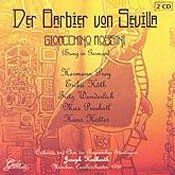
This Bavarian State Opera production is one of the first German opera telecasts, and it is now also available on DVD. This performance, sung in German, has the “standard” cuts of the 50s, but that does not diminish the quality, or enjoyment of the opera. The stellar cast is a veritable “Who’s Who” of opera, and one to be envied today. This is ensemble singing at its best, and it is evident throughout the performance that the singers are enjoying themselves participating in the pranks and mad cap situations of the libretto, as one is delighted to be listening to the recording.
Hermann Prey (July 11, 1929/July 22, 1998), probably better known for Lieder, was just as popular and successful singing opera, as this interpretation of Figaro will attest. His voice has been categorized as “lyric baritone” or “bass-baritone,” but whatever category one chooses for him, his mastery over his instrument, his perfect musicality, his phrasing, and the warmth of his voice cannot be denied.
In his introductory aria, “Ich bin das Faktotum/Largo al factotum” Prey displays his virtuosity, agility, and his overall ability to interpret and to keep up with Rossini’s fast paced music and intricate vocal writing, while showcasing all the diverse dynamics of the character: amusing, self assured, arrogant, and shy but not so humble barber and jack of all trades. At a time when other singers would have been tired, Prey ends his monologue as energetically as he started it. He shines as well in “Strathlt auf mich der Blitz des Goldes/La dolce idea del oro” with Graf Almaviva, and in the ensembles “Wünsche Ihnen wohl zu ruhen/Buona sera mio signore” when Figaro, Almaviva, Rosine and Doktor Bartolo convince Don Basilio that he is deathly ill, and later in the Terzetto, “Ist er’s wirklich? Ah! Qual colpo inaspettato!” with Almaviva and Rosine.
Graf Almaviva has had few interpreters as Fritz Wunderlich (Sept. 26, 1930/Sept. 17, 1966). The best German Lyric tenor of his generation and of the post war era, Wunderlich was a master technician, stylist, and as Fischer-Dieskau called him, a “superlative musician.”
In Act I, “Sieh Schon die Morgenröte/Ecco ridente,” Wunderlich is the ideal love-struck youth; his smooth, expressive, clear voice ending the aria with a supplicating note. His flawless and flexible instrument easily adapts to the different situations in the libretto as in: the exchange with Doktor Bartolo in “He, ihr Leute hier vom Hause/Ehi di casa…buona gente…,” where he frolics in a supposed drunken stupor and in Act II, in “Friede und Freudesei mit Ihnen/Ma vedi il mio destino…Pace e gioa sia con voi…” pretending to be the saintly Don Alonso; the more calculating moments with Figaro, “Strathlt auf mich der Blitz des Goldes/La dolce idea del oro” followed by “Si vediamo…che invenzione prelibata,” leading to the end of the scene; and in his more romantic moments with Rosine, “Wollet Ihr meinen Namen Jetzt kennen/ Se il mio nome saper voi branate,” His sudden and tragic death at age 36 cut short a career which would have reached the highest pinnacles. Luckily his voice has been preserved in many recordings.
In spite of Rossini having scored the female lead for a mezzo-soprano, he may as well have done so with coloratura Erika Köth (Sept. 15, 1927/Feb. 29, 1989) in mind. From her debut at age twenty-one, to her retirement, Köth never ceased to amaze. She possessed a clear voice with an expressive timbre, which enabled her to excel in a variety of roles ranging from Queen of the Night, Lucia, and Gilda, to Mimi, Musetta, lighter Strauss, Lortzing, Nicolai, and operetta.
Köth’s comedic timing is perfect for Rossini, as she so ably demonstrates in the coquettish coloratura exchange with Figaro, “Also ich! Glaubst es wirkin! /Dunque son io” to end of duet, or with Bartolo in “Mir fällt ein Stein vom Herzen/Insomma, colle buone...” where she ridicules him in her reply, “…mi parlo…qual biglietto?...” She excels in the ensembles too, and in the Terzetto, “Ist er’s wirklich?/ Ah! Qual colpo inaspettato!” where the blending of the voices is sublime, Köth is at her best. The soprano is as believable an interpreter as ever found, never sounding older than the age of the character. Köth’s musical intelligence, and effortless high notes are demonstrated in “Una voce poco fa.” The interpolated notes are tasteful, never out of place, and Köth tosses an F as easily as others would recite a prayer. Her singing is expressive and smooth, though there is some strain at the end of the aria. Her singing with Graf Almaviva in “O diese Glut in Blicken/Contro un cor che accende amore” is passionate and sensitive, and turns spectacular towards the end of the number. Köth’s breath control is impressive, as is her ability to produce, what appear to be, endless high notes.
Bass Max Proebstl (Sept-24-1913/Nov. 19, 1979) portrays the likeable anti-hero of the story, Doktor Bartolo. Proebstl performance is superb from his first to last note. In “Einen Doktor meinesgleichen/A un dottor della mia sorte” he is the quintessential lustful guardian/tutor seeking to deceive his younger ward. Proebstl is quick to keep up with the music while exaggerating some of the words to give more weight to their meaning, and at times giggling under his breath to add emphasis. His singing is solid with great shading in his voice to match the different tones of the aria. Proebstl is very amusing in the two previously mentioned scenes with Graf Almaviva, “He, ihr Leute hier vom Hause/Ehi di casa…buona gente…,” and “Friede und Freudesei mit Ihnen/Ma vedi il mio destino…Pace e gioa sia con voi,” his expressive voice instantly becoming indignant at the pranks of Graf Almaviva. In “Schöne Stimme! Bravissima!/Bella voce! Bravissima!” Proebst turns sentimental as he mimics Caffariello’s aria.
Proebstl made his operatic debut in 1941, and in 1949 he was engaged by the Bavarian State Opera which was to become his home for the next twenty five years. His repertoire was extensive and covered a wide range of characters, though mainly in the German language. Proebstl was well known for his portrayal of Pogner, Falstaff, and Bartolo among others. He left a small but unique recording legacy.
Don Basilio is sung by Hans Hotter (Jan. 19, 1909/Dec. 8, 2003), the leading post-war Wagnerian bass baritone. Hotter’s interpretations of Wotan, Hans Sachs, and Dutchman were characterized as noble and imposing, which led to the sobriquet “The Aristocrat of Bass-Baritones.” He made his debut in 1930, he created roles in the premieres of three Strauss operas, and he retired from the stage in 1972 after a distinguished career. Though retired, Hotter continued to sing smaller roles as late as 1991.
If Hotter’s rendition of Don Basilio is any indication, it is unfortunate he did not take on more buffo roles. Hotter’s natural flair for comedy, his timing, and his melancholic voice gives this character a human, naive aspect. His rendition of “Die Verleumdung, sie ist ein Lüftchen/La calunnia è un venticello” is restrained and elegant with an undercurrent of wicked humor and hypocrisy. In “Wünsche Ihnen wohl zu ruhen/Buona sera mio signore…” during Basilio’s exit after being convinced by all that he is deathly ill, Hotter’s character takes on a mellow tone disguising he knows more than he is willing to acknowledge.
Tenor Karl Ostertag (Jan. 10, 1903/ Dec. 15, 1979) nearing the end of his career when this performance took place, sings the role of Fiorillo with great aplomb and the energy of one half his age. He makes the best of this small role and keeps up with Graf Almaviva in “Piano, pianissimo,” and the riotous “Gar zu gütig, Euer Gnaden!/Mille grazzie mio signor.”
Mezzo-soprano Ina Gerhein (Oct. 29, 1906/?) in the role of Marzeline (Berta) does not get enough opportunity to display her instrument as most of her role has been cut. When she does sing, her voice is pleasant, and restrained.
Better known for conducting Strauss and Wagner, Conductor Joseph Keilberth (April 19, 1908/July 20, 1968) is quite comfortable in this performance and leads the orchestra and chorus of the Bavarian State Opera with thorough knowledge of the score, and energetic support of the ensemble cast.
There is a Bonus track from a performance of Rossini’s “Barber” in Vienna with another stellar cast: Eberhard Wachter as Figaro, Reri Grist as Rosine, and Fritz Wunderlich as Graf Almaviva. The Orchester und Chor der Wiener Staatsoper is conducted by Karl Bohm, Vienna, and recorded live on April 28, 1966.
Rossini would have approved!
This two disc set is a live performance recording and as such there will be some insignificant background noise which does not affect the overall enjoyment of the performance; the audience participation, in the form of well deserved applause, is kept to a minimum. The sound is not in stereo, but it is good, with one exception on CD 1, track #13, where the volume becomes slightly higher. There are several pages of liner notes, but there is no libretto.
Daniel Pardo 2005
Sources
Rossini: a Biography
© 1968 Herbert Weistock
Alfred A. Knopf, Inc.
Der Barbier von Sevilla
Liner Notes
© 2005 Gala
Dictionary-Catalogue of Operas & Operettas
Volume 1
John Towers
© 1967 Da Capo Press, New York
A Concise Biographical Dictionary of Singers
K.J. Kutsch/Leo Riemens
© 1969 Harry L. Jones
Chilton Book Company, Philadelphia
Fanfare
www.ffaire.com
www.bach-cantatas.com
http://www.andreas-praefcke.de
[Note: This recording is also available on Immortal DVD IMM 950015.]