Subscribe to
Opera Today

Receive articles and news via RSS feeds or email subscription.


twitter_logo[1].gif


UCP_9780226043425.gif

Recently in Recordings

Kaufmann Wagner

The economics of the recording companies dictate much that is not ideal. Wagner’s operas were not composed as they were in order to permit the extraction of bleeding chunks, even on those occasions when strophic song forms do occur.

Mahler: Symphony No. 8

Among the recent recordings of Mahler’s Eighth Symphony, Valery Gergiev’s release on the LSO Live label is an excellent addition to the discography of this work.

Songs by Zemlinsky

While not unknown, the songs of Alexander von Zemlinsky (1871-1942) deserve to be heard more frequently.

Gustav Mahler: Lieder eines fahrenden Gesellen, Rückert-Lieder, Kindertotenlieder.

Recorded on 5 and 6 May 2008 and 17 and 18 January 2009 at the Lisztzentrum (Raiding, Austria), this recent Bridge release makes available the piano-vocal versions of three song cycles by Gustav Mahler, Lieder eines fahrenden Gesellen, Rückert-Lieder, and Kindertotenlieder performed by mezzo-soprano Hermine Haselböck, accompanied by Russell Ryan.

Kathleen Ferrier: A Film by Diane Perelsztejn

Contraltos rarely achieve the acclaim and renown of sopranos. Assigned few leading roles in opera, they are condemned to playing the villain or the grandmother, or to stealing the castrati’s trousers in en travesti roles.

1612 Italian Vespers

Following their 2011 Decca recording of Striggio’s Mass in 40 Parts (1566), I Fagiolini continue their quest to unearth lost treasures of the High Renaissance and early Baroque, with this collection of world-premiere recordings, ‘reconstructions’ and ‘reconstitutions’ of music by Giovanni and Andrea Gabrieli, Monteverdi, Palestrina, and their less well-known compatriots Viadana, Barbarino and Soriano.

Eternal Echoes: Songs and Dances for the Soul

Eternal Echoes is an album of khazones [Jewish cantorial music] for cantorial soloist, solo violin and a blended instrumental ensemble comprising a small orchestra and the Klezmer Conservatory Band.

Mahler: Symphony no. 3 / Kindertotenlieder

Michael Tilson Thomas’s recording of Mahler’s Third Symphony is an outstanding contribution to the composer’s discography.

Oliver Knussen’s Symphonies from NMC

Oliver Knussen burst into British music with an unprecedented flourish. In 1967, the London Symphony Orchestra premiered Knussen’s First Symphony, with István Kertész scheduled to conduct.

Ludwig van Beethoven: Fidelio

Based on performances given in Summer 2010 at the Lucerne Festival, this recording of Beethoven’s Fidelio is an admirable recording that captures the vitality of the work as conducted by Claudio Abbado.

Stanisław Moniuszko: Flis

Stanisław Moniuszko (1819-1872) was one of the most popular composers of his day in Poland, and of the many works he wrote for the stage, two are performed from time to time, Halka (1848) and Strazny dwór [The Haunted Manor] (1865).

Stanisław Moniuszko: Pieśni Songs

The Polish alto Jadwiga Rappé is a familiar voice in various stage and concert works, and the recent release of a selection of songs by Stanisław Moniuszko (1819-1872) is an opportunity to hear her performing artsongs.

Joan Sutherland and Richard Bonynge: Serate Musicali

Originally released on multiple discs in 1981 this reissue on two CDs is a comprehensive collection of art songs by Italian and French composers from the nineteenth and early twentieth centuries.

Richard Strauss: Salome

An exciting contribution to the discography of this popular opera, the live performance of Richard Strauss’s Salome from the Festspielhaus at Baden-Baden is a compelling DVD.

Lulu by Gran Teatro del Liceu, Barcelona

Released in late 2011, Deutsche Grammophon’s DVD of the new staging of Berg’s Lulu at the Gran Teatro del Liceu, Barcelona is an excellent contribution to the discography of this fascinating opera.

Lulu by the Metropolitan Opera

A recent release by the Metropolitan Opera, this two-disc set makes available on DVD the famous performance of Berg’s Lulu that was broadcast on 20 December 1980 as part of the PBS series “Live from the Met.”

Elmer Gantry the Opera

The novels of Sinclair Lewis once shot across the American literary skies like comets, alarming and fascinating readers of that era, but their tails didn’t extend far behind them.

Historical Performances from Covent Garden: Barbiere, La traviata and Tosca

Once the province of only the most dedicated opera fanatics, mid-20th century recordings of privately taped live performances have become more widely available.

Lucia and the glass harmonica

Flute players in opera orchestra around the world must look forward to the frequent appearances of Donizetti’s Lucia di Lammermoor, knowing that while the stage spotlight in the mad scene will be on the soprano, the orchestral spotlight will be on their instrument.

Levine conducts at the Metropolitan Opera: 1978 to 2006

Since his debut at the Metropolitan Opera in 1971, conductor James Levine has come to represent the house’s commitment to artistic excellence — reliable, professional, and immaculately presented.

OPERA TODAY ARCHIVES »

Recordings

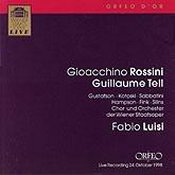
Gioachino Rossini: Guillaume Tell
28 Nov 2005

ROSSINI: Guillaume Tell

On 24 October 1998, the Vienna State Opera presented the opening night of its staging of Gioachino Rosssini’s Guillaume Tell. It was the first Staatsoper production in 91 years of Rossini’s final opera and masterpiece, as well as the Vienna premiere of the 1829 opera’s original French-language version.

Gioachino Rossini: Guillaume Tell

Thomas Hampson, Giuseppe Sabbatini, Nancy Gustafson, Dawn Kotoski, Chorus and Orchestra of the Wiener Staatsoper, Fabio Luisi (cond.)

Orfeo C 640 053 D [3CDs]


Perhaps the opera’s unflattering depiction of the Austrians as invaders and repressors of the Swiss people had something to do with the opera’s long absence from the Viennese repertoire. More likely, the extraordinary demands this epic work places upon the soloists, chorus, orchestra, and yes, the audience, were the main culprits. In any event, the Vienna Staatsoper did itself proud and Rossini’s masterwork justice with the 1998 revival. We are fortunate to have it documented in this recent Orfeo release.

Although the opera is named William Tell, the greatest challenge in staging the opera rests with the leading tenor role of Arnold. Written for the legendary French tenor Adolphe Nourrit, Arnold demands a singer who can sing with both heroic power and ardent tenderness, all the while negotiating a superhuman tessitura that seems to encompass countless high Cs. Arnold is, quite simply, one of the most difficult roles in the entire tenor repertoire.
In the Staatsoper production, Arnold is the Italian tenor Giuseppe Sabbatini. For the most part, he is superb. His French diction is quite excellent, the voice has both a penetrating and attractive timbre, and the many high notes are always brilliant, secure, and masterfully integrated with the rest of his vocal production. Sabbatini’s singing demonstrates an admirable combination of passion and elegant phrasing, as well as the ability to scale back dynamics to great musical and dramatic effect, as in the Act II duet with Mathilde and the second verse of his great aria, “Asil héréditaire.” On the negative side, Sabbatini often seems unable to maintain a true legato, substituting aspirates instead. And the voice lacks a basic heroic quality that I prefer in this role. But Sabbatini’s contribution, particularly in the context of the tightrope walk of an in-performance recording, is really quite extraordinary.

Likewise, Thomas Hampson’s William Tell is a great asset. As with Sabbatini, Hampson’s French is quite fine. Apart from some difficulty with the lower notes of Tell’s vocal writing, Hampson is in secure and impressive voice. I recommend this performance to those who view Hampson as an overly mannered singer. Here, he sings with the kind of directness and heroism that beautifully matches the character of the Swiss patriot. Hampson is also not afraid to abandon beautiful tonal production when the dramatic situation requires, as in the Act I duet with Arnold, or in his dispatch of the villain, Gessler. On the other hand, Hampson’s heartfelt and gorgeously sung “Sois immobile” is one of the highlights of the performance.

Soprano Nancy Gustafson sings with laudable vocal beauty and security. She also convincingly projects Mathilde’s tender, regal, and heroic aspects. Like Hampson, Gustafson is not totally secure in the lowest portions of the role. But overall, she is a major factor in the success of this production.

The many subsidiary roles are cast with strength. The contributions of the Vienna State Opera Chorus and Orchestra are outstanding, both in terms of precision and tonal beauty. The horn playing in particular is absolutely stunning.

No doubt much of the success of this William Tell rests with conductor Fabio Luisi, who leads a performance that has tremendous forward propulsion, but which never gives short shrift to this amazing score’s many details and beauties. Many have commented on how Rossini’s final opera paved the way for the course of much of 19th-century French and Italian opera. But the masterfully paced and brilliantly executed rendition of the opera’s stunning finale also brought to my mind (for the first time) the great symphonies of Anton Bruckner as well. What a remarkable work this is!

The in-performance recording features a superb balance between stage and pit, a wonderful sense of the hall’s ambience, as well as a fair amount of stage noise and well-deserved applause. All of this adds to the sense of a very special occasion, indeed.

The early-70s EMI studio recording with Gabriel Bacquier, Nicolai Gedda, and Montserrat Caballé, conducted by Lamberto Gardelli, remains my preferred version of Guillaume Tell. I also have a weak spot for a 1979 Geneva performance in Italian, conducted by Anton Guadagno. It documents a fearless and hair-raising (if occasionally rough) performance of Arnold by Franco Bonisolli. It is available as highlights from Gala, and issued complete by the Opera Magic’s label.

The Orfeo release has no libretto, just a listing of cast and music tracks, an essay on the opera and Staatsoper production, and cast photos. Still, this performance has numerous qualities that make it a major addition to the Tell discography, despite cuts in this mammoth score. As a great fan of this opera, I’m sure I’ll return often to this Orfeo Guillaume Tell.

Ken Meltzer
Send to a friend

Send a link to this article to a friend with an optional message.

Friend's Email Address: (required)

Your Email Address: (required)

Message (optional):