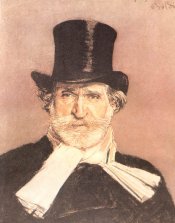
20 Nov 2005
VERDI: Macbeth
VERDI: Macbeth, melodramma in quattro parti.
Music composed by Giuseppe Verdi. Libretto by Francesco Maria Piave, based on the play by William Shakespeare.
Mozart and Salieri, an opera in one act consisting of two scenes.
Nicolai Rimsky-Korsakov (1844-1908), composer. Libretto derived from Alexander Puskhin's play of the same name.
First performance: 7 December 1898 in Moscow.
Ariadne auf Naxos, Oper with a prologue and one act. Music composed by Richard Strauss. Libretto by Hugo von Hofmannsthal.
La Vestale, a tragédie lyrique in three acts.
Boris Godunov, an opera in four acts with prologue
Modest Mussorgsky, composer. Libretto by the composer, based on Alexander Pushkin's drama Boris Godunov and Nikolai Karamazin's History of the Russian Empire
First performance: 8 February 1874 at the Mariinsky Theatre, St. Petersburg
Il Trovatore, dramma in four parts.
Only a few months following the premiere of Der Rosenkavalier, Hugo von Hofmannsthal proposed a new opera to Richard Strauss based on Molière’s comedy-ballet, Le Bourgeois gentilhomme (in German, Der Bürger als Edelmann).
Die Entführung aus dem Serail, Singspiel in 3 Acts.
Music composed by Wolfgang Amadeus Mozart (1756–1791). Libretto by Johann Gottlieb Stephanie the Younger, based on an earlier libretto by
Christoph Friedrich Bretzner.
Die Entführung aus dem Serail, Singspiel in 3 Acts.
Music composed by Wolfgang Amadeus Mozart (1756–1791). Libretto by Johann Gottlieb Stephanie the Younger, based on an earlier libretto by
Christoph Friedrich Bretzner.
Arabella: Lyrische Komödie in three acts
Die Entführung aus dem Serail, Singspiel in 3 Acts.
Music composed by Wolfgang Amadeus Mozart (1756–1791). Libretto by Johann Gottlieb Stephanie the Younger, based on an earlier libretto by
Christoph Friedrich Bretzner.
La Gioconda, dramma lirico in four acts.
Music composed by Amilcare Ponchielli (1834–1886). Libretto by Arrigo Boito (under the pseudonym Tobia Gorrio), based upon Victor Hugo's Angelo, Tyrant of Padua (1835).
Don Carlo, an opera in four acts. Music composed by Giuseppe Verdi (1813–1901). Libretto by Joseph Méry and Camille Du Locle after Friedrich von Schiller’s dramatic poem Don Carlos, Infant von Spanien. Revised version in four acts (French text revised by Du Locle, Italian translation by Achille de Lauzières and Angelo Zanardini).
Un ballo in maschera, a melodramma in three acts.
Music composed by Giuseppe Verdi. Libretto by Antonio Somma, based upon the work of Eugène Scribe Gustave III ou Le bal masqué (1833)
Medea: Melodramma tragico in three acts.
Die Tote Stadt, an opera in three acts.
Music composed by Erich Wolfgang Korngold (1897-1957). Libretto by Paul Schott (Julius and E. W. Korngold) after the novel Bruges la morte by Georges Rodenbach.
Some Details concerning the Revolution inaugurated by Rossini
Manon Lescaut, dramma lirico in quattro atti
Elektra: Tragedy in one act.
Lyric Opera of Chicago has announced both schedules and cast-lists for is Spring 2020 performances of Richard Wagner’s Ring Cycle. Given the series of individual productions already staged by the company since Fall 2016, that pave the way for the complete cycle, Lyric Opera of Chicago’s complete production should affirm the artistic might of the great composer.
“Diacono himself does not know what musical talent he possesses” – Mascagni
VERDI: Macbeth, melodramma in quattro parti.
Music composed by Giuseppe Verdi. Libretto by Francesco Maria Piave, based on the play by William Shakespeare.
Streaming Audio
First performance: 14 March 1847 at Teatro La Pergola, Florence.
First performance (revised version): 21 April 1865 at Théâtre Lyrique Impériale, Paris.
Principal Characters
| Duncano, Re di Scozia | Silent |
| Macbeth, Generali dell'esercito del Re Duncano | Baritone |
| Banco | Bass |
| Lady Macbeth, moglie di Macbeth | Soprano |
| Dama di Lady Macbeth | Mezzo-soprano |
| Macduff, nobile scozzese Signore Fiff | Tenor |
| Malcolm, figlio di Duncano | Tenor |
| Fleanzio, figlio di Banco | Silent |
| Domestico di Macbeth | Bass |
| Medico | Bass |
| Sicario | Bass |
In the castle Lady Macbeth reads the letter in which her husband tells her of his meeting with the witches, and she reflects that, in order for the prophecy to come true, King Duncano will have to be killed. She incites Macbeth to commit the crime, although he is the victim of terrifying visions. Duncano, spending the night in the castle as a guest, is assassinated. In the morning Macduff goes to wake Duncano and comes back horrified by what he has found. Everyone rushes to the scene to condemn the act of treason.
Act II
Since the witches predicted that Banco would be the father of kings, Macbeth, seeing this as an obstacle to his own ambitious plan to rise to power, decides to kill his friend together with his son Fleanzio. He entrusts the task to a group of murderers who ambush them while they are going through a wood, but they are only partially successful: Banco is killed and Fleanzio manages to escape.
Meanwhile in Macbeth's castle a banquet is being held, whose festive atmosphere is interrupted by the arrival of a murderer with blood on hs face. When he recounts what has happened, Macbeth is alarmed and starts to rave: Banco's ghost appears before him, his hair soaked in blood. He speaks wildly to it, denying his guilt, to the terror of the guests; Lady Macbeth exhorts him to compose himself, but shortly after the ghost reappears. Macbeth resolves to go and question the witches again.
Act III
In a dark cavern the witches are gathered around a cauldron. Macbeth arrives to question them and they call up a series of apparitions. The first tells Macbeth to beware of Macduff, the second that no man of woman born will harm him, the third pronounces him invincible until he sees Birnam Wood moving towards him. Then eight kings file past, Banco's offspring who will rule: Macbeth tries to attack them, then faints. Witches and aerial spirits revive him and he spurs himself on to increase his power.
Act IV
On the borders of Scotland and England the Scottish refugees lament the fate of their country now that it is at the mercy of a bloodthirsty tyrant. The victims of Macbeth's latest massacre are Macduff's wife and children. Malcolm and Macduff prepare the revolt against Macbeth: every soldier will advance towards the castle with a branch in his hand.
Inside the castle Lady Macbeth, watched over by a doctor and a lady-in-waiting, reveals her crisis of conscience every night by reliving the brutal deeds in her sleep and trying obsessively to wash the blood from her hands.
The enemy troops are attacking Macbeth's castle when the Queen's death is announced. Even this news does not shake him, but when he learns that Birnam Wood is moving towards him he shouts that he has been deceived and, seizing sword and dagger, confronts Macduff declaring he has no fear of him. Macduff tells him that he was not born, but untimely ripped from his mother's womb. Macbeth is mortally wounded and dies.