25 Dec 2005
BERLIOZ: La damnation de Faust
La damnation de Faust, Légende dramatique en quatre parties
Music composed by Hector Berlioz. Libretto by Hector Berlioz, Almire Gandonanière and Gérard de Nerval after Faust by Johann Wolfgang von Goethe
Mozart and Salieri, an opera in one act consisting of two scenes.
Nicolai Rimsky-Korsakov (1844-1908), composer. Libretto derived from Alexander Puskhin's play of the same name.
First performance: 7 December 1898 in Moscow.
Ariadne auf Naxos, Oper with a prologue and one act. Music composed by Richard Strauss. Libretto by Hugo von Hofmannsthal.
La Vestale, a tragédie lyrique in three acts.
Boris Godunov, an opera in four acts with prologue
Modest Mussorgsky, composer. Libretto by the composer, based on Alexander Pushkin's drama Boris Godunov and Nikolai Karamazin's History of the Russian Empire
First performance: 8 February 1874 at the Mariinsky Theatre, St. Petersburg
Il Trovatore, dramma in four parts.
Only a few months following the premiere of Der Rosenkavalier, Hugo von Hofmannsthal proposed a new opera to Richard Strauss based on Molière’s comedy-ballet, Le Bourgeois gentilhomme (in German, Der Bürger als Edelmann).
Die Entführung aus dem Serail, Singspiel in 3 Acts.
Music composed by Wolfgang Amadeus Mozart (1756–1791). Libretto by Johann Gottlieb Stephanie the Younger, based on an earlier libretto by
Christoph Friedrich Bretzner.
Die Entführung aus dem Serail, Singspiel in 3 Acts.
Music composed by Wolfgang Amadeus Mozart (1756–1791). Libretto by Johann Gottlieb Stephanie the Younger, based on an earlier libretto by
Christoph Friedrich Bretzner.
Arabella: Lyrische Komödie in three acts
Die Entführung aus dem Serail, Singspiel in 3 Acts.
Music composed by Wolfgang Amadeus Mozart (1756–1791). Libretto by Johann Gottlieb Stephanie the Younger, based on an earlier libretto by
Christoph Friedrich Bretzner.
La Gioconda, dramma lirico in four acts.
Music composed by Amilcare Ponchielli (1834–1886). Libretto by Arrigo Boito (under the pseudonym Tobia Gorrio), based upon Victor Hugo's Angelo, Tyrant of Padua (1835).
Don Carlo, an opera in four acts. Music composed by Giuseppe Verdi (1813–1901). Libretto by Joseph Méry and Camille Du Locle after Friedrich von Schiller’s dramatic poem Don Carlos, Infant von Spanien. Revised version in four acts (French text revised by Du Locle, Italian translation by Achille de Lauzières and Angelo Zanardini).
Un ballo in maschera, a melodramma in three acts.
Music composed by Giuseppe Verdi. Libretto by Antonio Somma, based upon the work of Eugène Scribe Gustave III ou Le bal masqué (1833)
Medea: Melodramma tragico in three acts.
Die Tote Stadt, an opera in three acts.
Music composed by Erich Wolfgang Korngold (1897-1957). Libretto by Paul Schott (Julius and E. W. Korngold) after the novel Bruges la morte by Georges Rodenbach.
Some Details concerning the Revolution inaugurated by Rossini
Manon Lescaut, dramma lirico in quattro atti
Elektra: Tragedy in one act.
Lyric Opera of Chicago has announced both schedules and cast-lists for is Spring 2020 performances of Richard Wagner’s Ring Cycle. Given the series of individual productions already staged by the company since Fall 2016, that pave the way for the complete cycle, Lyric Opera of Chicago’s complete production should affirm the artistic might of the great composer.
“Diacono himself does not know what musical talent he possesses” – Mascagni
La damnation de Faust, Légende dramatique en quatre parties
Music composed by Hector Berlioz. Libretto by Hector Berlioz, Almire Gandonanière and Gérard de Nerval after Faust by Johann Wolfgang von Goethe
Streaming Audio
First performance: 6 December 1846 at Opéra-Comique, Paris
Principal characters
| Marguerite | Mezzo-soprano |
| Faust | Tenor |
| Méphistophélès | Bass or baritone |
| Brander | Bass |
Synopsis
Part One
Faust, alone on a plain at sunrise, praises the awakening spring day, nature's renewal and his own life in solitude, far from the madding crowd. In a nearby village, merry country people celebrate spring with singing and dancing while an army equipped for battle marches by. Faust withdraws untouched by all.
Part Two
Having returned to his study pensive and unhappy, Faust sinks into profound melancholy and pessimism. Intent on suicide, he is about to drink a cup of poison when from outside he hears the Easter hymn. Faust remembers the purity and piety of his childhood. His faith is reawakened and he reaffirms his commitment to life.
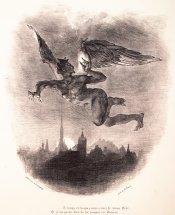
Suddenly Méphistophélès appears and, scorning Faust's sentimentality, suggests that he go out into the world rather than dwell in philosophical speculation. He promises Faust, who is mistrustful at first, to fulfill his most extravagant desires. Faust follows this diabolical companion.
The first stop is Auerbach's Cellar in Leipzig. Faust dislikes the drinkers' raucous singing, Brander's coarse song about the "Rat in the Cellar," and Méphistophélès' cynical reply with his "Song of the Flea." He insists they leave without delay.
Méphistophélès next leads him to the banks of the Elbe and sends him to sleep on a bed of roses. Méphistophélès concocts seductive dreams that beguile Faust, showing him a picture of his mistress-to-be, Marguerite. On awakening, Faust demands to be taken to the girl. Méphistophélès promises to arrange it. He advises Faust to join the soldiers and students going into town and to follow them to Marguerite's house.
Part Three
In Marguerites' room, Faust is filled with a sweet premonition of his romantic adventure. When Marguerite appears, he conceals himself. Marguerite has already seen her lover-to-be in a dream. She sings the ballad of "The King of Thule," in which she gives expression to her longing. As soon as Marguerite has fallen asleep, Méphistophélès appears. His band of beguiling spirits seduce and lead Marguerite to her destruction. With a sarcastic song, Méphistophélès delights in his certain victory.
Faust and Marguerite meet and declare their love for one another. They are interrupted by Méphistophélès who urges Faust to flee as the neighbors have become suspicious and want to warn Marguerite's mother. Méphistophélès assures them that they can meet again the following evening.
Part Four
Marguerite has been jilted by Faust. She longs for his return but senses that he will not come back. The singing of the students and soldiers can be heard from the street below. This makes Marguerite even more conscious of her loneliness.
Meanwhile, Faust finds renewed strength in the midst of nature.
He learns from Méphistophélès that Marguerite is in prison awaiting execution for killing her mother — a crime for which Faust is responsible. Faust implores Méphistophélès to rescue Marguerite. He is prepared to do this on condition that Faust seals their pact with his signature. Faust walks into the trap. They charge off on Méphistophélès' magic horses, but not to Marguerite's dungeon. Instead they descend into the depths of hell amidst earthquakes, thunder, and bloody rain, where diabolical spirits are awaiting their arrival. Faust, dammed until eternity, is thrown into the flames; Méphistophélès is triumphant.
In heaven the angels welcome Marguerite who has been absolved of her sins.