21 Dec 2005
Christmas with Renée and Bryn
Though singers have always recorded some of these arias and songs, it was young Leontyne Price who first started a trend by devoting a whole LP to the genre more than 45 years ago.
The Sixteen continues its exploration of Henry Purcell’s Welcome Songs for Charles II. As with Robert King’s pioneering Purcell series begun over thirty years ago for Hyperion, Harry Christophers is recording two Welcome Songs per disc.
In February this year, Albanian soprano Ermonela Jaho made a highly lauded debut recital at Wigmore Hall - a concert which both celebrated Opera Rara’s 50th anniversary and honoured the career of the Italian soprano Rosina Storchio (1872-1945), the star of verismo who created the title roles in Leoncavallo’s La bohème and Zazà, Mascagni’s Lodoletta and Puccini’s Madama Butterfly.
Collapsology. Or, perhaps we should use the French word ‘Collapsologie’ because this is a transdisciplinary idea pretty much advocated by a series of French theorists - and apparently, mostly French theorists. It in essence focuses on the imminent collapse of modern society and all its layers - a series of escalating crises on a global scale: environmental, economic, geopolitical, governmental; the list is extensive.
Amongst an avalanche of new Mahler recordings appearing at the moment (Das Lied von der Erde seems to be the most favoured, with three) this 1991 Mahler Second from the 2nd Kassel MahlerFest is one of the more interesting releases.
If there is one myth, it seems believed by some people today, that probably needs shattering it is that post-war recordings or performances of Wagner operas were always of exceptional quality. This 1949 Hamburg Tristan und Isolde is one of those recordings - though quite who is to blame for its many problems takes quite some unearthing.
The voices of six women composers are celebrated by baritone Jeremy Huw Williams and soprano Yunah Lee on this characteristically ambitious and valuable release by Lontano Records Ltd (Lorelt).
As Paul Spicer, conductor of the Royal Birmingham Conservatoire Chamber Choir, observes, the worship of the Blessed Virgin Mary is as ‘old as Christianity itself’, and programmes devoted to settings of texts which venerate the Virgin Mary are commonplace.
Ethel Smyth’s last large-scale work, written in 1930 by the then 72-year-old composer who was increasingly afflicted and depressed by her worsening deafness, was The Prison – a ‘symphony’ for soprano and bass-baritone soloists, chorus and orchestra.
‘Hamilton Harty is Irish to the core, but he is not a musical nationalist.’
‘After silence, that which comes closest to expressing the inexpressible is music.’ Aldous Huxley’s words have inspired VOCES8’s new disc, After Silence, a ‘double album in four chapters’ which marks the ensemble’s 15th anniversary.
A song-cycle is a narrative, a journey, not necessarily literal or linear, but one which carries performer and listener through time and across an emotional terrain. Through complement and contrast, poetry and music crystallise diverse sentiments and somehow cohere variability into an aesthetic unity.
One of the nicest things about being lucky enough to enjoy opera, music and theatre, week in week out, in London’s fringe theatres, music conservatoires, and international concert halls and opera houses, is the opportunity to encounter striking performances by young talented musicians and then watch with pleasure as they fulfil those sparks of promise.
“It’s forbidden, and where’s the art in that?”
Dublin-born John F. Larchet (1884-1967) might well be described as the father of post-Independence Irish music, given the immense influenced that he had upon Irish musical life during the first half of the 20th century - as a composer, musician, administrator and teacher.
The English Civil War is raging. The daughter of a Puritan aristocrat has fallen in love with the son of a Royalist supporter of the House of Stuart. Will love triumph over political expediency and religious dogma?
Beethoven Symphony no 9 (the Choral Symphony) in D minor, Op. 125, and the Choral Fantasy in C minor, Op. 80 with soloist Kristian Bezuidenhout, Pablo Heras-Casado conducting the Freiburger Barockorchester, new from Harmonia Mundi.
A Louise Brooks look-a-like, in bobbed black wig and floor-sweeping leather trench-coat, cheeks purple-rouged and eyes shadowed in black, Barbara Hannigan issues taut gestures which elicit fire-cracker punch from the Mahler Chamber Orchestra.
‘Signor Piatti in a fantasia on themes from Beatrice di Tenda had also his triumph. Difficulties, declared to be insuperable, were vanquished by him with consummate skill and precision. He certainly is amazing, his tone magnificent, and his style excellent. His resources appear to be inexhaustible; and altogether for variety, it is the greatest specimen of violoncello playing that has been heard in this country.’
Baritone Roderick Williams seems to have been a pretty constant ‘companion’, on my laptop screen and through my stereo speakers, during the past few ‘lock-down’ months.
Melodramas can be a difficult genre for composers. Before Richard Strauss’s Enoch Arden the concept of the melodrama was its compact size – Weber’s Wolf’s Glen scene in Der Freischütz, Georg Benda’s Ariadne auf Naxos and Medea or even Leonore’s grave scene in Beethoven’s Fidelio.
Though singers have always recorded some of these arias and songs, it was young Leontyne Price who first started a trend by devoting a whole LP to the genre more than 45 years ago.
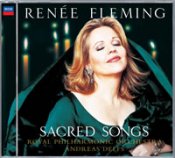
She judiciously mixed some of these songs with specific Christmas items and made it a bestselling classical album. Since that time all major singers have recorded recitals of “canti sacri.” Depending upon the number of carols, these were sometimes presented as Christmas albums, though even then there was usually no escaping the two Ave Marias, Louis Niedermeyer’s Pieta Signore, Franck’s Panis Angelicus, Händel’s ode to the shade of a tree and a few Mozart or Bach items — none of which has anything to do with Christmas. Decca’s marketing division and Renée Fleming have decided that it’s better to split these things more rigorously and so together with these “sacred songs” she recorded a “carol album only,” which corresponds with her current concert tour.
Fleming’s repertoire on this CD is almost wholly traditional, while Terfel is more adventurous, though it nevertheless roams along in the same sphere. And there is indeed no escaping Bach/Gounod, César Franck or Amazing Grace on both records. So why did I feel such a marked difference when listening to those two great vocalists? It starts with the title of their albums. I don’t think there is anything sacred to Humperdinck’s Hänsel and a lot of the other items on Fleming’s CD were definitely written by their composers to catch some not very sacred money. Therefore a less pretentious title like “Songs of Faith and Devotion” would maybe have been a better idea. Though “The Lord” and “God” is as much present on Terfel’s CD, his “Simple Gifts” someway makes a more sympathetic impression. Then there are the sleeve photographs: just Terfel looking earnestly into the camera while Fleming is photographed with eyes closed into what looks far more to be an orgasmic moment than a prayer of faith; and I have a feeling that some of the less enthusiastic reactions to Fleming’s CD were initiated by title and photo.
But of course Fleming got a lot of flack on her singing as well. Some comments on those venomous opera-forums spoke of Händel à la Duke Ellington. This is simply not fair as she doesn’t glide or scoop. True, she uses all kinds of allowable vocal tricks like rubato and a good trill, which are arms not all sopranos have. The first impression after her first tracks Ave Maria and Jesus bleibet is one of “how exquisite, how refined” and then first weariness and finally boredom makes its entrance. So what’s wrong in a CD-recital that would not have been boring on 78-records? Well, by the third track one realizes that she is not going to use her full voice and that she will never sing out; that everything will stop at mezza-voce while in that half voice she tries hard to unveil all hidden meanings in each word, if necessary in each syllable by voice inflexions. Moreover as she is nowadays the female star of the label, she suffers from what I’d call Kohnanization, though Domingo and Eugene Kohn are not the only perpetrators. Classical stars nowadays prefer to bring either their own maestros with them or otherwise want to be indulged by the conductor whom they honour by allowing him to have their name as well on their records. So Andreas Delfs nicely follows Fleming but definitely was not engaged to tell her some truths and to bring some vitality to the recording sessions. Once upon a time, Karajan conducted the Price Christmas recital, Gavazzeni led Bergonzi in his début recording and Molinari-Pradelli put the fear of the gods in Sutherland and no singer would have got away with these kind of easy tempi. Levine, Solti, Mackerras, Eschenbach, Tate were the conductors of Fleming’s many successful earlier recordings; and in retrospect one realizes that they were sympathetic to the artist without sapping all rhythmic liveliness from the CD, indulging every whim of the singer (and you didn’t need a looking glass to find their names on the sleeve).
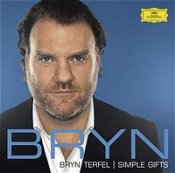
That too is one of the differences with the Terfel recording. Barry Wordsworth may not be a big name either as a conductor but he doesn’t linger on and at least gets his photograph in the booklet (or Terfel himself has a far better sense of tempi). Not that everything is perfect in this record as it shows some serious vocal problems. The bass-baritone who came in second after Dmitry Hvorostovsky in the Cardiff competition in 1989 has made some far fetching decisions. Though the voice has the tessitura of a real bass-baritone (I heard him do a fine Dulcamara in Amsterdam a few years ago), Terfel was blessed with good top notes and he couldn’t keep his hands off real baritone territory. His Amsterdam outing as Scarpia was not really a success. Moreover he has now stepped into heavy Wagner with some successes in Rheingold and Walküre but recently he withdrew as Wanderer in Siegfried. The low and middle register are still very beautiful but the voice really makes a clearly unmusical jump which sometimes almost becomes a shout to reach an F; and, as he does it several times on this record, it is clear he has somewhat damaged his vocal means.
Terfel doesn’t have Fleming’s intrinsic beauty of voice, indeed his timbre is somewhat indistinct, but his sense of phrasing and words is far greater. His Sondheim-song is particularly impressive. He too sings a lot in warm toned pianissimo but realizes that parts of some songs demand full voice. And then there is the repertoire: maybe not very adventurous but still known to most opera buffs who collect drawing room songs and ballads by Crooks, Kullmann and friends; and one can easily savour Terfel’s fine English pronunciation without his losing the vocal line. The CD offers us two duets with baritone-colleague, Simon Keenlyside, who clearly makes a bigger noise than Terfel (on record at least), though the voice has nothing of the beauty and the subtlety of the Welsh singer. Clearly I could easily have done without his part; but it is a nice reminder that Terfel, notwithstanding some vocal problems, is still a great artist.
Jan Neckers