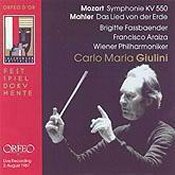
Among those recordings is the release in February 2005 of a concert Giulini led on 2 August 1987 at the Salzburg Festspiel. According to the notes that accompany this CD, it is the last recording the conductor approved for release.
Because of its length performances of Mahler’s song cycle Das Lied von der Erde sometimes preclude the inclusion of other works with it either in concert or on recordings, and the pairing with Mozart’s Symphony no. 40 in G minor reflects the programming used in Salzburg. Yet it is what Giulini chose for the particular concert, a rare opportunity for the conductor to lead the Vienna Philharmonic. As a highly esteemed interpreter of both Mozart and Mahler, Giulini offers strong performances of the two works. At a time when Mozart’s works were being performed with a bow to historic practice, Giulini chose to use a fuller orchestra than other conductors might employ. This reflects tacitly the tradition in which Giulini worked, where an earlier composer like Mozart did not have to be rediscovered through reviving older performing traditions. Rather, Giulini had been performing Mozart’s work throughout his career, having played under such conductors as Toscanini. Mozart’s music was part of the living tradition of the day.
In approaching a familiar work by Mozart with a relatively large orchestra, Giulini used relatively slower tempos, particularly in the outer movements. Yet tempo is only one dimension of this music. The clarity of line that emerges in the first movement is characteristic of this particular recording. Giulini achieves this quality not only with a modest pacing, but he allows lines to end, with points of silence that help to delineate the phrasing. He allows the slow movement (Andante) to linger and in doing so brings out some of the ensemble passages that the Vienna Philharmonic executes well. With the third movement, Giulini’s pacing contributes an almost solemn character to the stylized minuet. Within the string textures that Giulini uses well in this performance, the winds are notable for the careful and delicate timbres they create. Details like these emerge in the final movement (Allegro assai), which is taken at a modest pace. Inflections of modality are clearly apparent in this recording, in which Giulini brings out sonorities that may be passed over when the movement is taken at faster tempos than those found in this dignified performance.
In interpreting Mahler’s Das Lied von der Erde, Giulini’s tempos are similarly conservative in an evidently thoughtfully conceived interpretation of this monumental work. His soloists were the mezzo soprano Brigitte Fassbaender and the tenor Francisco Araiza, two fine singers who bring wonderful technique and facility to this demanding work. Both Fassbaender and Araiza offer compelling performances that complement Giulini’s leadership.
Araiza offers some fine performances of the three pieces for tenor and orchestra. As demanding as each can be, his makes maintains a fluid tone that conveys a sense of ease and comfort with the music. He delivers well the sustained opening piece “Das Trinklied vom Jammer der Erde” is engaging in the third song, “Von der Jugend.” With “Der Trunkene im Frühling” Araiza maintains the level of intensity that he used to excellent effect in first song, always evoking a fresh and ringing tone.
Fassbaender was at the height of her career for this performance, with a wonderful control of the various nuances required for expressing this piece effectively. With “Der Einsame im Herbst,” Fassbaender brings approaches the piece with a subtlety that brings out the details that are essential to the text. Her voice moves well within the orchestral accompaniment, which is Giulini has shaped well. Fassbaender maintains the intensity of this piece well, and the silence at its end is tribute to her command of the audience. With “Von der Schönheit,” Fassbaender colors her voice well, and Giulini’s pacing allows details to emerge comfortably. Some problems arise in the orchestra, though, when the tempo increases, and while the performers recover, it mars the result. Nevertheless Fassbaender never seems to lose her vocal composure in bringing the song to its conclusion.
“Der Abschied” is one of Mahler’s most demanding pieces, and this is a fine rendering of the music. The opening chimes resonate deeply to suggest to a break between the world of the first five songs and their counterpart in this single extended movement for voice and orchestra. The spacious tempos that Giulini chose for this performance create some extraordinarily moving passages that other conductors do not always achieve. From the start, Fassbaender is in good form as she shapes the vocal line with Giulini working well with her. The orchestral interlude before the second part, just prior to the passage “Ich stieg vom Pferd” is particularly effective, and from that point, the conductor and soloist never seem to relent in their intensity as they bring the music to its inevitably ambiguous conclusion. Fassbaender’s nuanced sound lingers on the repeated “ewig” at the end of “Der Abschied” and blends into the somewhat extended silence before the enthusiastic applause with which the recording ends.
All in all, the sound on this release is not as vibrant as can occur with studio recordings, and is reminiscent of some fine radio broadcasts. In addition to applause at the end of Mozart’s Symphony in G minor, some audience sounds occur at various points, although they are not entirely distracting. The voices benefit from the microphone placement, and while the orchestral sound is never blurred, at times the balance is off. As to the release itself, it is a rare live concert conducted by Giulini late in his career, and his masterful approach to both the Mozart Symphony and Mahler’s Das Lied von der Erde is laudable. Yet the existence of some gaffs in the orchestra show what can happen in live performances, even with such exceptional performers. Nevertheless, it is a fine souvenir of Giulini at the Salzburg Festspiel that captures both Fassbaender and Araiza at a fine time in their careers. While Das Lied von der Erde lends itself well to studio recordings, this is a memorable live performance.
James L. Zychowicz
Madison, Wisconsin