Recently in Recordings
The Sixteen continues its exploration of Henry Purcell’s Welcome Songs for Charles II. As with Robert King’s pioneering Purcell series begun over thirty years ago for Hyperion, Harry Christophers is recording two Welcome Songs per disc.
In February this year, Albanian soprano Ermonela Jaho made a highly lauded debut recital at Wigmore Hall - a concert which both celebrated Opera Rara’s 50th anniversary and honoured the career of the Italian soprano Rosina Storchio (1872-1945), the star of verismo who created the title roles in Leoncavallo’s La bohème and Zazà, Mascagni’s Lodoletta and Puccini’s Madama Butterfly.
Collapsology. Or, perhaps we should use the French word ‘Collapsologie’ because this is a transdisciplinary idea pretty much advocated by a series of French theorists - and apparently, mostly French theorists. It in essence focuses on the imminent collapse of modern society and all its layers - a series of escalating crises on a global scale: environmental, economic, geopolitical, governmental; the list is extensive.
Amongst an avalanche of new Mahler recordings appearing at the moment (Das Lied von der Erde seems to be the most favoured, with three) this 1991 Mahler Second from the 2nd Kassel MahlerFest is one of the more interesting releases.
If there is one myth, it seems believed by some people today, that probably needs shattering it is that post-war recordings or performances of Wagner operas were always of exceptional quality. This 1949 Hamburg Tristan und Isolde is one of those recordings - though quite who is to blame for its many problems takes quite some unearthing.
The voices of six women composers are celebrated by baritone Jeremy Huw Williams and soprano Yunah Lee on this characteristically ambitious and valuable release by Lontano Records Ltd (Lorelt).
As Paul Spicer, conductor of the Royal Birmingham Conservatoire Chamber Choir, observes, the worship of the Blessed Virgin Mary is as ‘old as Christianity itself’, and programmes devoted to settings of texts which venerate the Virgin Mary are commonplace.
Ethel Smyth’s last large-scale work, written in 1930 by the then 72-year-old composer who was increasingly afflicted and depressed by her worsening deafness, was The Prison – a ‘symphony’ for soprano and bass-baritone soloists, chorus and orchestra.
‘Hamilton Harty is Irish to the core, but he is not a musical nationalist.’
‘After silence, that which comes closest to expressing the inexpressible is music.’ Aldous Huxley’s words have inspired VOCES8’s new disc, After Silence, a ‘double album in four chapters’ which marks the ensemble’s 15th anniversary.
A song-cycle is a narrative, a journey, not necessarily literal or linear, but one which carries performer and listener through time and across an emotional terrain. Through complement and contrast, poetry and music crystallise diverse sentiments and somehow cohere variability into an aesthetic unity.
One of the nicest things about being lucky enough to enjoy opera, music and theatre, week in week out, in London’s fringe theatres, music conservatoires, and international concert halls and opera houses, is the opportunity to encounter striking performances by young talented musicians and then watch with pleasure as they fulfil those sparks of promise.
“It’s forbidden, and where’s the art in that?”
Dublin-born John F. Larchet (1884-1967) might well be described as the father of post-Independence Irish music, given the immense influenced that he had upon Irish musical life during the first half of the 20th century - as a composer, musician, administrator and teacher.
The English Civil War is raging. The daughter of a Puritan aristocrat has fallen in love with the son of a Royalist supporter of the House of Stuart. Will love triumph over political expediency and religious dogma?
Beethoven Symphony no 9 (the Choral Symphony) in D minor, Op. 125, and the Choral Fantasy in C minor, Op. 80 with soloist Kristian Bezuidenhout, Pablo Heras-Casado conducting the Freiburger Barockorchester, new from Harmonia Mundi.
A Louise Brooks look-a-like, in bobbed black wig and floor-sweeping leather trench-coat, cheeks purple-rouged and eyes shadowed in black, Barbara Hannigan issues taut gestures which elicit fire-cracker punch from the Mahler Chamber Orchestra.
‘Signor Piatti in a fantasia on themes from Beatrice di Tenda had also his triumph. Difficulties, declared to be insuperable, were vanquished by him with consummate skill and precision. He certainly is amazing, his tone magnificent, and his style excellent. His resources appear to be inexhaustible; and altogether for variety, it is the greatest specimen of violoncello playing that has been heard in this country.’
Baritone Roderick Williams seems to have been a pretty constant ‘companion’, on my laptop screen and through my stereo speakers, during the past few ‘lock-down’ months.
Melodramas can be a difficult genre for composers. Before Richard Strauss’s Enoch Arden the concept of the melodrama was its compact size – Weber’s Wolf’s Glen scene in Der Freischütz, Georg Benda’s Ariadne auf Naxos and Medea or even Leonore’s grave scene in Beethoven’s Fidelio.
Recordings
11 Dec 2005
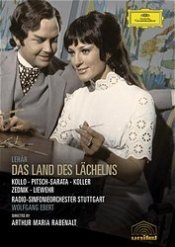
LEHÁR: Das Land des Lächelns
This version of Lehár’s second most popular operetta is not one for purists. By the mid-seventies, it was already clear that one of the biggest tragedies of Western classical music was taking place — the disappearance of operetta with its tons of wonderful music.
There were several reasons. Many German-language operetta stories took place in Austria-Hungary and the knowledge and familiarity with its history, its social mores and its nobility were quickly going away so that it all became old-fashioned and stale. Many operetta librettos were silly, though not sillier than most opera stories — the big difference being that impossible reunions, incredible coincidences are often skipped over in recitative in opera while in operetta they are mercilessly exposed in minutes of spoken dialogue. And, of course, the waltz no longer reigned supreme in an age where the onslaught of rock killed so many marvellous and inspired melodies.
During the sixties and early seventies, German television regularly broadcast its own productions of classic operettas, usually on New Year’s Eve and regrettably with first class singers doubled by actors. I remember Sandor Konya singing Paganini, though not acting it. And recently, a CD appeared with another and more purist Land des Lächelns with Fritz Wunderlich (who never sang an operetta on screen) while another operetta tenor, Gerhard Riedmann, acted the part. When colour came to the European continent at the end of the sixties, TV-operetta became showier, often taking clues from American musical movies with a dim view of those arias and duets that slowed the show, while open throated singing didn’t make for flashy pictures. Therefore producers and directors thought for a short time that distorting the story, cutting the music or even inserting numbers from other works (sometimes not even by the same composer) could salvage something from the wreck of changing taste. In the end it didn’t help much and operetta is now very low on the scale of merit. Strangely enough a lot of music remains known, sometimes even on a somewhat subconscious level, and when it pops up one is always amazed at the melodic richness.
Franz Lehár is still the best known name in the business and with good reason. He churned out one memorable tune after another and Land des Lächelns is especially memorable. In retrospect the score in this DVD is rather faithfully respected, though there are two barbaric cuts (only half of “Bei einem Tee à deux” and “Es ist nicht das erste Mal”). As the producer had engaged the Korean Court Ballet, one had to find employ for these girls and some probably authentic Korean music is inserted into Lehár’s score which makes twice for a rather distorting effect during the performance.
One is grateful that at least the singers act their parts themselves. René Kollo is a convincing and restrained Sou-Chong who sings better than I remember from memory when I watched the broadcast some 30 years ago. Kollo, the son and grandson of popular operetta composers, could probably already sing the score back to front at the time of the recording though he would wait till he was almost 60 (in 1996) before he played the role in the theatre. (Incidentally, his memoirs “Die Kunst, das Leben” are among the most brutally honest I have ever read and they really deserve translation.) At the time of the recording the 36-year old tenor already had numerous Parsifals, Eriks and even Walters von Stolzing under his belt; but the sound is clear, pure and beautiful. He knows how to make a pianissimo and he is superb after the break with his Western wife. Kollo never was a king of the high C and the voice thickens somewhat in the high register and he cuts notes short when the score goes too high. What is lacking most is charm, sweetness and a kind of freedom with the score that Tauber brought to it.
The echt -Wienerische operetta diva, Birgit Sarata, is Lisa. At the time it was still possible to be a stunning blonde, concentrate a career on operetta and have a voice as well. It is a rather small not unattractive soprano, becoming a little bit shrill above the stave.
Dagmar Koller is the fine spirited Mi, proving she once was a dancer and showing a lot of legs though one can hardly take her serious as an Asian princess. Most non-Europeans will know her name as the partner on recordings of Lehár’s Zarewitsch and Land des Lächelns with Giuseppe Di Stefano.
Heinz Zednik is a far better than average Gustl. Of course he cannot compete with Erich Kunz on the first EMI-recording but he really sings the role which is often more or less voicelessly said by so-called buffo’s in other recordings. As this is not a theatre production there is a slight though clearly noticeable synchronic difference. The picture quality is good for the times.
If you don’t know the original version you won’t be disturbed by some of the director’s many alterations. Indeed I admit that a lot of them make sense —decisions I utterly and somewhat unjustly rejected so many years ago. He has lifted the action out of China which is acceptable as the original writers still thought China was a Buddhist country which it isn’t. But I still don’t like the transposition towards the imaginary island of Buratonga. As a consequence the phrase “wir Chinezen” in Sou-Chongs first aria “Immer nur Lächeln” becomes the somewhat ridiculous “wir Asiaten”. And in the same number Sou-Chong no longer thinks that Lisa is intoxicating “wie Hasjisj”. Princess Mi doesn’t make her appearance in the second act as in the original but is already match-making for her brother in the first act and this makes her short affair with Gustl far more believable as both youngsters already know each other when they once more meet in ….well Buratonga.
The idea of having Sou-Chong recalled from Vienna to quell an uprising and succeeding his murdered brother is a good one, better than the original too where he becomes prime-minister. Therefore I was disillusioned that in the second act one of the most original and most impressive scenes is simply deleted. Though the music is mostly kept in place it only serves to show us the return of Lisa to her husband after a trip to the mountains. Originally this is where the ceremony of “Die Gelbe Jacke” (the yellow coat) takes place; the handing over of the coat as a symbol of the office and the original title of the first version of the operetta before Lehár reworked it for Tauber. A symbolic coat suits a hereditary ruler far better than a prime-minister and I sorely miss the combination of impressive music and the original idea.
In this version under review Sou-Chong and Lisa are at least married and are even somewhat desperate they are still childless after one year and this too is a dramatic improvement on many earlier versions. In the Tauber-movie the Chinese prince meets Lisa and they both go to see the operetta that proves that East and West will never meet. So they decide that marriage is not for them. Thus, a short marriage (and the implicit idea of sex) and an irregular divorce —things that could hurt the sensitivities of the public in the thirties — were avoided. All in all, this German TV-production is quite an acceptable proposal for those who want to hear and see one of Lehár’s masterpieces. For those who prefer to be their own directors and can substitute the soundtrack, Tauber’s movie is indispensable.
Jan Neckers