Fortunately, they kept coming, and in the ensuing years, about a dozen of them have been revived, with the bulk available on LP, CD or both.
Mercadante had been born in Altamura, in the South of Italy in 1895, and was to compose some 58 operas which had their premieres between 1819 and 1865. His earliest operas were generally in the style of Rossini, then the dominant figure in Italian opera. After Rossini left Italy in 1823 to go to Paris, Mercadante slowly changed his style, as did the other composers then active in Italy. In the ensuing years, Mercadante continued composing for Italian theaters, but also traveled to Spain, Portugal, and finally, Paris in 1836. He had generally written operas in the style then prevalent in Italy during the 1820s and most of the 1830s. But, perhaps due to his exposure to French opera when he was in Paris in 1836 for the premiere of I Briganti, he started to change his style, incorporating many of the ideas he picked up in the French capital. These changes in style were particularly noticeable in the five works starting with Il giuramento in 1837 and concluding with La vestale in 1840. Not surprisingly, they are frequently referred to as his “reform operas”. These reforms are described in a letter to Florimo, written about a year after the premiere of Il giuramento at the time of Elena da Feltre:
"I have continued the revolution I began with Il giuramento, forms varied, common cabalettas banished, crescendos out, vocal lines simplified, fewer repeats, more originality in the cadences, proper regard paid to the drama, orchestration rich but not so as to swamp the voices, no long solos in the ensembles--they only force the other parts to stand idle to the detriment of the action-, not much brass drum, and a lot less brass band."
It has been frequently stated that Mercadante abandoned his reforms in his later works, but this is not borne out by the four later operas that we have been privileged to hear. While there are indications that some of these "reforms" (perhaps the least significant) have been dropped, there are just as many indications of further progress. Thus, all four of them (Il reggente, [1843], Orazi e Curiazi [1846], Pelagio (1857), and Virginia [composed 1850, premiered 1866]) have many moments of great beauty and great dramatic impact.
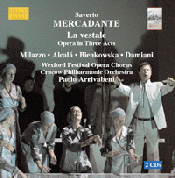
La vestale is also the fourth of these reform operas to be available on commercial CD, following Il Giuramento (1837), Elena da Feltre (1839), and Il Bravo (also 1839). It should only be a matter of time until Le Due illustre rivali (1838) joins them.
La vestale had its premiere in Naples on Mar. 10, 1840, some 8 months before Pacini’s Saffo. It was one of the most successful of Mercadante’s operas, its approximately 150 productions during the 19th century being exceeded only by Mercadante’s Il giuramento. To give some idea of what these numbers mean, I was only able to trace seven 19th century performances of Verdi’s Oberto (1839), even less (3) of Un giorno di regno, and 33 of the original (1857) Simon Boccanegra.
The total of 150 productions racked up by La vestale is really quite amazing, especially when you realize that neither Emilia (the equivalent of Giunia in Spontini’s work), nor Decio (the equivalent of Licinio) has an aria. While there are several arias in the opera, these belong to Giunia (Emilia’s dearest friend in the Mercadante work), Publio (Decio’s loyal friend and supporter) and the high priest, Metellio Pio. An equivalent situation would be if Verdi had written Rigoletto giving arias to Giovanna and Monterone instead of Gilda and Rigoletto. Any attempt to explain this anomaly would have to be pure conjecture. But it would seem that by 1840 both Adelina Spech, the creator of the heroine, and Domenico Reina, the first Decio, were approaching the end of significant careers. Paolo Barroilhet, the creator of Publio, on the other hand, had already achieved, star status. He had previously been the leading baritone in Naples for several seasons. He left that city for Paris in late 1840, and was destined to create many roles in that capital, most importantly Alphonse in La favorite, Sevère in Les martyrs, Camoens in Dom Sebastien, Lusignan in La reine de Chypre and the title role in Charles VI.
Being premiered in 1840, the Mercadante work first appeared some 33 years after Spontini’s opera on the same subject. No two operas could be more different. The Spontini is an “interregnum”opera, and can be viewed as belonging to either the very late classical or very early romantic period.. All of Rossini’s operas intervened, as did all of Bellini’s, almost all of Donizetti’s, quite a few of Mercadante’s and Pacini’s, but only one of Verdi’s (Oberto), although it seems very unlikely that the latter would have had any opportunity to influence Mercadante.* On the other hand, there is every indication that Verdi knew and was influenced by Metellio’s prophecy in La vestale by the time he composed Nabucco.
To return to a comparison of the two Vestales, Spontini ‘s was considered quite revolutionary at the time of its premiere. It was the first really successful new opera at the Academie Imperiale de Musique in years, and is considered by many scholars as the first real French grand opera, although it lacked some characteristics of the genre, including five acts and a full scale ballet. But it did have other typical features of grand opera, including an emphasis on spectacle and a tendency to alternate between crowd and private scenes. It is a considerably longer work than Mercadante’s version–the running time of a typical recording is 145 minutes, while the Mercadante is unusually short for a three act opera: just over 97 minutes. Another major difference between the two versions is that the Spontini has a happy ending to conform with the French taste of the time, while the Mercadante is a “tragedia lirica”, and ends, like Aida, with heroine entombed alive.
The success of Mercadante’s La vestale can probably be best explained by its beautiful music, and the relatively large amount of striking numbers it contains. Perhaps the most salient of these is the high priest’s invective and prophecy: “Versate amare lagrime” in Act II, after he has discovered that the sacred flame has been extinguished. This number shows the strong influence of Brogni’s “Vous qui de Dieu vivant” in La juive, with which Mercadante became familiar while in Paris, and points the way to similar prophecies in Verdi’s Nabucco (1842) and Donizetti’s Dom Sebastien (1843). Other personal favorites include the two act finales, especially that to the first act, Giunia’s aria at the start of Act II “Se fino al cielo ascendere” and the love duet between Decio and Emilia in Act II, “No l’acciar non fu spietato” during which the sacred flame goes out.
The Wexford Festival has built a reputation for utilizing young singers, and helping them establish their reputations. During the last ten or so years, they have been particularly fortunate with tenors, what with finding Juan Diego Flores for Etoile du Nord in 1996, Dario Volonté for Siberia in 1999, and Joseph Calleja for Si j’etais Roi in 2000. It seems that they have found another such winner in Dante Alcalá, the young Mexican who sang Decio in the 2004 revival (actually, the premiere in the British Isles), which is the basis of this recording. It should be mentioned at this point that the Marco Polo recording under review is actually the second Mercadante Vestale to be issued, since Bongiovanni had released the performance that took place in Split, Croatia in April 1987 about 15 years ago. Of the two performances, the one on Bongiovanni wins in terms of the presentation, since a bilingual libretto is provided. But the singing is generally comparable or superior in the Marco Polo release—strikingly so where the Metellio is concerned. In addition to the Decio and Metellio (Andrea Patucelli), I was also quite favorably impressed by the sweet-voiced Emilia (Doriana Milazzo) and the Publio (Davide Damiani), who has been making a name for himself over the last 10 years with appearances in Vienna in Le Prophete, Fedora, L’elisir d’amore, Le nozze di Figaro and other operas as well as Wexford in Il giuramento and other important theatres.
David Rosen’s liner notes are excellent, and up to Wexford’s usual standard for such notes. My only disappointment with the booklet is the lack of a libretto, which I consider an absolute must for unfamiliar operas such as this one. While it is true that a libretto is available on the Naxos web site (in Italian only), which would have increased the price, not everybody likely to buy the set has access to the Internet; and some might even prefer the portability of a libretto in hard copy.
Tom Kaufman
* Oberto was premiered in Milan Nov. 17, 1839, and given in Turin on Jan. 11, 1840. La vestale was premiered in Naples Mar. 10, 1840.