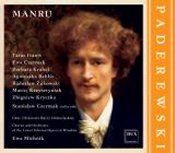
The opera was given its premiere in Dresden on 29 May 1901, and a measure of its success resides in the fact that it was given its New York premiere just a year later in 1902. Fully in line with the nationalism that Paderewski promoted, the libretto by Alfreda Nossig is based on Jósefa Ignacego Kraszewski’s 1843 novel Chaty za wsią (“The Cabin behind the Woods”). While this work is regarded as the first Polish music drama, the somewhat eclectic style that Paderewski used in this work is more than a slavish imitation of Wagnerian opera. The story itself resembles some of the narratives that attracted Verismo composers working at the same time as Paderewski. The plot concerns the ill-fated attraction between Polish woman Ulana and the gypsy Manru, which draws on some stereotypes to make its point about the clash of cultures. While the opera fell out of the repertoire, it is still considered to be Paderewski’s masterpiece, and this recording makes the work available again after years of being otherwise inaccessible.
As to the dramatic content of the opera, Paderewski used the first act to introduce the characters in the village, particularly Hedwig and her daughter Ulana, who has run off with Manru. Hedwig will have nothing to do with her daughter because of her association with a gypsy. Driven out of her family’s home, Ulana confides in Urok, a dwarf with a reputation as a sorcerer. While Urok longs for Ulana, he represses his desire for her when she asks him for a potion that will bind Manru to her. At that point the village girls encounter Ulana and try to tell her how faithless gypsy lovers can be, just as Manru returns to the village. Hedwig wants her daughter free of them, but when Ulana will not leave Manru, the mother treats the couple as pariahs as the act ends.
In the second act, Manru has left the gypsies to try to live in the village with Ulana, with whom he has a child. Despite his efforts, he is unhappy and Ulana fears Manru no longer loves her. Upon encountering Urok, Manru disdains the dwarf, who foresees something tragic for the couple. Suddenly violin music occurs in the distance, and upon hearing it Ulana realizes that Manru has run off to meet the gypsy tribe. Manru returns with the gypsy fiddler Jagu, who is responsible for the enticing music. Jagu tries to persuade Manru to leave Ulana, since a gypsy woman, Asa, still pines for Manru. Yet when Ulana asks about the conversation with Jagu, Manru claims that the fiddler is just a wandered and nothing more. Later, when Ulana is alone with Manru, she gives him Urok’s potion to restore Manru to her, and the magic seems to work on the gypsy, Manru declares his passion for Ulana as the conclusion of the act.
At the opening of the final act, Manru finds himself wandering in the forest, and wonders what kind of magic he encountered. The gypsies stumble on Manru, and Asa recognizes her former lover. Oros, the leader of the tribe wants to leave Manru, since he had abandoned them to live in the village. Asa tries to persuade Manru to join them, but Oros argues further with the woman until the fiddler Jagu intervenes. Seeing how Oros behaved in this situation, the tribe no longer want him as their leader and suggest that Manru take charge of the tribe, and as Manru hears Jagu’s fiddling, he decides to join them after all. In the final scene, Ulana realizes that she has lost Manru forever, and she drowns herself. Upon seeing this, Urok is enraged, and he exacts his revenge on the gypsy by throwing Manru into a chasm. The opera ends with Urok’s cries for Ulana and to God as he gets achieves his vengeance.
In setting this libretto, Paderewski adhered to the conventions of the late nineteenth century, with harmonies that reflect the influence of Wagner as well as the German composer’s approach to orchestration. The introduction to the third act is a telling point, in which various motifs may be seen to coalesce prior to the scene between Manru and the gypsies. It resembles in some ways the opening of the final act of Götterdämmerung, with its interplay between the solo tenor and the other male voices, which punctuated at times augmented chords and, at times, some brief dissonances in the orchestra. As to the melodic content, Paderewski’s approach resembles at times that of Smetana and Dvořák, whose opera Rusalka dates from the same time. Declamatory passages occur, with the kind of recitative associated with Italian opera virtually absent from the score. Rather, telling passages of dialogue that require attention to the text are rendered with relatively simple melodic lines with repeated tones to carry the text.
Some of the more expressive lines are given to the character of Manru, whose prominent role is evident Paderewski’s naming the opera after him. Manru’s part contains a number of poignant lines, especially in the touching scene between Ulana and him at the opening of the second act. While Ulana’s role had been more declamatory in the first act, her character is necessarily more reflective in the second act, where she and Manru are essentially living outside their respective communities and wonder if they have become estranged from each other. This scene is at the core of the work and sets up the emotional pitch that brings the opera to its tragic climax.
Suggestions of folk melodies and local color are part of Paderewski’s idiom, but nowhere does he lapse into formulaic numbers. This is an earnest work that draws effectively on folk elements in the larger context of a serious Polish opera. The sense of drama implicit in the text is underscored in the scoring that helps to suggest the emotional pitch of the action. At the same time Paderewski uses the orchestra deftly to underscore the text and suggest the action. The march of the gypsies later in the third act is redolent of orchestral colors without resorting to cliché, and the dramatic scoring in the final scene reinforces the action without overtaking it.
While Paderewski bowed to some nineteenth-century conventions in this work, with set pieces like the march of the gypsies, or the various male or female choruses that represent the peer groups of the protagonists, his extended scenes allow individual elements to work together well, an aspect of the score that is apparent in such a solid performance. Moreover, some aspects of the score point to developments of the time associated with Verismo, which is especially apparent in the final scene, with its highly evocative orchestral line.
For those interested in nineteenth-century opera, Paderewski’s Manru embodies various tendencies in an effective and masterful work. It is a powerful work that can be heard in this recent recording, which is performed convincingly by a cast who evidently know the music well. Taras Ivaniv is engaging in the demanding title role, with a focused sound that helps to deliver the text well. Likewise, the soprano Ewa Czermak brings a fresh, clear sound to the character of Ulana, which has its demands in the highly dramatic moments accorded her. Above all, the conductor Ewa Michnik creates a fine balance between the vocal and instrumental forces, while also establishing tempos that reinforce the emotions suggested in the text.
Sung in Polish, the performance is also convincing because of its rendering of the language clearly, particularly with the speech rhythms and idiomatic accents. For those unfamiliar with Polish, the detailed synopsis of each act is keyed to the tracks for each of the two CDs in the set, thus making it easy to follow the work. It would have been useful for the recording to include not just the entire libretto in Polish, but also a translation into German or English. While it is possible to appreciate the opera as presented in this recording, such a masterpiece of Polish musical culture deserves to be highlighted so that those familiar with other traditions can apprehend Paderewski’s accomplishments in this score. Poised between the operas of Moniusko and Szymanowski, Manru represents the strength of Polish music at the end of the nineteenth century, the very time when the generation of composers associated with the “Young Poland” movement was calling attention to national culture. At the same time, this recording makes available some of the finest music of Paderewski, who made a wonderful contribution to Polish culture with such an effective opera as Manru.
James L. Zychowicz
Madison, Wisconsin