Subscribe to
Opera Today

Receive articles and news via RSS feeds or email subscription.


twitter_logo[1].gif


UCP_9780226043425.gif

Recently in Recordings

Kaufmann Wagner

The economics of the recording companies dictate much that is not ideal. Wagner’s operas were not composed as they were in order to permit the extraction of bleeding chunks, even on those occasions when strophic song forms do occur.

Mahler: Symphony No. 8

Among the recent recordings of Mahler’s Eighth Symphony, Valery Gergiev’s release on the LSO Live label is an excellent addition to the discography of this work.

Songs by Zemlinsky

While not unknown, the songs of Alexander von Zemlinsky (1871-1942) deserve to be heard more frequently.

Gustav Mahler: Lieder eines fahrenden Gesellen, Rückert-Lieder, Kindertotenlieder.

Recorded on 5 and 6 May 2008 and 17 and 18 January 2009 at the Lisztzentrum (Raiding, Austria), this recent Bridge release makes available the piano-vocal versions of three song cycles by Gustav Mahler, Lieder eines fahrenden Gesellen, Rückert-Lieder, and Kindertotenlieder performed by mezzo-soprano Hermine Haselböck, accompanied by Russell Ryan.

Kathleen Ferrier: A Film by Diane Perelsztejn

Contraltos rarely achieve the acclaim and renown of sopranos. Assigned few leading roles in opera, they are condemned to playing the villain or the grandmother, or to stealing the castrati’s trousers in en travesti roles.

1612 Italian Vespers

Following their 2011 Decca recording of Striggio’s Mass in 40 Parts (1566), I Fagiolini continue their quest to unearth lost treasures of the High Renaissance and early Baroque, with this collection of world-premiere recordings, ‘reconstructions’ and ‘reconstitutions’ of music by Giovanni and Andrea Gabrieli, Monteverdi, Palestrina, and their less well-known compatriots Viadana, Barbarino and Soriano.

Eternal Echoes: Songs and Dances for the Soul

Eternal Echoes is an album of khazones [Jewish cantorial music] for cantorial soloist, solo violin and a blended instrumental ensemble comprising a small orchestra and the Klezmer Conservatory Band.

Mahler: Symphony no. 3 / Kindertotenlieder

Michael Tilson Thomas’s recording of Mahler’s Third Symphony is an outstanding contribution to the composer’s discography.

Oliver Knussen’s Symphonies from NMC

Oliver Knussen burst into British music with an unprecedented flourish. In 1967, the London Symphony Orchestra premiered Knussen’s First Symphony, with István Kertész scheduled to conduct.

Ludwig van Beethoven: Fidelio

Based on performances given in Summer 2010 at the Lucerne Festival, this recording of Beethoven’s Fidelio is an admirable recording that captures the vitality of the work as conducted by Claudio Abbado.

Stanisław Moniuszko: Flis

Stanisław Moniuszko (1819-1872) was one of the most popular composers of his day in Poland, and of the many works he wrote for the stage, two are performed from time to time, Halka (1848) and Strazny dwór [The Haunted Manor] (1865).

Stanisław Moniuszko: Pieśni Songs

The Polish alto Jadwiga Rappé is a familiar voice in various stage and concert works, and the recent release of a selection of songs by Stanisław Moniuszko (1819-1872) is an opportunity to hear her performing artsongs.

Joan Sutherland and Richard Bonynge: Serate Musicali

Originally released on multiple discs in 1981 this reissue on two CDs is a comprehensive collection of art songs by Italian and French composers from the nineteenth and early twentieth centuries.

Richard Strauss: Salome

An exciting contribution to the discography of this popular opera, the live performance of Richard Strauss’s Salome from the Festspielhaus at Baden-Baden is a compelling DVD.

Lulu by Gran Teatro del Liceu, Barcelona

Released in late 2011, Deutsche Grammophon’s DVD of the new staging of Berg’s Lulu at the Gran Teatro del Liceu, Barcelona is an excellent contribution to the discography of this fascinating opera.

Lulu by the Metropolitan Opera

A recent release by the Metropolitan Opera, this two-disc set makes available on DVD the famous performance of Berg’s Lulu that was broadcast on 20 December 1980 as part of the PBS series “Live from the Met.”

Elmer Gantry the Opera

The novels of Sinclair Lewis once shot across the American literary skies like comets, alarming and fascinating readers of that era, but their tails didn’t extend far behind them.

Historical Performances from Covent Garden: Barbiere, La traviata and Tosca

Once the province of only the most dedicated opera fanatics, mid-20th century recordings of privately taped live performances have become more widely available.

Lucia and the glass harmonica

Flute players in opera orchestra around the world must look forward to the frequent appearances of Donizetti’s Lucia di Lammermoor, knowing that while the stage spotlight in the mad scene will be on the soprano, the orchestral spotlight will be on their instrument.

Levine conducts at the Metropolitan Opera: 1978 to 2006

Since his debut at the Metropolitan Opera in 1971, conductor James Levine has come to represent the house’s commitment to artistic excellence — reliable, professional, and immaculately presented.

OPERA TODAY ARCHIVES »

Recordings

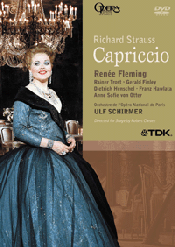
Richard Strauss: Capriccio
16 Jan 2006

STRAUSS: Capriccio

It is not uncommon for opera on DVD to have credits for two directors. In the case of this Paris Capriccio, a new production from June 2004, the credits list Robert Carsen as the stage director and Francois Roussillon as directing for TV and video.

Richard Strauss: Capriccio

Renée Fleming, Dietrich Henschel, Rainer Trost, Gerald Finely, Franz Hawlata, Anne Sofie von Otter, Robert Tear, Orchestre de l’Opéra National de Paris, Ulf Schirmer (cond.).

TDK DVWW-OPCAPR [DVD]


Carsen’s work focuses on bringing energy and movement to this static work, a parlor debate about the primacy of music or words, especially in opera. A brother and sister of nobility act as patrons for a new work, and the young composer and librettist not only vie artistically for primacy, but also to be the Countess’ first choice as paramour (while her brother the Count pursues Clairon, an actress). Meanwhile the proposed director frets that his role is bring slighted, and in a long monologue proposes that without his guiding genius, neither music nor words would come to life. Finally all step aside to get to work, and then the Countess reenters to soliloquize on the glorious unresolved nature of the debate.

The set Carsen works with mirrors the great Paris hall the performance takes place in, with its ornate, golden columns. Although the libretto retains its many references to Gluck as a contemporary opera composer of note, the costumes reflect the era in which Strauss wrote the opera. Dark-clad Nazi officers stray through the set at one point, with no particular purpose in mind.

Now, video director Roussillon had the clever idea of directing a sort of preamble in which Renée Fleming glides through the lobby of the theater, so that all DVD viewers can understand the set’s significance, even if the viewers have never attended an opera in that house. Fine enough.

However, at opera’s end, a very distracting filmed sequence has the cast – including Miss Fleming – taking box seats in the theater to enjoy the Countess’ final monologue. The number of “meaningful glances” exchanged here far exceeds the limit that should be placed on any director, and a coy, artificial feeling that has dogged the entire performance finally overcomes the senses, to an unfortunate degree spoiling the effect of that lovely postlude.

The final stage coup, however, with all the scenery pulling away to reveal the bare interior of the stage, makes for a compensatory climax.

Capriccio is a fragile piece, and without being able to place blame in one exact area, something false about the production hampers and deadens the affair. Perhaps Carsen overdirected, as the performers all work just a bit too hard to have fun. Especially noteworthy here are the cartoonish Italian singers, with some unfunny slapstick. In the huge ensemble section, a compositional miracle from Strauss, the chaotic action distracts from the music’s effect, rather than supporting it.

Carsen certainly has a notable cast to work with. Apart from a couple of tight high notes, Fleming glories in the role, and her dramatic restraint, amidst all the other cavortings, is most welcome. Dietrich Henschel, looking remarkably like the American satirist Harry Shearer, may not be a plausible brother to Fleming but sings well. Rainer Trost and Gerald Finley both appear a little foolish a little too often, which is not their fault, but they have the vocal goods for the roles.

Franz Hawlata makes a huge meal out of his solo, but there is no real character there, in this production. Similarly, Anne Sofie von Otter’s Clarion is all caricature, though she is in good vocal shape and always a charismatic performer. Robert Tear’s little solo scene as the prompter, with the head servant (well played by Petri Lindroos), suffers also from a cartoonish spin. And as mentioned above, Barry Banks and Annamaria Dell’Oste really have to make monkeys of themselves. Yes, they are figures of satire, but as overplayed here, a mean edge creeps in that the creators probably did not intend. Furthermore, as Banks seems to be made up to look a bit like Carlo Bergonzi, those of us who revere the great tenor may find some offense there as well.

No, for Capriccio, surely first choice remains the 1993 San Francisco opera production, with Kiri te Kanawa leading an exemplary cast, including Tatiana Troyanos as a truly stunning and funny Clairon, caught not long before her untimely death. Donald Runnicles leads that performance. Ulf Schirmer and his fine orchestra cannot be faulted at all in this Paris production.

One last cavil – the odd acoustic. On one hand, the voices have perfect placement and any audience present makes not a single cough or rustle. On the other hand, one wonders after a while if the sound picture shouldn’t change a bit when a singer turns his back or moves from stage rear to the front. It does not. Your reviewer almost suspects that this performance was not filmed before a live audience. Although applause greets the end of the performance, no audience is ever shown, and the sense of a performance caught in pristine conditions comes through. The DVD case has no date for the recording, only “June 2004.”

Yes, the cast is great, the music well performed, the sets and costumes imaginative and detailed – but somehow this Capriccio is much, much less than the sum of its considerable parts.

Chris Mullins
Los Angeles Unified School District, Secondary Literacy
Send to a friend

Send a link to this article to a friend with an optional message.

Friend's Email Address: (required)

Your Email Address: (required)

Message (optional):