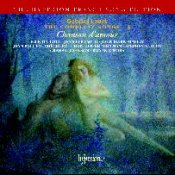
While the center piece of the collection is the cycle La bonne chanson, op. 61, a series of nine songs with texts by Paul Verlaine, the CD includes a number of impressive pieces. As with the other volumes in this series, the selections involve songs from various parts of the composer’s career, from pieces that date to his youth, like “Puisque j’ai mis ma lèvre,” a charming effort performed engagingly by John Mark Ainsley. As much as that setting of Victor Hugo is admirable, the next song in this collection, “Tristesse d’Olympie,” reflects a more mature approach by the composer in this more extended setting of a demanding text. Stephen Varcoe offers an ardent performance of “Tristesse d’Olympie,” which fits his voice well. Yet the relatively early three-song cycle Poème d’un jour reflects another aspect of Fauré’s facility at song. The three pieces in that work echo some of the stylistic devices associated with Lieder, with accompaniments that resemble those of Schumann or Brahms in their interaction with the vocal line. From “Rencontre” (“Meeting”) to “Toujours” (“Always”) and “Adieu” (“Farewell”), Fauré concisely portrays the life cycle of relationships, and in doing so avoids anything sardonic or, worse overtly saccharine. Ainsley’s reading is appropriately touching and sensitive, with a delicacy that is almost expected of such a seasoned musician.
It is difficult, though, to discuss Poème d’un jour without invoking the later cycle La bonne chanson, and the latter work stands apart from the other pieces in this recording because of its length and intensity. Performed by the baritone Christopher Maltman, La bonne chanson may be regarded as the epitome of Fauré’s efforts in solo song. It is acknowledged as an intense work, with the harmonic idiom and thematic connections between the various songs much more complex than his other efforts in this genre. While excellent liner notes by Graham Johnson help to establish an historic context for the reception of the work, Maltman’s performance demonstrates the attraction of this work. This is, perhaps, one of the more attractive performances of the cycle because of the sensitive phrasing in each of the pieces, as well as the delicacy that helps to capture the meaning of the texts. This recording shows both the voice and piano at their best, with an excellent balance in tone, as well as a fine give-and-take in tempo that suggests the attraction of the cycle for its arrangement with string quintet in piano – the textures that Fauré used evoke chamber music in the best sense. This is quite evident in the intensity of the second song in the cycle, “Puisque l’aube grandit” (“Since day breaks”).
When Fauré offers a self-conscious comment on the text of “J’allais par des chemins perfides”(“I go along treacherous ways”) with its pointed chromaticism, Maltman and Johnson give a fine reading of the sometimes chain of sustained dissonances that ultimately resolve on the utterance of the final word: “joie.” This text and the others by Verlaine dance around the topic of love in a piece associated with Fauré’s beloved Emma Bardac, who was also its first interpreter. Culminating in the song “L’hiver a cessé” (“Winter is over”), a fittingly complex piece that brings together the various elements of the cycle, this piece is a tour-de-force for any singer, and Maltman offers a convincing reading that is difficult to match for its musicality and effective presentation.
Of the other pieces in this recording, the music of the French playwright Edmond Haraucourt’s Shylock, an adaptation of Shakespeare’s Merchant of Venice offers a glimpse of the composer’s efforts at writing incidental music. Of the six pieces in the suite from Shylock, only two are vocal, the others being instrumental pieces arranged for piano duet. Not a literal translation of Shakespeare’s play, Haraucourt reworked the Merchant of Venice to create an idiomatic drama, and Fauré’s music suggests the tone of the new work. The pieces are engaging in themselves, and the notes that accompany the recording provide the appropriate cues that create the context for each of them as part of the stage business. While this kind of music is not encountered in recordings of French song, it is quite appropriate here, where the instrumental pieces help to establish the context for “Prélude et Chanson” and the song simply entitled “Madrigal.” Jean-Paul Fouchécourt’s pure, clear tenor voice stands out in this recording for its gentle and effective rendering of the music. Fouchécourt recorded two other pieces found on this CD, and his approach to Fauré’s is convincing.
With “Nell,” Fouchécourt delivers an ardent love song that embodies many characteristics of Fauré’s efforts in the genre. The text itself is a translation of Robert Burns’ familiar poem that begins “My love is like a red, red rose,” and in this French version, some of images differ from the English original to intensify the meaning conveyed. Fauré’s music captures the turns of phrase, which emerge clearly in this sensitive performance.
While many of the pieces in this collection are sung by men, the women offer equally effective performances. Felicity Lott is impressive in her interpretations of “Notre amour” and “Le secret,” two pieces in Fauré’s opus. 23 set. A masterful performer, Lott contributes an intensity that seems natural to both her voice and the music chosen. Likewise, Jennifer Smith has the final word in this recording with a late song, “Le don silencieux” (“The silent gift”). As Graham Johnson observed in the notes about this song, the piece shows Fauré composing in a somewhat different style. It is relatively more declamatory than some of his other songs, but the style chosen serves the text well and that is, perhaps, the key to appreciating Fauré’s songs, especially the ones that have texts which deal with various aspects of love.
Chanson d’amour is another fine volume in the four-CD set issued by Hyperion, and those who do not know this recording should find much in it to admire. It is consistent with the other releases in the set with regard to format and presentation, as well as the quality of performance. With the release of the fourth volume, Dans un parfum de roses, the set will be complete, and it should stand well for years as a standard for French song and the music of Fauré.
James L. Zychowicz
Madison, Wisconsin