Subscribe to
Opera Today

Receive articles and news via RSS feeds or email subscription.


twitter_logo[1].gif


UCP_9780226043425.gif

Recently in Recordings

Ariane et Barbe-Bleue on Blu-Ray

Paul Dukas’ Ariane et Barbe-Bleue, first heard in 1907, once seemed important. Arturo Toscanini conducted the Met premiere in 1911 with Farrar and later arranged some of its music for a 1947 recording with his NBC Symphony.

Kaufmann Wagner

The economics of the recording companies dictate much that is not ideal. Wagner’s operas were not composed as they were in order to permit the extraction of bleeding chunks, even on those occasions when strophic song forms do occur.

Mahler: Symphony No. 8

Among the recent recordings of Mahler’s Eighth Symphony, Valery Gergiev’s release on the LSO Live label is an excellent addition to the discography of this work.

Songs by Zemlinsky

While not unknown, the songs of Alexander von Zemlinsky (1871-1942) deserve to be heard more frequently.

Gustav Mahler: Lieder eines fahrenden Gesellen, Rückert-Lieder, Kindertotenlieder.

Recorded on 5 and 6 May 2008 and 17 and 18 January 2009 at the Lisztzentrum (Raiding, Austria), this recent Bridge release makes available the piano-vocal versions of three song cycles by Gustav Mahler, Lieder eines fahrenden Gesellen, Rückert-Lieder, and Kindertotenlieder performed by mezzo-soprano Hermine Haselböck, accompanied by Russell Ryan.

Kathleen Ferrier: A Film by Diane Perelsztejn

Contraltos rarely achieve the acclaim and renown of sopranos. Assigned few leading roles in opera, they are condemned to playing the villain or the grandmother, or to stealing the castrati’s trousers in en travesti roles.

1612 Italian Vespers

Following their 2011 Decca recording of Striggio’s Mass in 40 Parts (1566), I Fagiolini continue their quest to unearth lost treasures of the High Renaissance and early Baroque, with this collection of world-premiere recordings, ‘reconstructions’ and ‘reconstitutions’ of music by Giovanni and Andrea Gabrieli, Monteverdi, Palestrina, and their less well-known compatriots Viadana, Barbarino and Soriano.

Eternal Echoes: Songs and Dances for the Soul

Eternal Echoes is an album of khazones [Jewish cantorial music] for cantorial soloist, solo violin and a blended instrumental ensemble comprising a small orchestra and the Klezmer Conservatory Band.

Mahler: Symphony no. 3 / Kindertotenlieder

Michael Tilson Thomas’s recording of Mahler’s Third Symphony is an outstanding contribution to the composer’s discography.

Oliver Knussen’s Symphonies from NMC

Oliver Knussen burst into British music with an unprecedented flourish. In 1967, the London Symphony Orchestra premiered Knussen’s First Symphony, with István Kertész scheduled to conduct.

Ludwig van Beethoven: Fidelio

Based on performances given in Summer 2010 at the Lucerne Festival, this recording of Beethoven’s Fidelio is an admirable recording that captures the vitality of the work as conducted by Claudio Abbado.

Stanisław Moniuszko: Flis

Stanisław Moniuszko (1819-1872) was one of the most popular composers of his day in Poland, and of the many works he wrote for the stage, two are performed from time to time, Halka (1848) and Strazny dwór [The Haunted Manor] (1865).

Stanisław Moniuszko: Pieśni Songs

The Polish alto Jadwiga Rappé is a familiar voice in various stage and concert works, and the recent release of a selection of songs by Stanisław Moniuszko (1819-1872) is an opportunity to hear her performing artsongs.

Joan Sutherland and Richard Bonynge: Serate Musicali

Originally released on multiple discs in 1981 this reissue on two CDs is a comprehensive collection of art songs by Italian and French composers from the nineteenth and early twentieth centuries.

Richard Strauss: Salome

An exciting contribution to the discography of this popular opera, the live performance of Richard Strauss’s Salome from the Festspielhaus at Baden-Baden is a compelling DVD.

Lulu by Gran Teatro del Liceu, Barcelona

Released in late 2011, Deutsche Grammophon’s DVD of the new staging of Berg’s Lulu at the Gran Teatro del Liceu, Barcelona is an excellent contribution to the discography of this fascinating opera.

Lulu by the Metropolitan Opera

A recent release by the Metropolitan Opera, this two-disc set makes available on DVD the famous performance of Berg’s Lulu that was broadcast on 20 December 1980 as part of the PBS series “Live from the Met.”

Elmer Gantry the Opera

The novels of Sinclair Lewis once shot across the American literary skies like comets, alarming and fascinating readers of that era, but their tails didn’t extend far behind them.

Historical Performances from Covent Garden: Barbiere, La traviata and Tosca

Once the province of only the most dedicated opera fanatics, mid-20th century recordings of privately taped live performances have become more widely available.

Lucia and the glass harmonica

Flute players in opera orchestra around the world must look forward to the frequent appearances of Donizetti’s Lucia di Lammermoor, knowing that while the stage spotlight in the mad scene will be on the soprano, the orchestral spotlight will be on their instrument.

OPERA TODAY ARCHIVES »

Recordings

Thy Kiss of a Divine Nature:  The Contemporary Perotin
05 Mar 2006

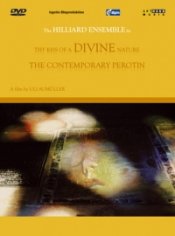
HILLIARD ENSEMBLE: Thy Kiss of a Divine Nature — The Contemporary Perotin

The richness of the Ars Antiqua flourishing in Paris in the twelfth and thirteenth centuries marks the time as one of high cultural achievement, drawing nurture from the contemporaneous rise of the Cathedral of Notre Dame and the University of Paris.

Thy Kiss of a Divine Nature: The Contemporary Perotin

A Film by Uli Aumüller, featuring the Hilliard Ensemble, Simona Furlani and Tanja Oetterli, dancers, Johann Kresnik, choreographer, with commentary by Martin Burckhardt, Rudolf Flotzinger, Christian Kaden, and Jürg Stenzl.

Art Haus Musik 100 695 [DVD]

€39.99  Click to buy

In this environment, the composer Perotinus, along with the older Leoninus, cultivated polyphony and counterpoint in exciting new ways, extending music both vertically and horizontally, and at the same time pioneering new control of the temporal aspects of composition. The Ars Antiqua is by no means the birth of polyphony, but it is without a doubt a high point in its early cultivation. It is thus no surprise that Uli Aumüller’s fantasia on the theme of Perotin, “Thy Kiss of a Divine Nature,” is a film that is itself essentially “polyphonic.” Its polyphony is a variegated counterpoint of multiple “voices.” One voice is the music of Perotinus, sung with consummate style and grace by the Hilliard Ensemble, echoing the stunning beauty of their 1988 recording of Perotinus on ECM. A second voice is a choreographic one: two dancers, Simona Furlani and Tanja Oetterli, the choreographer, Johann Kresnik, and the cultural historian, Martin Burckhardt are shown in various stages of creating a dance that will interpret medieval views of the conception of Jesus, based on images in the texts that Perotinus sets. A third voice emerges in the presence of four scholars, discussing such issues as new concepts of time, performance practice, and the building of Gothic cathedrals. And a fourth voice is comprised of visual images from diverse paintings, architecture, etc. By no means consecutive variations on a theme—here’s the music, here’s the dance, here’s the scholar’s account—the film instead interweaves the “voices” in a contrapuntal fashion, moving from a bit of this to a bit of that and back to this again. Dizzying if you are looking for a tidy documentary account, but compellingly rhapsodic, if you are not.

Much is memorable here. One of the most successful scenes is countertenor David James’ solo rendition of “Beata viscera.” The performance takes place in the stark Church of St. Petri in Lübeck, whose bare walls become projection screens for fragmented images from Marian iconography. The fragmentation and repetition of images becomes itself a trope on the way parts relate to the whole, and given the polyphonic nature of the whole enterprise, it is a trope that seems strongly emblematic. Particularly engaging is the scene devoted to the imposing organum, “Viderunt.” A long work, its performance gives ample time for visual imagery to evolve, and it does so interestingly here. One of the themes of the film’s discussion is how the music of Perotinus reveals a new sense of time, resonant with the invention of the mechanical clock, an invention that allowed old, circular perceptions of time to be augmented by smaller modules of linear time. Thus, it is no surprise that during “Viderunt” we see clockwork imagery. Initially it appears iconic. That is, the imagery symbolizes the concept itself. But as things evolve, the clockwork becomes less iconic and more integral: the wheels and cogs moving at different speeds “choreograph” the motion of the notes and their interrelationships in a beautiful way.

One of the most memorable scenes is a tableau vivant, a stylized recreation of the Annunciation, breathtaking in its color, lighting, and mood. Surprisingly though, the visual inspiration here seems to be much more from the Renaissance than the Middle Ages, an anachronism that crops up in other places, as well. Also breathtaking is the long conductus, “Dum sigillum,” performed with projections of the dancers in a mystical whirl, the kind of moment where one feels—satisfyingly—that one has been awhirl oneself.

On the plus side, as well, are a number of extras in the production. A companion DVD offers a film record of a scholarly symposium on Perotinus—interesting in its substance, but also entertaining in the confrontations of personality and view—and a director’s commentary, “Perotinus Magnus: the Vision of a Film Project.” Additionally, there is also a CD soundtrack

There are some things with which to quibble. The film of the Hilliard Ensemble and the sound track are occasionally out of synch, something that surprises in a “music” film. And there is also a surprising confusion in the director’s mind about the “Immaculate Conception,” a doctrine that refers not to Mary’s virginal conception of Jesus, but rather to her own conception without original sin. As the conception of Jesus is one of the sharp focuses of the film, the misappropriation or confusion of terms is regrettable. But these are quibbles. A more substantial issue is the end product itself. “Thy Kiss of a Divine Nature” is a film that seeks to be bigger than the sum of its individual parts, and as a film, it needs to be. Here is where Aumüller faces his biggest challenge. All the “voices” here bear the imprint of the theme, but cohesion seems at times to be at risk. Given the number of intertwinings, one is not surprised that the “counterpoint” is complex, but in the end, it needs to be satisfyingly harmonious, as well. Twelfth-century enthusiasts will grant this to Aumüller’s work with a generous smile; others will likely find this quality a bit harder to find . . . but will smile, too.

Steven Plank
Oberlin College
Send to a friend

Send a link to this article to a friend with an optional message.

Friend's Email Address: (required)

Your Email Address: (required)

Message (optional):