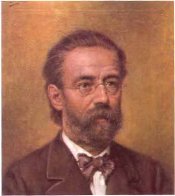
26 Mar 2006
SMETANA: Die verkaufte Braut
Die verkaufte Braut (The Bartered Bride; Prodaná nevěsta)
Comic opera in three acts.
Music composed by Bedřich Smetana. Libretto by Karel Sabina
Mozart and Salieri, an opera in one act consisting of two scenes.
Nicolai Rimsky-Korsakov (1844-1908), composer. Libretto derived from Alexander Puskhin's play of the same name.
First performance: 7 December 1898 in Moscow.
Ariadne auf Naxos, Oper with a prologue and one act. Music composed by Richard Strauss. Libretto by Hugo von Hofmannsthal.
La Vestale, a tragédie lyrique in three acts.
Boris Godunov, an opera in four acts with prologue
Modest Mussorgsky, composer. Libretto by the composer, based on Alexander Pushkin's drama Boris Godunov and Nikolai Karamazin's History of the Russian Empire
First performance: 8 February 1874 at the Mariinsky Theatre, St. Petersburg
Il Trovatore, dramma in four parts.
Only a few months following the premiere of Der Rosenkavalier, Hugo von Hofmannsthal proposed a new opera to Richard Strauss based on Molière’s comedy-ballet, Le Bourgeois gentilhomme (in German, Der Bürger als Edelmann).
Die Entführung aus dem Serail, Singspiel in 3 Acts.
Music composed by Wolfgang Amadeus Mozart (1756–1791). Libretto by Johann Gottlieb Stephanie the Younger, based on an earlier libretto by
Christoph Friedrich Bretzner.
Die Entführung aus dem Serail, Singspiel in 3 Acts.
Music composed by Wolfgang Amadeus Mozart (1756–1791). Libretto by Johann Gottlieb Stephanie the Younger, based on an earlier libretto by
Christoph Friedrich Bretzner.
Arabella: Lyrische Komödie in three acts
Die Entführung aus dem Serail, Singspiel in 3 Acts.
Music composed by Wolfgang Amadeus Mozart (1756–1791). Libretto by Johann Gottlieb Stephanie the Younger, based on an earlier libretto by
Christoph Friedrich Bretzner.
La Gioconda, dramma lirico in four acts.
Music composed by Amilcare Ponchielli (1834–1886). Libretto by Arrigo Boito (under the pseudonym Tobia Gorrio), based upon Victor Hugo's Angelo, Tyrant of Padua (1835).
Don Carlo, an opera in four acts. Music composed by Giuseppe Verdi (1813–1901). Libretto by Joseph Méry and Camille Du Locle after Friedrich von Schiller’s dramatic poem Don Carlos, Infant von Spanien. Revised version in four acts (French text revised by Du Locle, Italian translation by Achille de Lauzières and Angelo Zanardini).
Un ballo in maschera, a melodramma in three acts.
Music composed by Giuseppe Verdi. Libretto by Antonio Somma, based upon the work of Eugène Scribe Gustave III ou Le bal masqué (1833)
Medea: Melodramma tragico in three acts.
Die Tote Stadt, an opera in three acts.
Music composed by Erich Wolfgang Korngold (1897-1957). Libretto by Paul Schott (Julius and E. W. Korngold) after the novel Bruges la morte by Georges Rodenbach.
Some Details concerning the Revolution inaugurated by Rossini
Manon Lescaut, dramma lirico in quattro atti
Elektra: Tragedy in one act.
Lyric Opera of Chicago has announced both schedules and cast-lists for is Spring 2020 performances of Richard Wagner’s Ring Cycle. Given the series of individual productions already staged by the company since Fall 2016, that pave the way for the complete cycle, Lyric Opera of Chicago’s complete production should affirm the artistic might of the great composer.
“Diacono himself does not know what musical talent he possesses” – Mascagni
Die verkaufte Braut (The Bartered Bride; Prodaná nevěsta)
Comic opera in three acts.
Music composed by Bedřich Smetana. Libretto by Karel Sabina
Streaming Audio
First Performance: 30 May 1866 at the Provisional Theatre, Prague (definitive version 25 September 1870 at same)
Principal Characters:
| Krušina, a farmer | Baritone |
| Ludmila, his wife | Soprano |
| Mařenka their daughter | Soprano |
| Mícha, a wealthy landowner | Bass |
| Háta, his wife | Mezzo-Soprano |
| Vašek, their son | Tenor |
| Jeník, Mícha’s son from his first marriage | Tenor |
| Kecal, a village marriage-broker | Bass |
| Circus Master | Tenor |
| Esmeralda, circus artist | Soprano |
| Indian circus artist | Bass |
Time and Place: A small village during Spring Festival.
Synopsis:
Act I
In a Bohemian village during Spring Festival, the beautiful Marenka is sad. She loves Jenik; but her parents have promised her to another boy, Vašek, the son of the rich landowner Mícha. The marriage broker, Kecal, arrives to finalize the contract. Krušina, Marenka's father, remarks that he has always heard that Mícha has two sons, but has never met either one. He asks Kecal to tell him about both sons, but Kecal insists that Vašek is just the man for Marenka and that no one knows what has happened to Mícha 's eldest son. Marenka joins them and tells her parents that she already has a sweetheart she has promised to wed. As the square fills with villagers celebrating the festival with their traditional dances, Kecal plots to find out who Marenka's sweetheart is and to offer him money to leave her.
Act II
During festivities near a country inn, Vašek finally appears. He has just learned that parents are about to marry him off. Marenka draws near him. Not knowing that she is his possible bride, Marenka relates to him that the girl is a horrid person and convinces him to give up her. Meanwhile, Kecal approaches Jenik. They negotiate a contract that provides that Jenik will relinquish his claim to the young girl for three hundred florins but, per Jenik’s stipulation, only to the “child of Tobiaš Mícha.” The villagers are utterly disgusted by Jenik’s actions.
Act III
A company of acrobats arrive at the village square to give a show. Vašek is approached by the dancer, Esmeralda, who convinces him to take the place of an absent dancer and perform the part of the dancing bear. Inspired by this adventure, Vašek refuses the hand of Marenka. Marenka, in the meantime, learns that she has been sold. She is so offended and humiliated, that she declares to Jenik that she is ready to marry the rich child of Mícha. When the marriage contract is concluded, Jenik reveals himself. He is the stepbrother of Vašek, the offspring of Mícha’s first marriage. He had been cast out of house by his stepmother, Hata, when he was child. He has thus sold Marenka to himself. The young girl understands the joke and renews her love for Jenik. Jenik’s father is happy to see his child once again. Only the mother of Vašek resists the marriage. But when she sees Vašek get out of a bearskin to the derision by all those present, she concedes that Vašek’s union with Marenka is impossible. Marenka and Jenik are then married and all are in celebration.