Recently in Recordings
The Sixteen continues its exploration of Henry Purcell’s Welcome Songs for Charles II. As with Robert King’s pioneering Purcell series begun over thirty years ago for Hyperion, Harry Christophers is recording two Welcome Songs per disc.
In February this year, Albanian soprano Ermonela Jaho made a highly lauded debut recital at Wigmore Hall - a concert which both celebrated Opera Rara’s 50th anniversary and honoured the career of the Italian soprano Rosina Storchio (1872-1945), the star of verismo who created the title roles in Leoncavallo’s La bohème and Zazà, Mascagni’s Lodoletta and Puccini’s Madama Butterfly.
Collapsology. Or, perhaps we should use the French word ‘Collapsologie’ because this is a transdisciplinary idea pretty much advocated by a series of French theorists - and apparently, mostly French theorists. It in essence focuses on the imminent collapse of modern society and all its layers - a series of escalating crises on a global scale: environmental, economic, geopolitical, governmental; the list is extensive.
Amongst an avalanche of new Mahler recordings appearing at the moment (Das Lied von der Erde seems to be the most favoured, with three) this 1991 Mahler Second from the 2nd Kassel MahlerFest is one of the more interesting releases.
If there is one myth, it seems believed by some people today, that probably needs shattering it is that post-war recordings or performances of Wagner operas were always of exceptional quality. This 1949 Hamburg Tristan und Isolde is one of those recordings - though quite who is to blame for its many problems takes quite some unearthing.
The voices of six women composers are celebrated by baritone Jeremy Huw Williams and soprano Yunah Lee on this characteristically ambitious and valuable release by Lontano Records Ltd (Lorelt).
As Paul Spicer, conductor of the Royal Birmingham Conservatoire Chamber Choir, observes, the worship of the Blessed Virgin Mary is as ‘old as Christianity itself’, and programmes devoted to settings of texts which venerate the Virgin Mary are commonplace.
Ethel Smyth’s last large-scale work, written in 1930 by the then 72-year-old composer who was increasingly afflicted and depressed by her worsening deafness, was The Prison – a ‘symphony’ for soprano and bass-baritone soloists, chorus and orchestra.
‘Hamilton Harty is Irish to the core, but he is not a musical nationalist.’
‘After silence, that which comes closest to expressing the inexpressible is music.’ Aldous Huxley’s words have inspired VOCES8’s new disc, After Silence, a ‘double album in four chapters’ which marks the ensemble’s 15th anniversary.
A song-cycle is a narrative, a journey, not necessarily literal or linear, but one which carries performer and listener through time and across an emotional terrain. Through complement and contrast, poetry and music crystallise diverse sentiments and somehow cohere variability into an aesthetic unity.
One of the nicest things about being lucky enough to enjoy opera, music and theatre, week in week out, in London’s fringe theatres, music conservatoires, and international concert halls and opera houses, is the opportunity to encounter striking performances by young talented musicians and then watch with pleasure as they fulfil those sparks of promise.
“It’s forbidden, and where’s the art in that?”
Dublin-born John F. Larchet (1884-1967) might well be described as the father of post-Independence Irish music, given the immense influenced that he had upon Irish musical life during the first half of the 20th century - as a composer, musician, administrator and teacher.
The English Civil War is raging. The daughter of a Puritan aristocrat has fallen in love with the son of a Royalist supporter of the House of Stuart. Will love triumph over political expediency and religious dogma?
Beethoven Symphony no 9 (the Choral Symphony) in D minor, Op. 125, and the Choral Fantasy in C minor, Op. 80 with soloist Kristian Bezuidenhout, Pablo Heras-Casado conducting the Freiburger Barockorchester, new from Harmonia Mundi.
A Louise Brooks look-a-like, in bobbed black wig and floor-sweeping leather trench-coat, cheeks purple-rouged and eyes shadowed in black, Barbara Hannigan issues taut gestures which elicit fire-cracker punch from the Mahler Chamber Orchestra.
‘Signor Piatti in a fantasia on themes from Beatrice di Tenda had also his triumph. Difficulties, declared to be insuperable, were vanquished by him with consummate skill and precision. He certainly is amazing, his tone magnificent, and his style excellent. His resources appear to be inexhaustible; and altogether for variety, it is the greatest specimen of violoncello playing that has been heard in this country.’
Baritone Roderick Williams seems to have been a pretty constant ‘companion’, on my laptop screen and through my stereo speakers, during the past few ‘lock-down’ months.
Melodramas can be a difficult genre for composers. Before Richard Strauss’s Enoch Arden the concept of the melodrama was its compact size – Weber’s Wolf’s Glen scene in Der Freischütz, Georg Benda’s Ariadne auf Naxos and Medea or even Leonore’s grave scene in Beethoven’s Fidelio.
Recordings
29 Mar 2006
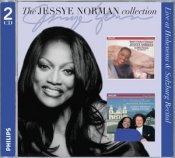
The Jessye Norman Collection from Philips
Jessye Norman’s long-time label, Philips, celebrates the artist’s sizeable recorded heritage with an expansive series of double CDs of re-releases, under the sobriquet The Jessye Norman Collection.
Thankfully some care has been taken to bring together recordings of compatible repertoire, whether it be a set of live recitals, another focusing on stark modernism (Schoenberg and Stravinsky), or two of her Christmas holiday extravaganzas. The singer’s ample gifts are on display on every set—but whether one has the appetite to devour a heaping platter of 5 of the sets in succession really depends on a strong preference for her voice of dark chocolate laced with honey. In the right amounts, what a stunning treat. In excess—an unhealthy wallow.
Each of the sets presents the original cover art for the CDs (except for A Wagner Collection, the second CD of which contains a compilation of excerpts from complete opera recordings). The original liner notes accompany a biographical note, reprinted in every set, which details Ms. Norman’s concert appearances in recent years and many honors bestowed on her. The prose here wanders fearfully close to obituary mode, but then an air of a “career achievement” retrospective covers the whole enterprise.
Of the five sets under review, your reviewer found the Live at Hohenems & Salzburg Recital set most enjoyable. The amount of applause recorded on the former could have been cut back, but tolerance wins the day, as the singer is in exemplary voice, in repertoire starting with Handel, working up to a large Schubert sampling, and ending with spirituals as encores. Few will want to hear Lascia ch’io pianga always sung with this ostentatious gorgeousness, but why not once in a while? Norman makes a substantial case for giving into temptation.
The second disc, with James Levine in impeccable accompaniment, has very disciplined but lively Wolf lieder, broken up with 5 satisfying dollops of Debussy.
The studio lieder sets (Schubert & Mahler Lieder) can’t be faulted for not possessing the extra aura of vitality a live recording bestows, but a sense of formality and restraint comes over both recordings at times.
The Wagner set has a first disc of rather short duration, with Colin Davis leading the LSO in the Tristan und Isolde prelude before Norman’s self-conscious but exquisite love death. A fine performance of the Wesendonk lieder follows. On the second disc, the excerpts from Parsifal, Lohengrin, and Die Walkure partner Norman with Placido Domingo for the first two and Gary Lakes for the last. The Norman voice exhibits its full power here—in company with a certain remoteness from the drama. Perhaps she is not helped her by a tentative quality in Domingo and Lakes’s adequate but uninspiring contribution.
Stravinsky’s Oedipus Rex has never come close to giving the Firebird or Le Sacre du Printemps any competition as one of the composer’s most popular pieces, but those who respond to the work can surely find much to value in Seiji Ozawa's recording, with Peter Schreier in the title role and a young Bryn Terfel as Creon. Norman’s refulgent tone here offers some aural compensation for those unenamored of Stravinsky’s dry approach. The second disc has Norman’s offering similar virtues to Schoenberg’s Erwartung, 25 minutes of a woman losing her mind in atonal agony. Many will sympathize. Several of the composer’s cabaret songs end the set with a sense of humor and style Schoenberg not too frequently allowed himself. Or us.
The last of these five sets will separate the Norman besotted from the Norman tolerant. Disc one, Christmastide, will fill the former with a grand, exuberant expression of the holiday spirit. The latter will cringe in pain and moan in despair at the lugubrious ballads and manic up-tempo numbers. And Philips has to release a larger version of that cover photo, for the perversely curious. What is going on with the singer’s hair? The Bride of Frankenstein would look askance. In the Spirit, the second disc, thankfully redeems the first (or supplements it beautifully, for those fans). Here the arrangements have taste and restraint, and Norman’s singing revels in the finer music, truly offering reason to be grateful.
Philips has several more of these two-disc sets, including Norman’s luxuriant Strauss and a compilation of her forays into spirituals. The best singing on the sets has an incomparable grandeur and beauty, so new comers to her art have many a treat in store for them. Her fans probably have most if not all of these already, and for those indifferent to the pleasures of releasing oneself into the all-encompassing embrace of her immense gift—they can skip these collections as they did the first time. Many great singers engender such a wide-range of responses, and Jessye Norman’s huge career deserves this generously proportioned celebration.
Chris Mullins
Los Angeles Unified School District, Secondary Literacy