17 Apr 2006
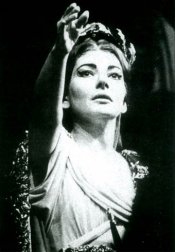
BELLINI: Norma — Trieste 1953
Norma: Tragedia lirica in due atti
Mozart and Salieri, an opera in one act consisting of two scenes.
Nicolai Rimsky-Korsakov (1844-1908), composer. Libretto derived from Alexander Puskhin's play of the same name.
First performance: 7 December 1898 in Moscow.
Ariadne auf Naxos, Oper with a prologue and one act. Music composed by Richard Strauss. Libretto by Hugo von Hofmannsthal.
La Vestale, a tragédie lyrique in three acts.
Boris Godunov, an opera in four acts with prologue
Modest Mussorgsky, composer. Libretto by the composer, based on Alexander Pushkin's drama Boris Godunov and Nikolai Karamazin's History of the Russian Empire
First performance: 8 February 1874 at the Mariinsky Theatre, St. Petersburg
Il Trovatore, dramma in four parts.
Only a few months following the premiere of Der Rosenkavalier, Hugo von Hofmannsthal proposed a new opera to Richard Strauss based on Molière’s comedy-ballet, Le Bourgeois gentilhomme (in German, Der Bürger als Edelmann).
Die Entführung aus dem Serail, Singspiel in 3 Acts.
Music composed by Wolfgang Amadeus Mozart (1756–1791). Libretto by Johann Gottlieb Stephanie the Younger, based on an earlier libretto by
Christoph Friedrich Bretzner.
Die Entführung aus dem Serail, Singspiel in 3 Acts.
Music composed by Wolfgang Amadeus Mozart (1756–1791). Libretto by Johann Gottlieb Stephanie the Younger, based on an earlier libretto by
Christoph Friedrich Bretzner.
Arabella: Lyrische Komödie in three acts
Die Entführung aus dem Serail, Singspiel in 3 Acts.
Music composed by Wolfgang Amadeus Mozart (1756–1791). Libretto by Johann Gottlieb Stephanie the Younger, based on an earlier libretto by
Christoph Friedrich Bretzner.
La Gioconda, dramma lirico in four acts.
Music composed by Amilcare Ponchielli (1834–1886). Libretto by Arrigo Boito (under the pseudonym Tobia Gorrio), based upon Victor Hugo's Angelo, Tyrant of Padua (1835).
Don Carlo, an opera in four acts. Music composed by Giuseppe Verdi (1813–1901). Libretto by Joseph Méry and Camille Du Locle after Friedrich von Schiller’s dramatic poem Don Carlos, Infant von Spanien. Revised version in four acts (French text revised by Du Locle, Italian translation by Achille de Lauzières and Angelo Zanardini).
Un ballo in maschera, a melodramma in three acts.
Music composed by Giuseppe Verdi. Libretto by Antonio Somma, based upon the work of Eugène Scribe Gustave III ou Le bal masqué (1833)
Medea: Melodramma tragico in three acts.
Die Tote Stadt, an opera in three acts.
Music composed by Erich Wolfgang Korngold (1897-1957). Libretto by Paul Schott (Julius and E. W. Korngold) after the novel Bruges la morte by Georges Rodenbach.
Some Details concerning the Revolution inaugurated by Rossini
Manon Lescaut, dramma lirico in quattro atti
Elektra: Tragedy in one act.
Lyric Opera of Chicago has announced both schedules and cast-lists for is Spring 2020 performances of Richard Wagner’s Ring Cycle. Given the series of individual productions already staged by the company since Fall 2016, that pave the way for the complete cycle, Lyric Opera of Chicago’s complete production should affirm the artistic might of the great composer.
“Diacono himself does not know what musical talent he possesses” – Mascagni
Norma: Tragedia lirica in due atti
Streaming Audio
Music composed by Vincenzo Bellini (1801–1835). Libretto by Felice Romani, from Norma ou L’infanticide (1831) by Alexandre Soumet.
First Performance: 26 December 1831, Teatro alla Scala, Milan.
Principal Characters:
| Pollione, Proconsole di Roma nelle Gallie | Tenor |
| Oroveso, capo dei Druidi | Bass |
| Norma, Druidessa, figlia di Oroveso | Soprano |
| Adalgisa, giovine ministra del tempio d'Irminsul | Soprano |
| Clotilde, confidente di Norma | Mezzo-Soprano |
| Flavio, amico di Pollione | Tenor |
| Due fanciulli, figli di Norma e di Pollione | Silent roles |
Time and Place: Ancient Gaul during the Roman conquest.
Synopsis:
Act I
In a forest in Gaul, at the time of the Roman conquest, the head of the Druids, Oroveso, announces to his people that the priestess Norma, his daughter, is about to reveal the will of the god Irminsul: all are hoping that the time has come to rebel against their oppressors. Meanwhile the Roman proconsul Pollione confides to his friend Flavio that he no longer loves Norma, in spite of the two children she has borne him and who live hidden in Norma's house, their existence a secret, but loves Adalgisa, a young priestess in the temple of Irminsul. Pollione fears Norma's anger, and recounts a dream in which she slaughters their children. Rut the sound of the sacred gong is heard announcing Norma's arrival, and the two Romans disappear into the forest. Now all the Druids are gathered, eager to be given the signal to revolt; but Norma reveals that the time for war has not yet come, and by the light of the moon she performs the sacred rite of cutting the mistletoe, invoking peace — a peace that is necessary for her to consolidate her secret liaison with Pollione. When Adalgisa is left alone she anguishes over her illicit love; Pollione arrives and eventually persuades her to follow him to Rome.
In her dwelling Norma looks anxiously at her children: she knows that Pollione must leave, but she has received no message from him, and is afraid that he no longer loves her as he once did. Adalgisa arrives, and cannot conceal that she has betrayed her vocation as a priestess and yielded to love. Norma understands her and reassures her, and releasing her from her vows she encourages her to follow the man she loves. But what is his name? Adalgisa indicates Pollione, who is approaching at that moment. At this tragic revelation Norma threatens revenge, and Pollione vainly tries to defend himself. Adalgisa, who knew nothing of Pollione's former love for Norma, is deeply distressed, and reassures Norma with generous words that she will break off all relations with the faithless Roman.
Act II
In her despair, Norma wishes she could kill her children: she is afraid, they will be turned into slaves in Rome, and also wishes to make Pollione suffer terribly. But she cannot bring herself to carry out the mad deed. She calls Adalgisa, and asks her to agree to marry Pollione and to keep the children with her; but Adalgisa no longer loves the Roman, and undertakes instead to rekindle his love for Norma. In the forest the warriors are ready to attack the Romans and kill the proconsul, but Oroveso has to stop them: Norma continues to remain silent about the decisions of Irminsul.
In the temple of Irminsul Norma learns from her friend Clotilde that Adalgisa's attempt has failed, and that Pollione is planning to abduct the girl. Norma has an overwhelming desire for revenge, and calls all her people together: it is the signal for war. Pollione is immediately taken prisoner, guilty of having broken into the cloister of young priestesses. It, is Norma who will have to sacrifice him, but first she must interrogate him and asks to be left alone with the guilty man. Norma promises to save Pollione's life if he will give up Adalgisa, but Pollione refuses and invites Norma to kill him, urging her to have, mercy on Adalgisa. Norma summons back her people and announces that there is another culprit, a priestess who has broken her vows: after a moment's hesitation she does not say Adalgisa's name, but her own. Only now does Pollione understand the nobility of the woman he has betrayed, and feels that he loves her again. Norma entrusts her children to her father Oroveso, who tearfully forgives her, and she serenely mounts the pyre with Pollione.
Click here for the complete libretto.