31 May 2006
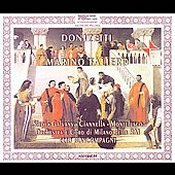
DONIZETTI: Marino Faliero
There was a great northward swing of composers from Italy to Paris and London in the 1820s and 1830s. Actually, this has been going on for a long time, but was temporarily halted by the Napoleonic wars.
The Sixteen continues its exploration of Henry Purcell’s Welcome Songs for Charles II. As with Robert King’s pioneering Purcell series begun over thirty years ago for Hyperion, Harry Christophers is recording two Welcome Songs per disc.
In February this year, Albanian soprano Ermonela Jaho made a highly lauded debut recital at Wigmore Hall - a concert which both celebrated Opera Rara’s 50th anniversary and honoured the career of the Italian soprano Rosina Storchio (1872-1945), the star of verismo who created the title roles in Leoncavallo’s La bohème and Zazà, Mascagni’s Lodoletta and Puccini’s Madama Butterfly.
Collapsology. Or, perhaps we should use the French word ‘Collapsologie’ because this is a transdisciplinary idea pretty much advocated by a series of French theorists - and apparently, mostly French theorists. It in essence focuses on the imminent collapse of modern society and all its layers - a series of escalating crises on a global scale: environmental, economic, geopolitical, governmental; the list is extensive.
Amongst an avalanche of new Mahler recordings appearing at the moment (Das Lied von der Erde seems to be the most favoured, with three) this 1991 Mahler Second from the 2nd Kassel MahlerFest is one of the more interesting releases.
If there is one myth, it seems believed by some people today, that probably needs shattering it is that post-war recordings or performances of Wagner operas were always of exceptional quality. This 1949 Hamburg Tristan und Isolde is one of those recordings - though quite who is to blame for its many problems takes quite some unearthing.
The voices of six women composers are celebrated by baritone Jeremy Huw Williams and soprano Yunah Lee on this characteristically ambitious and valuable release by Lontano Records Ltd (Lorelt).
As Paul Spicer, conductor of the Royal Birmingham Conservatoire Chamber Choir, observes, the worship of the Blessed Virgin Mary is as ‘old as Christianity itself’, and programmes devoted to settings of texts which venerate the Virgin Mary are commonplace.
Ethel Smyth’s last large-scale work, written in 1930 by the then 72-year-old composer who was increasingly afflicted and depressed by her worsening deafness, was The Prison – a ‘symphony’ for soprano and bass-baritone soloists, chorus and orchestra.
‘Hamilton Harty is Irish to the core, but he is not a musical nationalist.’
‘After silence, that which comes closest to expressing the inexpressible is music.’ Aldous Huxley’s words have inspired VOCES8’s new disc, After Silence, a ‘double album in four chapters’ which marks the ensemble’s 15th anniversary.
A song-cycle is a narrative, a journey, not necessarily literal or linear, but one which carries performer and listener through time and across an emotional terrain. Through complement and contrast, poetry and music crystallise diverse sentiments and somehow cohere variability into an aesthetic unity.
One of the nicest things about being lucky enough to enjoy opera, music and theatre, week in week out, in London’s fringe theatres, music conservatoires, and international concert halls and opera houses, is the opportunity to encounter striking performances by young talented musicians and then watch with pleasure as they fulfil those sparks of promise.
“It’s forbidden, and where’s the art in that?”
Dublin-born John F. Larchet (1884-1967) might well be described as the father of post-Independence Irish music, given the immense influenced that he had upon Irish musical life during the first half of the 20th century - as a composer, musician, administrator and teacher.
The English Civil War is raging. The daughter of a Puritan aristocrat has fallen in love with the son of a Royalist supporter of the House of Stuart. Will love triumph over political expediency and religious dogma?
Beethoven Symphony no 9 (the Choral Symphony) in D minor, Op. 125, and the Choral Fantasy in C minor, Op. 80 with soloist Kristian Bezuidenhout, Pablo Heras-Casado conducting the Freiburger Barockorchester, new from Harmonia Mundi.
A Louise Brooks look-a-like, in bobbed black wig and floor-sweeping leather trench-coat, cheeks purple-rouged and eyes shadowed in black, Barbara Hannigan issues taut gestures which elicit fire-cracker punch from the Mahler Chamber Orchestra.
‘Signor Piatti in a fantasia on themes from Beatrice di Tenda had also his triumph. Difficulties, declared to be insuperable, were vanquished by him with consummate skill and precision. He certainly is amazing, his tone magnificent, and his style excellent. His resources appear to be inexhaustible; and altogether for variety, it is the greatest specimen of violoncello playing that has been heard in this country.’
Baritone Roderick Williams seems to have been a pretty constant ‘companion’, on my laptop screen and through my stereo speakers, during the past few ‘lock-down’ months.
Melodramas can be a difficult genre for composers. Before Richard Strauss’s Enoch Arden the concept of the melodrama was its compact size – Weber’s Wolf’s Glen scene in Der Freischütz, Georg Benda’s Ariadne auf Naxos and Medea or even Leonore’s grave scene in Beethoven’s Fidelio.
There was a great northward swing of composers from Italy to Paris and London in the 1820s and 1830s. Actually, this has been going on for a long time, but was temporarily halted by the Napoleonic wars.
Singers had also been making the trek for as long as these cities had standing opera companies. Rossini, of course, was the first to make the trip in the post Napoleonic period, leaving for Paris after his Semiramide in 1823, and composed all his remaining operas for that city. The last, and most important, of these was Guillaume Tell, in 1829. Meyerbeer came next, and scored what was easily one of his greatest triumphs with Robert le Diable in 1831. Auber and Halévy were there already, with Auber having written several successes. Halévy's best year was to come in 1835. With Rossini entrenched in a position of power in the musical life of Paris, he extended invitations to both Bellini and Donizetti to compose new works for the 1834-1835 season.
In the meantime, some of Italy's greatest singers of the period: Giulia Grisi, Giovanni Battista Rubini, Antonio Tamburini and Luigi Lablache (later called the Puritani quartet) had already come North. They were splitting their seasons between Paris (autumn and winter) and London (spring and early summer), often performing as a unit. By the start of 1835, the stage was set for what was to become possibly the greatest single year in the history of opera. It started gloriously on January 25 with the premiere of I puritani, probably one of the greatest triumphs in the history of the Théâtre Italien. Less than a month after that, on Feb. 23, came the premiere of Halévy's La juive. Marino Faliero had to wait until March 12—more on that opera below. Not to be outdone, Auber's Le cheval de Bronze had its' premiere at the Opéra Comique eleven days afterward. By September, Donizetti was back in Naples for Lucia di Lammermoor, and in December, Halévy's second most important work, L'éclair was premiered at the Opéra Comique.
Donizetti, who had started working on Marino Faliero while still in Italy, arrived in Paris in time to attend the prima of I puritani, and put the finishing touches on in that city. The work was based on a drama by Casimir Delavigne, which, in turn had been based on Byron. The premiere came at the end of the Paris season, and, due to various problems, it was only possible to give a few performances. Donizetti was pleased with its success, although it was less tumultuous than of the Bellini work. Both operas were repeated when the singers traveled to London, Marino Faliero being given first, on May 14, actually one week ahead of Puritani, and repeated next season in both cities. It had a long and successful career, being given all over the world, and probably had about twice as many productions in the nineteenth century as Roberto Devereux. Its U.S premiere was in New Orleans in 1842 and it was later given in New York City.
The music of Marino Faliero has many strikingly beautiful moments. The first act has a wonderful, and fiendishly difficult, aria for the tenor, Fernando, followed by one of Donizetti's better love duets, and another duet, this time for the two basses. This duet is sufficiently similar to that in I puritani, that some have wondered if it was actually composed after Donizetti heard his rival's opera. The act ends with one of Donizetti's rousing finales. The second act starts with a stunning barcarole for the Gondolier and chorus (a part of which was reused in Il Campanelllo), and a second solo for Fernando, perhaps even more difficult than the first. The act finale is a big aria for Faliero, with the participation of the rest of the cast, except for Elena. Fernando dies a beautiful death between the slow and fast portions of this number. The highlight of the third act is a prayer for Elena, which, as Ashbrook states, "has moved a long way from the convention of the aria finale. And, if the singer should feel slighted, the actress has a golden moment”.* Before the premiere of his own I puritani, Bellini had been horrified to learn that Donizetti would again be competing with him—and feared another confrontation, as had happened three times before (Genoa, 1828, Milan 1830-31 and 1831-32). Puritani became a repertory work (being given in almost every season in both Paris and London for many years), and was probably the most successful Italian opera ever premiered in France. Marino Faliero never made it into the standard repertory, except in a few isolated cities, but did get performed somewhere or other for many years. In fact, it was one of the more successful of his operas. Its' last known performance in the nineteenth century was in Venice in 1888, after which it disappeared until it was revived in Bergamo in 1966. It has had sporadic revivals since, three of which being by the Opera Camerata of Washington D.C. in March 1998, followed by Parma in January 2002 and OONY that April. It was originally planned to issue the Parma revival commercially, but this has not yet taken place. The Parma cast featured Rockwell Blake as Fernando, Mariella Devia as Elena, Roberto Servile as Israele and Michele Pertusi as Faliero.
It might be interesting to compare the two bel canto operas, one by Bellini and the other by Donizetti, which had their primas in the same season with essentially the same cast: I puritani and Marino Faliero. The big differences are that the Donizetti has a tragic plot while the Bellini has a happy ending and a longer and more showy role for the prima donna, with two arias rather than one. Thus, Elena has little to do in the first two acts—a love duet, and the Act I finale and does not even appear in Act II. Elvira, on the other hand, has two major arias and a brilliant rondo finale.
This opera marks Donizetti's third attempt to do away with the established practice of giving the prima donna the final aria. Usually, of course, this honor went to her. It seems almost traditional, starting with Bellini's Il pirata, to give the penultimate aria to the tenor, and the last word to the soprano. But, there were exceptions—in Torquato Tasso, the baritone virtually had the last act to himself, his lady love having died while he was in prison. And, in Lucia di Lammermoor, Donizetti's next work, he reversed the order—first Lucia's mad scene, then the tenor's big aria.
But Donizetti had tried to eliminate this aria entirely in Lucrezia Borgia, only to have Méric-Lalande insist on her rights. He did eliminate it in Rosmonda d'Inghilterra, but the opera, beautiful as it is, failed. Finally, in Marino Faliero, Donizetti pulled it off. Mercadante also pulled it off in Il giuramento (1837), and although some more works still featured the bravura aria finale, Italian opera was never the same after that.
The performance presented by Bongiovanni is one recorded for Italian radio in 1976. It was previously released on LP. The cast, headed by soprano Marisa Galvany and the wonderful bass Cesare Siepi, together with Giuliano Cianella and Licinio Montefusco ranges from acceptable to great.
With the exception of some botched high notes by the tenor, the singing is generally fine. Marisa Galvany is one of the better sopranos of the 1970s and 1980s, but never had the career she deserved. She sang two seasons with the Metropolitan Opera, but only one performance (a Norma in 1979) was in New York. During her other season she took part in the 1985 spring tour singing one Ortrud and five Gertruds. She is perhaps best known for taking part in the revival of Mayr’s Medea in Corinto in 1970, which was released by Vanguard Records. The tenor, Giuliano Cianella, has a very attractive voice, and sang a varied repertoire during seven seasons with the Met. However, he would have been well advised to have stayed away from roles requiring an incredibly challenging top. It would be unkind to discuss his attempts at the high Ds in the tenor role, which had been created by Rubini. Licinio Montefusco is a serviceable baritone, while Cesare Siepi is one of the better basses of the last century. He was already slightly past his prime by 1976, but still gives but strikes me as the best reading of the score on records.
Those of us who view bel canto operas simply from the standpoint of the soprano and her role may be slightly disappointed, since some of them might consider her part as “too little and too late in the opera”. Actually, though, the fact is that they might be just a little bit spoiled by all the Donizetti operas where the soprano has two big arias to only one (if that)by the tenor. Both have four major numbers, and it just so happens that two of the soprano’s (her aria and final duet) come in the last act where the tenor is already dead. On the other hand, Donizetti fans and especially Donizetti completists like myself will be as delighted with this recording as I am.
In closing, I would like to return to Ashbrook, who states:
Marin Faliero marks a significant step forward for Donizetti. It provides clear evidence of his search to bend the conventions to his own dramatic needs.**
Tom Kaufman
* William Ashbrook, Donizetti and his Operas, Cambridge University Press, Cambridge and New York, 1982, p. 373
** Ibid, idem, p.374