Subscribe to
Opera Today

Receive articles and news via RSS feeds or email subscription.


twitter_logo[1].gif


UCP_9780226043425.gif

Recently in Recordings

Kaufmann Wagner

The economics of the recording companies dictate much that is not ideal. Wagner’s operas were not composed as they were in order to permit the extraction of bleeding chunks, even on those occasions when strophic song forms do occur.

Mahler: Symphony No. 8

Among the recent recordings of Mahler’s Eighth Symphony, Valery Gergiev’s release on the LSO Live label is an excellent addition to the discography of this work.

Songs by Zemlinsky

While not unknown, the songs of Alexander von Zemlinsky (1871-1942) deserve to be heard more frequently.

Gustav Mahler: Lieder eines fahrenden Gesellen, Rückert-Lieder, Kindertotenlieder.

Recorded on 5 and 6 May 2008 and 17 and 18 January 2009 at the Lisztzentrum (Raiding, Austria), this recent Bridge release makes available the piano-vocal versions of three song cycles by Gustav Mahler, Lieder eines fahrenden Gesellen, Rückert-Lieder, and Kindertotenlieder performed by mezzo-soprano Hermine Haselböck, accompanied by Russell Ryan.

Kathleen Ferrier: A Film by Diane Perelsztejn

Contraltos rarely achieve the acclaim and renown of sopranos. Assigned few leading roles in opera, they are condemned to playing the villain or the grandmother, or to stealing the castrati’s trousers in en travesti roles.

1612 Italian Vespers

Following their 2011 Decca recording of Striggio’s Mass in 40 Parts (1566), I Fagiolini continue their quest to unearth lost treasures of the High Renaissance and early Baroque, with this collection of world-premiere recordings, ‘reconstructions’ and ‘reconstitutions’ of music by Giovanni and Andrea Gabrieli, Monteverdi, Palestrina, and their less well-known compatriots Viadana, Barbarino and Soriano.

Eternal Echoes: Songs and Dances for the Soul

Eternal Echoes is an album of khazones [Jewish cantorial music] for cantorial soloist, solo violin and a blended instrumental ensemble comprising a small orchestra and the Klezmer Conservatory Band.

Mahler: Symphony no. 3 / Kindertotenlieder

Michael Tilson Thomas’s recording of Mahler’s Third Symphony is an outstanding contribution to the composer’s discography.

Oliver Knussen’s Symphonies from NMC

Oliver Knussen burst into British music with an unprecedented flourish. In 1967, the London Symphony Orchestra premiered Knussen’s First Symphony, with István Kertész scheduled to conduct.

Ludwig van Beethoven: Fidelio

Based on performances given in Summer 2010 at the Lucerne Festival, this recording of Beethoven’s Fidelio is an admirable recording that captures the vitality of the work as conducted by Claudio Abbado.

Stanisław Moniuszko: Flis

Stanisław Moniuszko (1819-1872) was one of the most popular composers of his day in Poland, and of the many works he wrote for the stage, two are performed from time to time, Halka (1848) and Strazny dwór [The Haunted Manor] (1865).

Stanisław Moniuszko: Pieśni Songs

The Polish alto Jadwiga Rappé is a familiar voice in various stage and concert works, and the recent release of a selection of songs by Stanisław Moniuszko (1819-1872) is an opportunity to hear her performing artsongs.

Joan Sutherland and Richard Bonynge: Serate Musicali

Originally released on multiple discs in 1981 this reissue on two CDs is a comprehensive collection of art songs by Italian and French composers from the nineteenth and early twentieth centuries.

Richard Strauss: Salome

An exciting contribution to the discography of this popular opera, the live performance of Richard Strauss’s Salome from the Festspielhaus at Baden-Baden is a compelling DVD.

Lulu by Gran Teatro del Liceu, Barcelona

Released in late 2011, Deutsche Grammophon’s DVD of the new staging of Berg’s Lulu at the Gran Teatro del Liceu, Barcelona is an excellent contribution to the discography of this fascinating opera.

Lulu by the Metropolitan Opera

A recent release by the Metropolitan Opera, this two-disc set makes available on DVD the famous performance of Berg’s Lulu that was broadcast on 20 December 1980 as part of the PBS series “Live from the Met.”

Elmer Gantry the Opera

The novels of Sinclair Lewis once shot across the American literary skies like comets, alarming and fascinating readers of that era, but their tails didn’t extend far behind them.

Historical Performances from Covent Garden: Barbiere, La traviata and Tosca

Once the province of only the most dedicated opera fanatics, mid-20th century recordings of privately taped live performances have become more widely available.

Lucia and the glass harmonica

Flute players in opera orchestra around the world must look forward to the frequent appearances of Donizetti’s Lucia di Lammermoor, knowing that while the stage spotlight in the mad scene will be on the soprano, the orchestral spotlight will be on their instrument.

Levine conducts at the Metropolitan Opera: 1978 to 2006

Since his debut at the Metropolitan Opera in 1971, conductor James Levine has come to represent the house’s commitment to artistic excellence — reliable, professional, and immaculately presented.

OPERA TODAY ARCHIVES »

Recordings

Errico Petrella: Jone
17 May 2006

PETRELLA: Jone

Jone is the only Italian opera from the 1850s by a composer other than Giuseppe Verdi to make it into the standard repertory for a period of well over 50 years, lasting until the onset of World War I before eventually disappearing.

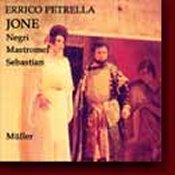
Errico Petrella: Jone

Adelaide Negri sop. (Jone); Stella Silva mez. (Nidia); Bruno Sebastian ten. (Glauco); Gianpiero Mastromei bar. (Arbace); Louis Lebherz bass (Burbo); Coro de la Fundación Teresa Carreño Orquestra Sinfónica Municipal de Caracas; Edoardo Müller, conductor

New Ornamenti 121 [2CDs]

$30.00  Click to buy

The last confirmed performance in Italy took place in Palermo in 1924. After that, nothing anywhere in the world, except for the revival in Caracas in 1981, that was recorded and issued. First on an Italian LP, and now on a CD released in Argentina.

There is a bit of a mystery here. How could a composer have been so successful and popular about 100 years ago, with at least three operas (Jone, La Contessa d’Amalfi and Le precauzioni) in the standard repertory, and be so completely forgotten and neglected today? Unlike the works of Pacini and Mercadante, and several other composers of the period, those of Petrella have not experienced any return to popularity. In fact, the last Petrella opera to be given in Italy was I Promessi Sposi, in Naples, back in 1950, over 55 years ago. I don’t have an answer to that, except perhaps that there may have been a greater interest in reviving the works of composers who influenced Verdi, like Pacini and Mercadante, than those who, like Petrella, were influenced by him. Another factor may well have been that Petrella had earned Verdi’s scorn.

Petrella had been born in Palermo on December 10, 1813, the same year as both Verdi and Wagner. But while he did lack the greatness of the other two, especially Verdi, much of his music, certainly including Jone, makes for pleasant listening. He was a very popular composer in his day, both of comic and tragic operas. None of his early works, premiered between December 1829 and 1839 were particularly successful. It was not until Il carnevale di Venezia (Naples, Teatro Nuovo, May 20, 1851) that he really became noticed. Elena di Tolosa (Naples, Fondo, Aug. 12, 1852) followed. Then, in 1854, he took the Italian operatic world by storm with Marco Visconti (Naples, San Carlo, 1854). L'assedio di Leida (La Scala, 1856) was his fourth straight triumph, while Jone (La Scala, 1858) was a major event and remained in the repertory well into the 20th century. The creators were Augusta Albertini in the title role, the prominent spinto tenor Carlo Negrini, who also was the original Gabriele in Simon Boccanegra as Glauco, and Giovanni Guicciardi, the first De Luna as the wicked Arbace.With two exceptions (La Contessa d'Amalfi and I Promessi Sposi) his operas during the 1860s generally failed.

I was already very familiar with Simon Boccanegra, when I first heard Jone, the two operas having their premieres within less than a year of each other, and found it hard to understand how the Petrella work, which may have had as many as 600 productions, could have been so much more successful than the Verdi, which was produced about 60 times (counting both versions) during the 19th century. To give a better idea of the popularity of Jone, it was given all over Italy and Spain, and as far away as Melbourne, Alexandria, Calcutta, Jakarta, Santiago, Lima, Manila and Tbilisi. But it was never staged in Paris, Berlin or Moscow, and only once each in London (by amateurs) and Vienna (by an Italian company returning from a season in Bucharest). Its one time popularity was almost certainly due to such striking pieces as two fine numbers for the tenor (a drinking song and a romanza), the baritone’s great aria and cabaletta in Act III, and one of the most effective funeral marches in all of opera.

Much as I have enjoyed this performance of Jone in its several incarnations, I am convinced that a better cast than the one provided here could have made a much better case for the opera. Of the three principals, only baritone Gian Piero Mastromei really acquits himself with full honors. He is a fine “Verdi baritone”, and has proved himself time and again in many leading roles all over the world’s stages and on CD. Negri also had a fine career, including several season at the Metropolitan Opera. But, until another Verdi baritone of Mastromei's stature is found, and a tenor of the same caliber utilized for Glauco, this will be the only game in town.

The presentation of the opera is basically of the “bare bones” type. There is no libretto, no liner notes, and only a plot of the opera in Spanish, but without translation, not even into Italian or English. It is apparently intended for the Argentine market, not surprising since it is part of a series of CDs featuring the soprano Adelaide Negri, herself Argentinian.. A look at Adelaide Negri’s web site (www.adelaidanegri.com) tells us that they are dedicated to issuing Ms. Negri’s performances of a vast repertory, much of which originates in Buenos Aires. Others in the series include many Donizetti, Rossini, and Verdi operas. Most have been recorded many times, but other relative rarities include Spontini’s Fernando Cortez, Pacini’s Saffo and Meyerbeer’s L’africana.

If you are looking for a masterpiece sung by an all-star cast, this recording is not for you. On the other hand, if you cannot resist important 19th century works that once had a great appeal to the audiences for whom they were composed, you should get quite a bit of enjoyment from it.

Tom Kaufman
Send to a friend

Send a link to this article to a friend with an optional message.

Friend's Email Address: (required)

Your Email Address: (required)

Message (optional):