Subscribe to
Opera Today

Receive articles and news via RSS feeds or email subscription.


twitter_logo[1].gif


UCP_9780226043425.gif

Recently in Recordings

Ariane et Barbe-Bleue on Blu-Ray

Paul Dukas’ Ariane et Barbe-Bleue, first heard in 1907, once seemed important. Arturo Toscanini conducted the Met premiere in 1911 with Farrar and later arranged some of its music for a 1947 recording with his NBC Symphony.

Kaufmann Wagner

The economics of the recording companies dictate much that is not ideal. Wagner’s operas were not composed as they were in order to permit the extraction of bleeding chunks, even on those occasions when strophic song forms do occur.

Mahler: Symphony No. 8

Among the recent recordings of Mahler’s Eighth Symphony, Valery Gergiev’s release on the LSO Live label is an excellent addition to the discography of this work.

Songs by Zemlinsky

While not unknown, the songs of Alexander von Zemlinsky (1871-1942) deserve to be heard more frequently.

Gustav Mahler: Lieder eines fahrenden Gesellen, Rückert-Lieder, Kindertotenlieder.

Recorded on 5 and 6 May 2008 and 17 and 18 January 2009 at the Lisztzentrum (Raiding, Austria), this recent Bridge release makes available the piano-vocal versions of three song cycles by Gustav Mahler, Lieder eines fahrenden Gesellen, Rückert-Lieder, and Kindertotenlieder performed by mezzo-soprano Hermine Haselböck, accompanied by Russell Ryan.

Kathleen Ferrier: A Film by Diane Perelsztejn

Contraltos rarely achieve the acclaim and renown of sopranos. Assigned few leading roles in opera, they are condemned to playing the villain or the grandmother, or to stealing the castrati’s trousers in en travesti roles.

1612 Italian Vespers

Following their 2011 Decca recording of Striggio’s Mass in 40 Parts (1566), I Fagiolini continue their quest to unearth lost treasures of the High Renaissance and early Baroque, with this collection of world-premiere recordings, ‘reconstructions’ and ‘reconstitutions’ of music by Giovanni and Andrea Gabrieli, Monteverdi, Palestrina, and their less well-known compatriots Viadana, Barbarino and Soriano.

Eternal Echoes: Songs and Dances for the Soul

Eternal Echoes is an album of khazones [Jewish cantorial music] for cantorial soloist, solo violin and a blended instrumental ensemble comprising a small orchestra and the Klezmer Conservatory Band.

Mahler: Symphony no. 3 / Kindertotenlieder

Michael Tilson Thomas’s recording of Mahler’s Third Symphony is an outstanding contribution to the composer’s discography.

Oliver Knussen’s Symphonies from NMC

Oliver Knussen burst into British music with an unprecedented flourish. In 1967, the London Symphony Orchestra premiered Knussen’s First Symphony, with István Kertész scheduled to conduct.

Ludwig van Beethoven: Fidelio

Based on performances given in Summer 2010 at the Lucerne Festival, this recording of Beethoven’s Fidelio is an admirable recording that captures the vitality of the work as conducted by Claudio Abbado.

Stanisław Moniuszko: Flis

Stanisław Moniuszko (1819-1872) was one of the most popular composers of his day in Poland, and of the many works he wrote for the stage, two are performed from time to time, Halka (1848) and Strazny dwór [The Haunted Manor] (1865).

Stanisław Moniuszko: Pieśni Songs

The Polish alto Jadwiga Rappé is a familiar voice in various stage and concert works, and the recent release of a selection of songs by Stanisław Moniuszko (1819-1872) is an opportunity to hear her performing artsongs.

Joan Sutherland and Richard Bonynge: Serate Musicali

Originally released on multiple discs in 1981 this reissue on two CDs is a comprehensive collection of art songs by Italian and French composers from the nineteenth and early twentieth centuries.

Richard Strauss: Salome

An exciting contribution to the discography of this popular opera, the live performance of Richard Strauss’s Salome from the Festspielhaus at Baden-Baden is a compelling DVD.

Lulu by Gran Teatro del Liceu, Barcelona

Released in late 2011, Deutsche Grammophon’s DVD of the new staging of Berg’s Lulu at the Gran Teatro del Liceu, Barcelona is an excellent contribution to the discography of this fascinating opera.

Lulu by the Metropolitan Opera

A recent release by the Metropolitan Opera, this two-disc set makes available on DVD the famous performance of Berg’s Lulu that was broadcast on 20 December 1980 as part of the PBS series “Live from the Met.”

Elmer Gantry the Opera

The novels of Sinclair Lewis once shot across the American literary skies like comets, alarming and fascinating readers of that era, but their tails didn’t extend far behind them.

Historical Performances from Covent Garden: Barbiere, La traviata and Tosca

Once the province of only the most dedicated opera fanatics, mid-20th century recordings of privately taped live performances have become more widely available.

Lucia and the glass harmonica

Flute players in opera orchestra around the world must look forward to the frequent appearances of Donizetti’s Lucia di Lammermoor, knowing that while the stage spotlight in the mad scene will be on the soprano, the orchestral spotlight will be on their instrument.

OPERA TODAY ARCHIVES »

Recordings

Gesualdo da Venosa:  Quarto Libro di Madrigali
05 Jul 2006

GESUALDO DA VENOSA: Quarto Libro di Madrigali
MONTEVERDI: Madrigals Book 4

Two sets of madrigals, each the fourth book published by its composer, give complementary views of the state of madrigal composition in Italy in the years either side of 1600.

Gesualdo da Venosa: Quarto Libro di Madrigali

La Venexiana

Glossa GCD 920934 [CD]

$18.99  Click to buy

Similarly, recent recordings of the two books illustrate the development of early music performance by Italian ensembles at the turn of the twenty-first century. The composers are Carlo Gesualdo and Claudio Monteverdi; the performers, respectively, La Venexiana and Delitiæ Musicæ.

La Venexiana has been producing high-quality recordings for some ten years now, and their contribution to the discography of the madrigal is substantial. The present recording, Gesualdo: Quarto libro di Madrigali (Glossa GCD 920934) is in fact a re-release of a CD made in 2000, with the well-designed gatefold packaging now favoured by Glossa (not that the previous version was in any way substandard in this regard). Gesualdo’s Fourth Book dates from 1596, and embodies the ‘transitional’ style, identified by Glenn Watkins in his study of the composer, between the contrapuntally-based writing of the early years and the ‘highly personal and affective style’ of Books Five and Six. The composer had been in residence at Ferrara for two years at the time of publication of this volume, and had adopted certain traits of Luzzasco Luzzaschi, a major figure in the development of the madrigal but as yet one lacking a modern edition. (Luzzaschi is, however, the subject of a previous CD by La Venexiana.)

The beauty of singing on this disc is quite wondrous: simply the opening phrase of the first track, ‘Luce serene e chiare’, captivates the listener with its perfectly weighted trajectory. If anything, the tenderness that La Venexiana bring to some of Gesualdo’s utterances perhaps lends a certain detachment from the passionate texts. For instance, the second madrigal, Tal’hor sano desio, ends with the words ‘eterno duolo’ (eternal sorrow). The performing style here is careful rather than deeply involved: it is as if the ensemble were observing the poet’s anguish from a distance, commenting sympathetically, rather than embodying the poetic voice.

Ultimately, though, the trade-off between poetic involvement and musical virtuosity is one worth making when the level of vocal skill is as high as this. The extreme harmonic juxtapositions of madrigals such as Ecco, morirò dunque are handled not just with rhetorical aplomb but with control of tuning so adept that these pieces come across as more mellifluous than one had ever supposed. Perhaps, indeed, if he had known that La Venexiana would smoothe the edges of his madrigals so effectively, Gesualdo might have written yet harsher dissonances.
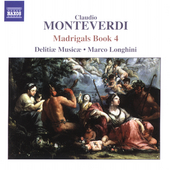
Monteverdi_madrigals4.jpg

A contrasting approach is taken by the Italian ensemble Delitiæ Musicæ,
directed by Marco Longhini. This group appears to be working its way through
the entirety of Monteverdi’s madrigalian output on the Naxos label,
having released the first three books prior to the appearance of this disc
(Claudio Monteverdi Madrigals Book 4: Naxos 8.555310). The group
claims to be ‘dedicated to plausible reconstructions of a cappella
music of the Italian Renaissance’, ‘plausible’ being the
operative word. The ensemble here consists of a flexible combination of six
singers, five of whom are used in any one piece; half of the tracks are
accompanied by theorbo, harpsichord, or both. Among the singers, the two
countertenors and the bass are ever-present, with two tenors and a baritone
sharing the middle parts according to cleffing and range. It is noted on the
back of the jewel case that the use of exclusively adult male voices reflects
recent research into seventeenth-century performance practice. It does,
however, bring some performance problems of its own: individual madrigals can
range as widely as twenty-four notes (three octaves plus a minor third), and
the book as a whole frequently employs the extremities of these ranges. It is
rather difficult to find a suitable pitch even for a mixed choir to cover
such a wide span, and with countertenors on the top lines, the only way to
achieve it is to have a bass who can extend well below the stave with comfort
– happily Walter Testolin on the present recording fulfils this
requirement with apparent ease – and to require the countertenors to
sing higher than they, or the listener, might wish. In the original
performance circumstances, Monteverdi had castrati available to him, and in
their absence today, a more pleasant effect is achieved by the use of female
voices on the higher lines of this music, as is the case with La Venexiana,
than countertenors are able to create. The availability to a mixed ensemble
of a higher performing pitch than employed on the present recording is also
an advantage, as the excessive muddiness of passages such as ‘I vivi
ardori miei’ in the fourth madrigal, ‘Sfogava con le
stelle’, can then be avoided.

As to the performing style of Delitiæ Musicæ: the extent to which the madrigals are subjected to variations in tempo is well beyond anything that could be called tempo rubato, and at times leads the listener to suppose that the piece has actually ended prematurely (an instance being the cadence before the repeated last phrase of ‘Ah, dolente partita’). The rhetoric of the poetry is depicted on a large scale, as if the madrigals were being projected into a stadium rather than through one’s living room speakers. At times the effect achieved by these huge rhetorical devices is extremely powerful: such moments are particularly noticeable in the earlier parts of ‘Sfogava con le stelle’, for example. However, often the degree of manipulation applied to the musical text – in terms of tempo, extreme dynamics and indeed extreme vocal range – overshadows the composer’s contribution: although Delitiæ Musicæ’s ideas are often interesting, I would prefer to view Monteverdi’s madrigals through a less highly-coloured lens.

Stephen Rice
Send to a friend

Send a link to this article to a friend with an optional message.

Friend's Email Address: (required)

Your Email Address: (required)

Message (optional):