05 Jul 2006
PUCCINI: Il Tabarro
LEONCAVALLO: I Pagliacci
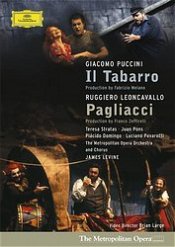
The recent Deutsche Grammaphone release of an insightful Metropolitan Opera double bill from 1994 provides a fascinating comparison of contrasting verismo worlds.
The Sixteen continues its exploration of Henry Purcell’s Welcome Songs for Charles II. As with Robert King’s pioneering Purcell series begun over thirty years ago for Hyperion, Harry Christophers is recording two Welcome Songs per disc.
In February this year, Albanian soprano Ermonela Jaho made a highly lauded debut recital at Wigmore Hall - a concert which both celebrated Opera Rara’s 50th anniversary and honoured the career of the Italian soprano Rosina Storchio (1872-1945), the star of verismo who created the title roles in Leoncavallo’s La bohème and Zazà, Mascagni’s Lodoletta and Puccini’s Madama Butterfly.
Collapsology. Or, perhaps we should use the French word ‘Collapsologie’ because this is a transdisciplinary idea pretty much advocated by a series of French theorists - and apparently, mostly French theorists. It in essence focuses on the imminent collapse of modern society and all its layers - a series of escalating crises on a global scale: environmental, economic, geopolitical, governmental; the list is extensive.
Amongst an avalanche of new Mahler recordings appearing at the moment (Das Lied von der Erde seems to be the most favoured, with three) this 1991 Mahler Second from the 2nd Kassel MahlerFest is one of the more interesting releases.
If there is one myth, it seems believed by some people today, that probably needs shattering it is that post-war recordings or performances of Wagner operas were always of exceptional quality. This 1949 Hamburg Tristan und Isolde is one of those recordings - though quite who is to blame for its many problems takes quite some unearthing.
The voices of six women composers are celebrated by baritone Jeremy Huw Williams and soprano Yunah Lee on this characteristically ambitious and valuable release by Lontano Records Ltd (Lorelt).
As Paul Spicer, conductor of the Royal Birmingham Conservatoire Chamber Choir, observes, the worship of the Blessed Virgin Mary is as ‘old as Christianity itself’, and programmes devoted to settings of texts which venerate the Virgin Mary are commonplace.
Ethel Smyth’s last large-scale work, written in 1930 by the then 72-year-old composer who was increasingly afflicted and depressed by her worsening deafness, was The Prison – a ‘symphony’ for soprano and bass-baritone soloists, chorus and orchestra.
‘Hamilton Harty is Irish to the core, but he is not a musical nationalist.’
‘After silence, that which comes closest to expressing the inexpressible is music.’ Aldous Huxley’s words have inspired VOCES8’s new disc, After Silence, a ‘double album in four chapters’ which marks the ensemble’s 15th anniversary.
A song-cycle is a narrative, a journey, not necessarily literal or linear, but one which carries performer and listener through time and across an emotional terrain. Through complement and contrast, poetry and music crystallise diverse sentiments and somehow cohere variability into an aesthetic unity.
One of the nicest things about being lucky enough to enjoy opera, music and theatre, week in week out, in London’s fringe theatres, music conservatoires, and international concert halls and opera houses, is the opportunity to encounter striking performances by young talented musicians and then watch with pleasure as they fulfil those sparks of promise.
“It’s forbidden, and where’s the art in that?”
Dublin-born John F. Larchet (1884-1967) might well be described as the father of post-Independence Irish music, given the immense influenced that he had upon Irish musical life during the first half of the 20th century - as a composer, musician, administrator and teacher.
The English Civil War is raging. The daughter of a Puritan aristocrat has fallen in love with the son of a Royalist supporter of the House of Stuart. Will love triumph over political expediency and religious dogma?
Beethoven Symphony no 9 (the Choral Symphony) in D minor, Op. 125, and the Choral Fantasy in C minor, Op. 80 with soloist Kristian Bezuidenhout, Pablo Heras-Casado conducting the Freiburger Barockorchester, new from Harmonia Mundi.
A Louise Brooks look-a-like, in bobbed black wig and floor-sweeping leather trench-coat, cheeks purple-rouged and eyes shadowed in black, Barbara Hannigan issues taut gestures which elicit fire-cracker punch from the Mahler Chamber Orchestra.
‘Signor Piatti in a fantasia on themes from Beatrice di Tenda had also his triumph. Difficulties, declared to be insuperable, were vanquished by him with consummate skill and precision. He certainly is amazing, his tone magnificent, and his style excellent. His resources appear to be inexhaustible; and altogether for variety, it is the greatest specimen of violoncello playing that has been heard in this country.’
Baritone Roderick Williams seems to have been a pretty constant ‘companion’, on my laptop screen and through my stereo speakers, during the past few ‘lock-down’ months.
Melodramas can be a difficult genre for composers. Before Richard Strauss’s Enoch Arden the concept of the melodrama was its compact size – Weber’s Wolf’s Glen scene in Der Freischütz, Georg Benda’s Ariadne auf Naxos and Medea or even Leonore’s grave scene in Beethoven’s Fidelio.
The recent Deutsche Grammaphone release of an insightful Metropolitan Opera double bill from 1994 provides a fascinating comparison of contrasting verismo worlds.
The term verismo awakens strong feelings among opera lovers. Some view it as cheap, musically undernourished entertainment. For others it is a great love. Yet for all that, the term “verismo” can be rather hard to pin down. It was originally coined to describe the operatic incarnation of literary realism, and was initially attached to two brief but passionate shockers—Pietro Mascagni’s Cavalleria rusticana in 1890, and Ruggiero Leoncavallo’s I Pagliacci two years later. Both related tales of adultery and murder among the peasants of southern Italy. But before long, both composers turned to wildly different subjects—Leoncavallo started writing operettas, and Mascagni wrote such non-veristic fare as Isabeau, a fairy-tale retelling of the Lady Godiva story, and the Wagnerian-scaled Parisina which took on the decadent, stylized, medieval world of Gabriele d’Annunzio. Eventually the term verismo, depending on the context of its usage, grew to embrace the musical style which clothed all these dramas, realistic or not.
And then, to complicate matters, there is Puccini. He’d been Mascagni’s roommate during their conservatory days, but none of his early subjects fit very neatly into the verismo-as-realism category. This has led many to exclude him from being part of the “verismo movement”—especially those who look down their noses at verismo. After all, without the wildly popular Puccini, verismo appears to be a bit of a dud, as movements go—at most producing three or four candidates for the central repertory. But with Puccini, verismo suddenly looks a lot like one of the most successful movements in operatic history, and the number of verismo warhorses suddenly triples. And Puccini did, after all, write an opera that fits the verismo category like a glove: his 1918 drama Il Tabarro, which premiered at the Metropolitan Opera as part of a triple-bill of Puccini shorts.
In 1994, the same Metropolitan Opera put two contrasting pieces of the verismo puzzle side by side—the belated verismo of Puccini’s Il Tabarro and the classic verismo of Leoncavallo’s I Pagliacci, which had reached the stage some twenty-six years earlier. The comparison is enlightening. The stories are very similar. The music is clearly fruit from the same tree. And yet the many intervening years have also clearly left their mark. Leoncavallo’s warhorse is passionately and unashamedly Italian, painted in primary colors. There is no guilt in his hummable, clearly delineated melodies.
By contrast, Il Tabarro was written by a composer who’d studied the shadowy world of Debussy, and the frenzied brilliance of Richard Strauss. He knew Stravinsky’s Rite of Spring, and Schoenberg’s atonal Pierrot Lunaire. Puccini was a great melodist, yet here he is sly in their use—maybe too sly here for some tastes. Leoncavallo’s primary colors have been replaced by a thousand subtle shades. Yet everywhere in the score Puccini’s mature musical genius and his judgment as a dramatist are well in evidence. The end result is an opera of rare sophistication and dramatic truth, if at times it is a little less memorable in its melodic material than is Pagliacci. Leoncavallo’s opera would be a good selection for a newcomer to opera. Puccini’s is more a connoisseur’s choice.
In this particular production, the Met cast the major roles from strength, featuring the era’s two most renowned tenors in the leading roles. In Il Tabarro, Placido Domingo sings the role of the interloper Luigi with his characteristic golden tone and impassioned acting. The role of the older, jilted husband was sung with impressive power and gravitas by Juan Pons. If there are reservations to be felt about the cast, they might be directed towards the Giorgetta of Teresa Stratas—a great singing actress who knows how to thrill. My complaint is not directed towards any lack of ability or dedication on her part. Rather she perhaps presses a little too hard—turning a believable and human character into a bit of a caricature. Her Giorgetta is a Parisian variety of “white trash”—loud, loose, and lacking in feminine grace or refinement, with chemically damaged red hair to match. Stratas regularly reaches for something guttural in her lower register which reinforces this rather brassy impression and makes her singing at times unlovely. Also, some things which would go unnoticed on the stage spring to mind when viewed with the intimacy of video. Pons, playing the older Michele, is clearly much younger than are Domingo and Stratas, our “young” lovers! A vibrant cameo performance is turned in by Florence Quivar as La Frugola.
Stratas and Pons reappear in I Pagliacci, with Stratas’s Nedda largely being a reprise of her Giorgetta. Pons again does an admirable job, though this time in the far less sympathetic role of Tonio. Luciano Pavarotti, however considerable his vocal assets, is often a bit of a dramatic dud—especially in comparison to the passionate Domingo. And though Pav was no spring chicken in 1994 either, somehow he came across very strongly on this night. Sure, he does sometimes revert to his old “stand and sing” acting style, but there is a dignity in his bearing that makes his Canio all the more human, and when he smears the greasepaint on his face before launching into “Vesti la giubba”, he generates pathos in spades. Dwayne Croft is a convincing Silvio.
It’s a shame the James Levine ventures into the verismo repertory so rarely, as his reading here, at the helm of the now legendary Met orchestra, is revelatory. The productions are of the most traditional variety, with lots of period detail—especially Franco Zeffirelli’s Pagliacci. Other fine accounts of the latter exist on video, but if you’re looking for a compelling pair of verismo shorts in riveting, top notch performances, you could do worse than this DVD.
Eric D. Anderson