28 Aug 2006
HANDEL: Giulio Cesare in Egitto
Sometimes an invidious comparison cannot be avoided, and such is the case with two recent DVD versions of Georg Frederic Handel's masterpiece, Giulio Cesare.
The Sixteen continues its exploration of Henry Purcell’s Welcome Songs for Charles II. As with Robert King’s pioneering Purcell series begun over thirty years ago for Hyperion, Harry Christophers is recording two Welcome Songs per disc.
In February this year, Albanian soprano Ermonela Jaho made a highly lauded debut recital at Wigmore Hall - a concert which both celebrated Opera Rara’s 50th anniversary and honoured the career of the Italian soprano Rosina Storchio (1872-1945), the star of verismo who created the title roles in Leoncavallo’s La bohème and Zazà, Mascagni’s Lodoletta and Puccini’s Madama Butterfly.
Collapsology. Or, perhaps we should use the French word ‘Collapsologie’ because this is a transdisciplinary idea pretty much advocated by a series of French theorists - and apparently, mostly French theorists. It in essence focuses on the imminent collapse of modern society and all its layers - a series of escalating crises on a global scale: environmental, economic, geopolitical, governmental; the list is extensive.
Amongst an avalanche of new Mahler recordings appearing at the moment (Das Lied von der Erde seems to be the most favoured, with three) this 1991 Mahler Second from the 2nd Kassel MahlerFest is one of the more interesting releases.
If there is one myth, it seems believed by some people today, that probably needs shattering it is that post-war recordings or performances of Wagner operas were always of exceptional quality. This 1949 Hamburg Tristan und Isolde is one of those recordings - though quite who is to blame for its many problems takes quite some unearthing.
The voices of six women composers are celebrated by baritone Jeremy Huw Williams and soprano Yunah Lee on this characteristically ambitious and valuable release by Lontano Records Ltd (Lorelt).
As Paul Spicer, conductor of the Royal Birmingham Conservatoire Chamber Choir, observes, the worship of the Blessed Virgin Mary is as ‘old as Christianity itself’, and programmes devoted to settings of texts which venerate the Virgin Mary are commonplace.
Ethel Smyth’s last large-scale work, written in 1930 by the then 72-year-old composer who was increasingly afflicted and depressed by her worsening deafness, was The Prison – a ‘symphony’ for soprano and bass-baritone soloists, chorus and orchestra.
‘Hamilton Harty is Irish to the core, but he is not a musical nationalist.’
‘After silence, that which comes closest to expressing the inexpressible is music.’ Aldous Huxley’s words have inspired VOCES8’s new disc, After Silence, a ‘double album in four chapters’ which marks the ensemble’s 15th anniversary.
A song-cycle is a narrative, a journey, not necessarily literal or linear, but one which carries performer and listener through time and across an emotional terrain. Through complement and contrast, poetry and music crystallise diverse sentiments and somehow cohere variability into an aesthetic unity.
One of the nicest things about being lucky enough to enjoy opera, music and theatre, week in week out, in London’s fringe theatres, music conservatoires, and international concert halls and opera houses, is the opportunity to encounter striking performances by young talented musicians and then watch with pleasure as they fulfil those sparks of promise.
“It’s forbidden, and where’s the art in that?”
Dublin-born John F. Larchet (1884-1967) might well be described as the father of post-Independence Irish music, given the immense influenced that he had upon Irish musical life during the first half of the 20th century - as a composer, musician, administrator and teacher.
The English Civil War is raging. The daughter of a Puritan aristocrat has fallen in love with the son of a Royalist supporter of the House of Stuart. Will love triumph over political expediency and religious dogma?
Beethoven Symphony no 9 (the Choral Symphony) in D minor, Op. 125, and the Choral Fantasy in C minor, Op. 80 with soloist Kristian Bezuidenhout, Pablo Heras-Casado conducting the Freiburger Barockorchester, new from Harmonia Mundi.
A Louise Brooks look-a-like, in bobbed black wig and floor-sweeping leather trench-coat, cheeks purple-rouged and eyes shadowed in black, Barbara Hannigan issues taut gestures which elicit fire-cracker punch from the Mahler Chamber Orchestra.
‘Signor Piatti in a fantasia on themes from Beatrice di Tenda had also his triumph. Difficulties, declared to be insuperable, were vanquished by him with consummate skill and precision. He certainly is amazing, his tone magnificent, and his style excellent. His resources appear to be inexhaustible; and altogether for variety, it is the greatest specimen of violoncello playing that has been heard in this country.’
Baritone Roderick Williams seems to have been a pretty constant ‘companion’, on my laptop screen and through my stereo speakers, during the past few ‘lock-down’ months.
Melodramas can be a difficult genre for composers. Before Richard Strauss’s Enoch Arden the concept of the melodrama was its compact size – Weber’s Wolf’s Glen scene in Der Freischütz, Georg Benda’s Ariadne auf Naxos and Medea or even Leonore’s grave scene in Beethoven’s Fidelio.
Sometimes an invidious comparison cannot be avoided, and such is the case with two recent DVD versions of Georg Frederic Handel's masterpiece, Giulio Cesare.
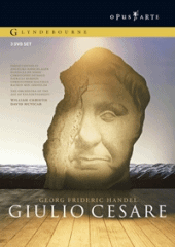
TDK offers a July 2004 performance at the Liceu in Barcelona. Directed by Herbert Wernicke, this staging deserves acknowledgment for its intriguing design and committed performers. When viewed, however, alongside the OpusArte release of the 2005 Glyndebourne production directed by David McVicar, the Liceu production pales. Sure to be a classic of opera on DVD, the Glyndebourne set is a treasure trove: generously proportioned, with two bonus features and one act per disc, an incomparable cast and orchestral performance, and a production design of delightful invention and dramatic strength.
Giulio Cesare requires a most sophisticated approach, as it veers from over-the-top comic villainy (Tolomeo and his henchmen), past heartfelt pathos (Pompey's widow and son, Cornelia and Sesto), and through heroism and seductiveness (Giulio Cesare and Cleopatra). The miracle of McVicar's direction for Glyndebourne resides in his complete mastery of these shifting tones. The performers play to the audience, but never wink at it. Each character has an individual profile, yet each interacts with the others as a true ensemble.
As McVicar maintains in the bonus feature centered on him ("Entertainment is not a dirty word"), the director feels at home with the da capo structures. Some other directors throw up their hands and let the stage picture grow stagnant during the longer arias. Others go in the other direction and throw on too much distracting business. McVicar employs character-based movement and brilliant choreography (by movement director Andrew Gorge) with an effectiveness that makes the arias essential and vivid pictures of emotional states suspended in time.
Robert Jones spartan set design features classic baroque elements, such as horizontal, rotating blue poles for an ocean effect, with a few handsome props. Brigitte Reifenstuel's costumes manage the neat trick of revealing the essence of each character while placing the character's in McVicar's chosen time setting of colonial, mid-19th century British rule. The taste of "Bollywood" McVicar injects in some numbers makes for an appealing spice.
But description can never serve to convey the sheer fun of this production. It has to be seen and heard. And what a cast McVicar assembled. Sarah Connolly redefines masculinity in her strutting and then besotted Cesare. Patricia Bardon and Angelika Kirchshlager make Cornelia and Sesto, respectively, into truly involving roles, instead of the tiresome victims they can often be. Christopher Maltman tears into the twisted psychology of Achilla, in love with Cornelia and realizing too late the depth of Tolomeo's duplicity. Rising counter-tenor Christophe Dumaux for once gives a Tolomeo without undue emphasis on his effiminancy, so that he can effect a truly worthy antagonism. Some may feel that Rachid ben Abdeslam prances a bit too much as Nireno, but his solos have an adorable quality that make them stand out much more than they usually do.
Opus Arte apparently considers Danielle de Niese, the Cleopatra, to be the star of the show, as she gets a 20 minute bonus feature, a sort-of "day in the life" vignette highlighted for your reviewer by a sequence in which she cheerfully babbles on about how much fun she is having with the show, while speeding down a country lane, her bracelet-laden hands casually draped over the wheel. And OpusArte is correct, for as consistently great as this Giulio Cesare is, it seems to get a rocket boost of energy when de Niese comes on. Her voice, though entirely satisfactory, has no special qualities. But her charisma and physical allure - not to mention her dancing ability - establish her as a performer to watch for.
The performers were given body microphones for the filming (as seen in the De Niese feature). The resulting audio picture offers little or no sense of perspective. The voices are well out in front of the excellent Orchestra of the Age of Enlightenment, led with both precision and passion by William Christie. Some may wish for a more realistic stage sound.
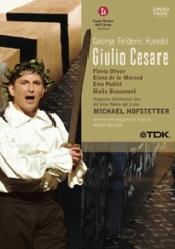 That sort of sound can be found in the Liceu production. Unfortunately, neither the orchestra nor the cast in Barcelona compares well with Glyndebourne's. Michael Hofstetter seems to lead a smaller ensemble; at least the sound is scrawnier and less flexible. Countertenor Flavio Oliver often cannot be heard well enough to establish Cesare's authority, although he has some handsome runs. Elena de la Merced's Cleopatra, unalluringly dressed in heavy brocades, has a pleasant voice but little of the allure that the role demands. The effete Tolomeo, Jordi Domenech, sings with that nasal whine of some countertenors, which underline the unpleasantness of his character, perhaps too well. Maito Beaumont does well as Sesto, and if one can overlook a most unfortunate striptease by the pale and plump Oliver Zwarg, he sings an effective Achilla.
For many, the star of the show will be Ewa Podles as Cornelia. In heavy black "widow's weeds" and a fiercely shellacked head of hair, Podles here stays mostly in the middle range of her voice, with little opportunity to display her pyrotechnics. Bolder casting, with Podles and Oliver switching roles, would have made for a more interesting, posibly even credible, production.
Wernicke has the action take place on a shiny black slab, with a reflective surface dangling above. He makes good use of this for many interesting stage pictures, in particular in act two when a maze of walls appears on stage and characters can be seen reflected above as they enter, exit, and dart around.
Elsewhere, the production offers ideas that don't coalesce into a meaningful interpretation. A "puppet" crocodile clambers around throughout the opera, sometimes menacing and sometimes as sweet as a puppy. The booklet essay proposes an explanation. Perhaps Opera Today readers will understand it better than yuour reviwer did. Especially unfortunate was the decision to have Cornelia and Sesto retain Pompey's head in every scene. This only serves to distance the viewer from the emotions that Handel wishes to express.
Wernicke decided to honor a practice of Handel's time by inserting a small number of arias from other works of the composer, including two for the relatively minor character of Curio and an additional aria each for Cesare and Tolomeo in the last act. Handelians can take up sides on the effectiveness of these additions and substitutions. For all others who merely want to enjoy the best possible version of Giulio Cesare, the OpusArte Glyndebourne set will be first choice.
Chris Mullins
Related Link:
HANDEL: Giulio Cesare in Egitto