Subscribe to
Opera Today

Receive articles and news via RSS feeds or email subscription.


twitter_logo[1].gif


9780521746472.png

Recently in Recordings

Adding Movie Magic to The Magic Flute

What better way for Masonic brothers, Wolfgang Amadeus Mozart and Emmanuel Shikaneder to disseminate Masonic virtues, than through the most popular musical entertainment of their age, a happy ending folktale that features a dragon, enchanting flutes and bells, mixed-up parentage, and a beautiful young princess in distress?

L’Incoronazione di Poppea from Virgin Classics

Since its first performance at the Teatro Santi Giovanni e Paolo during Venice’s 1643 Carnevale, Monteverdi’s L’Incoronazione di Poppea has been one of the most important milestones in the genesis of modern opera despite its 250 years of unmerited obscurity. 

Saverio Mercadante: I due Figaro

Though 2013 is the bicentennial of the births of Giuseppe Verdi and Richard Wagner, the releases of Cecilia Bartoli’s recording of Bellini’s Norma on DECCA, a new studio recording of Donizetti’s Caterina Cornaro from Opera Rara, and this première recording of Saverio Mercadante’s forgotten I due Figaro, suggest that this is the start of a summer of bel canto.

Christian Thielemann’s Der Ring des Nibelungen

Recording Richard Wagner’s Der Ring des Nibelungen is for a record label equivalent to a climber reaching the summit of Mount Everest: it is the zenith from which a label surveys its position among its rivals and appreciates an achievement that can define its reputation for a generation. 

Cecilia Bartoli as Norma

Few people who love opera in general and bel canto in particular have never heard the comment made by Lilli Lehmann, veteran of the inaugural Ring at Bayreuth in 1876, that singing all three of Wagner’s Brünnhildes—in Die Walküre, Siegfried, and Götterdämmerung, respectively, all of which she sang to great acclaim—pales in comparison with singing the title rôle in Bellini’s Norma

Ariane et Barbe-Bleue on Blu-Ray

Paul Dukas’ Ariane et Barbe-Bleue, first heard in 1907, once seemed important. Arturo Toscanini conducted the Met premiere in 1911 with Farrar and later arranged some of its music for a 1947 recording with his NBC Symphony.

Kaufmann Wagner

The economics of the recording companies dictate much that is not ideal. Wagner’s operas were not composed as they were in order to permit the extraction of bleeding chunks, even on those occasions when strophic song forms do occur.

Mahler: Symphony No. 8

Among the recent recordings of Mahler’s Eighth Symphony, Valery Gergiev’s release on the LSO Live label is an excellent addition to the discography of this work.

Songs by Zemlinsky

While not unknown, the songs of Alexander von Zemlinsky (1871-1942) deserve to be heard more frequently.

Gustav Mahler: Lieder eines fahrenden Gesellen, Rückert-Lieder, Kindertotenlieder.

Recorded on 5 and 6 May 2008 and 17 and 18 January 2009 at the Lisztzentrum (Raiding, Austria), this recent Bridge release makes available the piano-vocal versions of three song cycles by Gustav Mahler, Lieder eines fahrenden Gesellen, Rückert-Lieder, and Kindertotenlieder performed by mezzo-soprano Hermine Haselböck, accompanied by Russell Ryan.

Kathleen Ferrier: A Film by Diane Perelsztejn

Contraltos rarely achieve the acclaim and renown of sopranos. Assigned few leading roles in opera, they are condemned to playing the villain or the grandmother, or to stealing the castrati’s trousers in en travesti roles.

1612 Italian Vespers

Following their 2011 Decca recording of Striggio’s Mass in 40 Parts (1566), I Fagiolini continue their quest to unearth lost treasures of the High Renaissance and early Baroque, with this collection of world-premiere recordings, ‘reconstructions’ and ‘reconstitutions’ of music by Giovanni and Andrea Gabrieli, Monteverdi, Palestrina, and their less well-known compatriots Viadana, Barbarino and Soriano.

Eternal Echoes: Songs and Dances for the Soul

Eternal Echoes is an album of khazones [Jewish cantorial music] for cantorial soloist, solo violin and a blended instrumental ensemble comprising a small orchestra and the Klezmer Conservatory Band.

Mahler: Symphony no. 3 / Kindertotenlieder

Michael Tilson Thomas’s recording of Mahler’s Third Symphony is an outstanding contribution to the composer’s discography.

Oliver Knussen’s Symphonies from NMC

Oliver Knussen burst into British music with an unprecedented flourish. In 1967, the London Symphony Orchestra premiered Knussen’s First Symphony, with István Kertész scheduled to conduct.

Ludwig van Beethoven: Fidelio

Based on performances given in Summer 2010 at the Lucerne Festival, this recording of Beethoven’s Fidelio is an admirable recording that captures the vitality of the work as conducted by Claudio Abbado.

Stanisław Moniuszko: Flis

Stanisław Moniuszko (1819-1872) was one of the most popular composers of his day in Poland, and of the many works he wrote for the stage, two are performed from time to time, Halka (1848) and Strazny dwór [The Haunted Manor] (1865).

Stanisław Moniuszko: Pieśni Songs

The Polish alto Jadwiga Rappé is a familiar voice in various stage and concert works, and the recent release of a selection of songs by Stanisław Moniuszko (1819-1872) is an opportunity to hear her performing artsongs.

Joan Sutherland and Richard Bonynge: Serate Musicali

Originally released on multiple discs in 1981 this reissue on two CDs is a comprehensive collection of art songs by Italian and French composers from the nineteenth and early twentieth centuries.

Richard Strauss: Salome

An exciting contribution to the discography of this popular opera, the live performance of Richard Strauss’s Salome from the Festspielhaus at Baden-Baden is a compelling DVD.

OPERA TODAY ARCHIVES »

Recordings

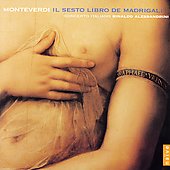
Claudio Monteverdi. “Il Sesto Libro de Madrigali”
22 Sep 2006

MONTEVERDI: Il Sesto Libro de Madrigali

It is somewhat ironic that until recent years Italy has generally been slow to take a leading role in the historical performance movement: ironic in that historically Italy both dominates and defines the early baroque style and ironic in that that style enshrines the primacy of text— the Italian text.

Claudio Monteverdi. “Il Sesto Libro de Madrigali”

Concerto Italiano. Rinaldo Alessandrini, Director

Naïve OP 30423 [CD]

$15.99  Click to buy

One might have suspected that on grounds of national pride, to say nothing of the advantage of native fluency with the language, Italians would have been in the forefront of the “early music revival,” where early baroque repertory has been foundational. Yet, for whatever reason—the strength of the modern opera tradition, perhaps—Italy’s robust participation in the world of historical performance has developed later than others. However, the brilliant work of Concerto Italiano, under the direction of Rinaldo Alessandrini, amply and welcomingly shows how robust! With a large discography that includes eleven recordings of the works of Monteverdi already, this present recording of pieces from the Sixth Book of Madrigals is, like its predecessors, one that overwhelms with the naturalness of the performing idiom and the sensitivity of the performers.

Monteverdi’s Sixth Book of Madrigals was published in 1614, shortly after his appointment as maestro di capella at the Basilica of St. Mark’s in Venice, but the madrigals are in the main (if not totally) from Mantua, and poignantly so. Several events lend a tragic hue to Monteverdi’s later years at the Gonzaga court. In September, 1607 he suffered the loss of his wife, the singer Claudia Cattaneo, and in the next year he faced the death of the young singer Caterina Martinelli. In 1603 Martinelli had come to Mantua as a young teen, and had lived in Monteverdi’s house for several years, perhaps studying with Claudia. She died suddenly of small pox in 1608 amid preparations for the opera, Arianna, in which she was to have sung the title role.

Almost inescapably then, we tend to interpret the lamentative bent of Book Six autobiographically. Much of the volume is devoted to two large-scale works, an ensemble arrangement of the famous Lamento d’Arianna, and a Sestina (“Lagrime d”Amante al Sepolcro dell’Amata”). The first is an arrangement of the only music that survives from “Martinelli’s” opera, and the latter is a memorial work for her, requested by the Duke. In the wake of Monteverdi’s deep personal losses, these works (and others in the volume) compel us to find in them echoes of the composer’s grief.

The ensemble version of Arianna’s lament is an interesting trope of the surviving monodic version. In both forms, Arianna’s abandonment by Theseus becomes the trigger for affective music of the highest order, be it born of her despair, anger, love, or inner ambivalence. In the ensemble arrangement, however, because of the independence of the individual lines, Monteverdi’s dissonances have stronger substance than that of a single voice against the basso continuo, and this gives striking weight to a work already heavy laden. In the monodic version, however, we not only hear the vocal line as the character “Arianna,”—and thus hear things dramatically—but the solo line can claim a performance flexibility that well serves the emotional contours of the text. Concerto Italiano’s ensemble remarkably manages to sing the lament as a group with all the power, expression, and flexibility of a soloist. In fact, in hearing the ensemble, one has no doubt but that each of the singers would render the solo version with great command, and they clearly bring this understanding to a cohesive ensemble performance, wonderfully exemplified in the explosively angry sections of the fourth stanza.

Lamento d’Arianna, of course, echoes the opera. Some of the madrigals here well show the potential closeness of the madrigal and the stage, as well. “Misero Alceo,” “Batto, qui pianse Ergasto,” and :Presso un fiume tranquillo” all present scenes where the ensemble offers a narrative frame while solo or duo textures render dialogue, sometimes at great length. The degree to which the madrigal is becoming soloistic shows its continuing response to an increasingly operatic world, as does the adoption of dramatic structures. And tellingly, this development may seem to bring Monteverdi’s output into a closer unity.

It is an output that Concerto Italiano performs with stunning fluency and dramatic flair. Their sound is forward, flexible and lithe, their skill unflaggingly impressive, and their results most sensitive, dynamic and memorable.

Steven Plank
Oberlin College
Send to a friend

Send a link to this article to a friend with an optional message.

Friend's Email Address: (required)

Your Email Address: (required)

Message (optional):