Recently in Recordings
The Sixteen continues its exploration of Henry Purcell’s Welcome Songs for Charles II. As with Robert King’s pioneering Purcell series begun over thirty years ago for Hyperion, Harry Christophers is recording two Welcome Songs per disc.
In February this year, Albanian soprano Ermonela Jaho made a highly lauded debut recital at Wigmore Hall - a concert which both celebrated Opera Rara’s 50th anniversary and honoured the career of the Italian soprano Rosina Storchio (1872-1945), the star of verismo who created the title roles in Leoncavallo’s La bohème and Zazà, Mascagni’s Lodoletta and Puccini’s Madama Butterfly.
Collapsology. Or, perhaps we should use the French word ‘Collapsologie’ because this is a transdisciplinary idea pretty much advocated by a series of French theorists - and apparently, mostly French theorists. It in essence focuses on the imminent collapse of modern society and all its layers - a series of escalating crises on a global scale: environmental, economic, geopolitical, governmental; the list is extensive.
Amongst an avalanche of new Mahler recordings appearing at the moment (Das Lied von der Erde seems to be the most favoured, with three) this 1991 Mahler Second from the 2nd Kassel MahlerFest is one of the more interesting releases.
If there is one myth, it seems believed by some people today, that probably needs shattering it is that post-war recordings or performances of Wagner operas were always of exceptional quality. This 1949 Hamburg Tristan und Isolde is one of those recordings - though quite who is to blame for its many problems takes quite some unearthing.
The voices of six women composers are celebrated by baritone Jeremy Huw Williams and soprano Yunah Lee on this characteristically ambitious and valuable release by Lontano Records Ltd (Lorelt).
As Paul Spicer, conductor of the Royal Birmingham Conservatoire Chamber Choir, observes, the worship of the Blessed Virgin Mary is as ‘old as Christianity itself’, and programmes devoted to settings of texts which venerate the Virgin Mary are commonplace.
Ethel Smyth’s last large-scale work, written in 1930 by the then 72-year-old composer who was increasingly afflicted and depressed by her worsening deafness, was The Prison – a ‘symphony’ for soprano and bass-baritone soloists, chorus and orchestra.
‘Hamilton Harty is Irish to the core, but he is not a musical nationalist.’
‘After silence, that which comes closest to expressing the inexpressible is music.’ Aldous Huxley’s words have inspired VOCES8’s new disc, After Silence, a ‘double album in four chapters’ which marks the ensemble’s 15th anniversary.
A song-cycle is a narrative, a journey, not necessarily literal or linear, but one which carries performer and listener through time and across an emotional terrain. Through complement and contrast, poetry and music crystallise diverse sentiments and somehow cohere variability into an aesthetic unity.
One of the nicest things about being lucky enough to enjoy opera, music and theatre, week in week out, in London’s fringe theatres, music conservatoires, and international concert halls and opera houses, is the opportunity to encounter striking performances by young talented musicians and then watch with pleasure as they fulfil those sparks of promise.
“It’s forbidden, and where’s the art in that?”
Dublin-born John F. Larchet (1884-1967) might well be described as the father of post-Independence Irish music, given the immense influenced that he had upon Irish musical life during the first half of the 20th century - as a composer, musician, administrator and teacher.
The English Civil War is raging. The daughter of a Puritan aristocrat has fallen in love with the son of a Royalist supporter of the House of Stuart. Will love triumph over political expediency and religious dogma?
Beethoven Symphony no 9 (the Choral Symphony) in D minor, Op. 125, and the Choral Fantasy in C minor, Op. 80 with soloist Kristian Bezuidenhout, Pablo Heras-Casado conducting the Freiburger Barockorchester, new from Harmonia Mundi.
A Louise Brooks look-a-like, in bobbed black wig and floor-sweeping leather trench-coat, cheeks purple-rouged and eyes shadowed in black, Barbara Hannigan issues taut gestures which elicit fire-cracker punch from the Mahler Chamber Orchestra.
‘Signor Piatti in a fantasia on themes from Beatrice di Tenda had also his triumph. Difficulties, declared to be insuperable, were vanquished by him with consummate skill and precision. He certainly is amazing, his tone magnificent, and his style excellent. His resources appear to be inexhaustible; and altogether for variety, it is the greatest specimen of violoncello playing that has been heard in this country.’
Baritone Roderick Williams seems to have been a pretty constant ‘companion’, on my laptop screen and through my stereo speakers, during the past few ‘lock-down’ months.
Melodramas can be a difficult genre for composers. Before Richard Strauss’s Enoch Arden the concept of the melodrama was its compact size – Weber’s Wolf’s Glen scene in Der Freischütz, Georg Benda’s Ariadne auf Naxos and Medea or even Leonore’s grave scene in Beethoven’s Fidelio.
Recordings
29 Sep 2006
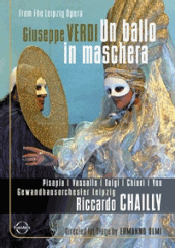
VERDI: Un ballo in maschera
Of late opera stagings often seem to be slotted into one of two categories: the "traditional," with sets as the original libretto detailed and singers in period costumes; and "non-traditional," "regie theater," or "Eurotrash," what you will.
The latter ranges from stark, modernistic exercises to over-the-top re-interpretations (such as the recent Berlin "Rigoletto" set on the "Planet of the Apes"). And between these two polar extremes lies a vast wasteland of unexplored territory, melding, one hopes, the best of both a production true to the essence of the opera's story and yet imaginative, evocative, and truly contemporary.
On this global picture of opera stagings, where does this Euroarts DVD of a Leipzig Un ballo in maschera fall? Nowhere. It is not on the same planet. Director Ermanno Olmi and designer Arnaldo Pomodoro appear to operate in their own dimension. "Cloud cuckoo land" would be your reviewer's guess.
The problem lies in the sheer baffling oddness of the production, which doesn't appear to be symbolic or referential. The singers perform as if they are in a traditional production. But where they are, dressed as they are, remains bewildering. After some fairly traditional peasants appear to sing the king's praises, military men appear in oddly cut tunic-jackets, carrying spears. Riccardo wears an upscale, monk-like gunny-sack brown affair, and the unfortunate Renato must perform in a laughable silver-lamè outfit. Court ladies stroll on in gowns with bizarre ruffled sleeves and hoop skirts. The men sport a sort of stiff beret, and the women have fan-like headdresses. The cast tends to move into position and stand stiffly before a painted backdrop of odd metallic slashes and cross-hatches. This is not the Boston of the revised libretto or the Swedish court of the original setting. In fact, it appears to be a cross between The Wizard of Oz and a Star Trek episode.
As odd as the opening act strikes the viewer, the Ulrica episode takes the production down several levels. Her psychic sessions are held in a run-down basement that has spike-like columns piercing through at odd angles. Costumed as an inter-stellar porcupine, Anna Maria Chiuri, a strong Ulrica, is allowed almost no physical movement above the waist, but give her credit - she makes use of some very expressive eyebrows.
For act three, a reasonable facsimile of a room gets wheeled onstage, and when Ricardo appears to sing his aria, he sings from behind a desk in a space beside a wall, on the other side of which Amelia sits despondently. The director and designers deserve credit for that effective idea, but then the ball begins, and the descent into weirdness resumes. With the cast so obviously in "maschera" to begin with, the production team goes for oddly shaped gold-flaked masks of various shapes, including a donut-shaped one for tenor Massimiliano Pisapia (emphasis on the "mass"). After Renato stabs the King (your reviewer expected a ray gun blast), four game dancers lift the hefty singer up and carry him around the ramp of a circular platform, at the top of which Amelia joins him for the final lines. This is not recommended emergency procedure for stabbing victims.
Non-sensical and laughable, the whole affair seems to be a display piece for the set and costuming inspirations of the creators, with no explicable rationale your reviewer could discern.
In the meanwhile, a cast of unfamiliar names gives decent performances. Pisapia has a lot of voice, although the top lacks the security and sheen that would help ameliorate the dulling effect of his unimpressive physique and deportment. Chiara Taigi, a striking woman with a passing resemblance to the slimmed-down Deborah Voigt, tends to get shrieky at the top. Judging her acting in this production would not be fair. Franco Vassallo gets the heartiest response at curtain; he has more even production from bottom to top than the two leads, though the basic instrument is not especially attractive.
The two best singers appear in smaller roles. Eun Yee You makes a charming Oscar, and has some fun with her cheesy ensemble at the end, as she totters around on outsized platform shoes. And the Samuel of Tuomas Pursio impresses with a rich, handsome bass.
The best contribution of the evening comes from conductor Riccardo Chailly and his Leipzig Gewandhausorchester. Verdi could ask no more in terms of energy, impetus, and drama. If only the production didn't work so hard to distract from the musical performance.
Chris Mullins