08 Oct 2006
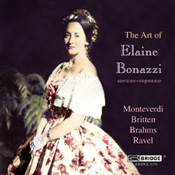
The Art of Elaine Bonazzi
This is a recital disc notable for the compelling presence and intimacy of the vocal performance.
The Sixteen continues its exploration of Henry Purcell’s Welcome Songs for Charles II. As with Robert King’s pioneering Purcell series begun over thirty years ago for Hyperion, Harry Christophers is recording two Welcome Songs per disc.
In February this year, Albanian soprano Ermonela Jaho made a highly lauded debut recital at Wigmore Hall - a concert which both celebrated Opera Rara’s 50th anniversary and honoured the career of the Italian soprano Rosina Storchio (1872-1945), the star of verismo who created the title roles in Leoncavallo’s La bohème and Zazà, Mascagni’s Lodoletta and Puccini’s Madama Butterfly.
Collapsology. Or, perhaps we should use the French word ‘Collapsologie’ because this is a transdisciplinary idea pretty much advocated by a series of French theorists - and apparently, mostly French theorists. It in essence focuses on the imminent collapse of modern society and all its layers - a series of escalating crises on a global scale: environmental, economic, geopolitical, governmental; the list is extensive.
Amongst an avalanche of new Mahler recordings appearing at the moment (Das Lied von der Erde seems to be the most favoured, with three) this 1991 Mahler Second from the 2nd Kassel MahlerFest is one of the more interesting releases.
If there is one myth, it seems believed by some people today, that probably needs shattering it is that post-war recordings or performances of Wagner operas were always of exceptional quality. This 1949 Hamburg Tristan und Isolde is one of those recordings - though quite who is to blame for its many problems takes quite some unearthing.
The voices of six women composers are celebrated by baritone Jeremy Huw Williams and soprano Yunah Lee on this characteristically ambitious and valuable release by Lontano Records Ltd (Lorelt).
As Paul Spicer, conductor of the Royal Birmingham Conservatoire Chamber Choir, observes, the worship of the Blessed Virgin Mary is as ‘old as Christianity itself’, and programmes devoted to settings of texts which venerate the Virgin Mary are commonplace.
Ethel Smyth’s last large-scale work, written in 1930 by the then 72-year-old composer who was increasingly afflicted and depressed by her worsening deafness, was The Prison – a ‘symphony’ for soprano and bass-baritone soloists, chorus and orchestra.
‘Hamilton Harty is Irish to the core, but he is not a musical nationalist.’
‘After silence, that which comes closest to expressing the inexpressible is music.’ Aldous Huxley’s words have inspired VOCES8’s new disc, After Silence, a ‘double album in four chapters’ which marks the ensemble’s 15th anniversary.
A song-cycle is a narrative, a journey, not necessarily literal or linear, but one which carries performer and listener through time and across an emotional terrain. Through complement and contrast, poetry and music crystallise diverse sentiments and somehow cohere variability into an aesthetic unity.
One of the nicest things about being lucky enough to enjoy opera, music and theatre, week in week out, in London’s fringe theatres, music conservatoires, and international concert halls and opera houses, is the opportunity to encounter striking performances by young talented musicians and then watch with pleasure as they fulfil those sparks of promise.
“It’s forbidden, and where’s the art in that?”
Dublin-born John F. Larchet (1884-1967) might well be described as the father of post-Independence Irish music, given the immense influenced that he had upon Irish musical life during the first half of the 20th century - as a composer, musician, administrator and teacher.
The English Civil War is raging. The daughter of a Puritan aristocrat has fallen in love with the son of a Royalist supporter of the House of Stuart. Will love triumph over political expediency and religious dogma?
Beethoven Symphony no 9 (the Choral Symphony) in D minor, Op. 125, and the Choral Fantasy in C minor, Op. 80 with soloist Kristian Bezuidenhout, Pablo Heras-Casado conducting the Freiburger Barockorchester, new from Harmonia Mundi.
A Louise Brooks look-a-like, in bobbed black wig and floor-sweeping leather trench-coat, cheeks purple-rouged and eyes shadowed in black, Barbara Hannigan issues taut gestures which elicit fire-cracker punch from the Mahler Chamber Orchestra.
‘Signor Piatti in a fantasia on themes from Beatrice di Tenda had also his triumph. Difficulties, declared to be insuperable, were vanquished by him with consummate skill and precision. He certainly is amazing, his tone magnificent, and his style excellent. His resources appear to be inexhaustible; and altogether for variety, it is the greatest specimen of violoncello playing that has been heard in this country.’
Baritone Roderick Williams seems to have been a pretty constant ‘companion’, on my laptop screen and through my stereo speakers, during the past few ‘lock-down’ months.
Melodramas can be a difficult genre for composers. Before Richard Strauss’s Enoch Arden the concept of the melodrama was its compact size – Weber’s Wolf’s Glen scene in Der Freischütz, Georg Benda’s Ariadne auf Naxos and Medea or even Leonore’s grave scene in Beethoven’s Fidelio.
This is a recital disc notable for the compelling presence and intimacy of the vocal performance.
From the opening phrase declaimed on virtually a single pitch in Monteverdi’s “Io ch’armato sin hor” we are captured and simply have to hear what the next note will sound like, and the next, and the next. Whether or not we approve of this and the other Monteverdi pieces that begin the program is another matter and will likely depend upon our concerns about authenticity in early music performance. Elaine Bonazzi doesn’t hold back from using her whole voice to sing these pieces, nor does she shrink from shaping the phrases of the three Scherzi Musicali with a flowing legato that frequently becomes full-fledged portamento, set off by the spare piano accompaniment. This was an “old-fashioned” approach to music of this period by the time this disc was recorded in 1985, but it works remarkably well here, probably because the artist’s concern is with shaping the phrases into beautiful lines that express the emotion of the text without sacrificing the integrity of the music’s essential purity. That this was a stylistic choice is clear when we hear the Messenger’s scene from Monteverdi’s opera Orfeo, which is beautifully phrased without portamento to bring out the drama of the extended declamation. To my ear the artists do an admirable job of performing early music in a way that resonates with modern sensibilities while not forsaking the fundamental emotional integrity of the music.
The description of Euridice sinking into death sets us up for a program of more recent music united by a theme of sleep or dreaminess. Britten’s A Charm of Lullabies opens with “Sleep, sleep, beauty bright”, with a gently rocking accompaniment that can make us think we’re hearing a conventional lullaby—until Bonazzi’s excellent English diction brings out Blake’s unsettling text that hints at “dreadful lightnings” when the child wakens into adulthood. We get a better idea of what these might look like in “The Highland Balou”, where a poor highland woman imagines her young son stealing livestock in raids into the more prosperous lowlands, sung in a Scottish accent (the authenticity of which I can’t evaluate) over a humorous syncopated dance rhythm. “Sephestia’s Lullaby” alternates tender consolation to the child too young to know adult sorrow with a frantically abbreviated history of how the baby’s arrival has ultimately led to the father’s departure. Bonazzi handles the mood swings very effectively, pattering out the frantic sections, and beautifully sustaining the last note of the penultimate phrase of the final slow section. In the humorously hostile “A Charm”, the frustrated mother or nurse threatens the child with the vividly described wrath of the Furies if it does not quiet down and sleep. After the energy of these two songs, a peaceful sleep would seem impossible for any child, but then we hear “The Nurse’s Song”, a quietly spectacular song of reassurance that the child’s nurse will be there to take care of it. The vocal line is extremely exposed, beginning with several unaccompanied lines of melodic but unusual intervals that must be sung with supreme musicality so that, when the piano enters at the end of the first verse, it is a perfect meeting. Bonazzi’s artistry is well up to the challenge, spinning a vocal line that combines the improvisational sound of the nurse singing alone with the sure musicality that allows the audience to relax with the child at the moment the piano enters in perfect tune with the voice, reassuring us that the nurse will always be right where she needs to be.
Following the spare precision of the Orfeo scene and the Britten songs, the listener is invited to bask in the sheer beauty of Brahms’s Opus 91 songs for voice, piano and viola, which set two texts that continue the theme of sleep and rest. First is a setting of a Rückert poem seeking rest from yearning, and in the second, the viola begins playing the old German Christmas song “Joseph lieber, Joseph mein” as the voice takes the part of the Virgin Mary asking the winds to be quiet so that her baby may find rest from the sorrow he came into the world to bear. Interwoven with the viola line, sensitively executed by Karen Tuttle, Bonazzi’s rendition of Brahms’s gorgeous vocal melodies flows seamlessly while allowing every German consonant to be clearly heard. In listening to these pieces I am struck by some similarity I hear between the timbre of Bonazzi’s voice and that of the string instruments, which I confess makes it less pleasant to me than the sound of some other mezzos. This is largely a matter of personal taste however, and I have to say that at all times on this recording she brings out the best in her instrument.
A phrase by another string instrument, in this case the cello, opens the Chansons Madécasses of Ravel, easing the rather abrupt transition from the lush Brahms songs to the twentieth-century dissonances of Ravel’s late work. The first and third songs in the set, which Ravel set as a quartet for voice, cello, flute, and piano, are languid and dreamy with more than a little eroticism expressed in these spare musical lines. The dream turns temporarily to a nightmare in the dissonant “Aoua!” that separates them, whose text is a lament upon the effects of colonialism. In all three songs the ensemble is seamless, making the disc a true showpiece of the talents of the faculty at the Peabody Conservatory of Music, where Bonazzi was teaching when this performance was recorded. My one quibble at this point is that, while the Chansons Madécasses bring together the most instruments with the voice and might therefore be expected to be a fitting climax to the recital, the fact is that “Il est doux”, which closes the set, so perfectly expresses the indolence of the tropical afternoon that it describes, that it peters off into a single a capella vocal phrase before dropping into complete silence, bringing the recital to an abrupt end.
The CD booklet includes texts and English translations, and some brief notes on the songs, but the bulk of the booklet is given over to a summary of Elaine Bonazzi’s career, with photographs from her personal collection. Given the number of world premieres in which she participated and the high level of her artistry that is clearly demonstrated by this recital, this information is a valuable adjunct to the recording and a welcome memento to those who enjoyed her work during her performing career, as well as an impressive introduction for those who will be encountering it for the first time in this recital performance.
Barbara Miller