24 Jan 2007
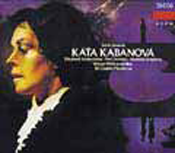
JANACEK: Káťa Kabanová
I saw my first Káťa 37 years ago during the Flanders Festival. At the time it was still an almost complete novelty on the scene and the Czech company performed it according to the composer’s intentions.
The Sixteen continues its exploration of Henry Purcell’s Welcome Songs for Charles II. As with Robert King’s pioneering Purcell series begun over thirty years ago for Hyperion, Harry Christophers is recording two Welcome Songs per disc.
In February this year, Albanian soprano Ermonela Jaho made a highly lauded debut recital at Wigmore Hall - a concert which both celebrated Opera Rara’s 50th anniversary and honoured the career of the Italian soprano Rosina Storchio (1872-1945), the star of verismo who created the title roles in Leoncavallo’s La bohème and Zazà, Mascagni’s Lodoletta and Puccini’s Madama Butterfly.
Collapsology. Or, perhaps we should use the French word ‘Collapsologie’ because this is a transdisciplinary idea pretty much advocated by a series of French theorists - and apparently, mostly French theorists. It in essence focuses on the imminent collapse of modern society and all its layers - a series of escalating crises on a global scale: environmental, economic, geopolitical, governmental; the list is extensive.
Amongst an avalanche of new Mahler recordings appearing at the moment (Das Lied von der Erde seems to be the most favoured, with three) this 1991 Mahler Second from the 2nd Kassel MahlerFest is one of the more interesting releases.
If there is one myth, it seems believed by some people today, that probably needs shattering it is that post-war recordings or performances of Wagner operas were always of exceptional quality. This 1949 Hamburg Tristan und Isolde is one of those recordings - though quite who is to blame for its many problems takes quite some unearthing.
The voices of six women composers are celebrated by baritone Jeremy Huw Williams and soprano Yunah Lee on this characteristically ambitious and valuable release by Lontano Records Ltd (Lorelt).
As Paul Spicer, conductor of the Royal Birmingham Conservatoire Chamber Choir, observes, the worship of the Blessed Virgin Mary is as ‘old as Christianity itself’, and programmes devoted to settings of texts which venerate the Virgin Mary are commonplace.
Ethel Smyth’s last large-scale work, written in 1930 by the then 72-year-old composer who was increasingly afflicted and depressed by her worsening deafness, was The Prison – a ‘symphony’ for soprano and bass-baritone soloists, chorus and orchestra.
‘Hamilton Harty is Irish to the core, but he is not a musical nationalist.’
‘After silence, that which comes closest to expressing the inexpressible is music.’ Aldous Huxley’s words have inspired VOCES8’s new disc, After Silence, a ‘double album in four chapters’ which marks the ensemble’s 15th anniversary.
A song-cycle is a narrative, a journey, not necessarily literal or linear, but one which carries performer and listener through time and across an emotional terrain. Through complement and contrast, poetry and music crystallise diverse sentiments and somehow cohere variability into an aesthetic unity.
One of the nicest things about being lucky enough to enjoy opera, music and theatre, week in week out, in London’s fringe theatres, music conservatoires, and international concert halls and opera houses, is the opportunity to encounter striking performances by young talented musicians and then watch with pleasure as they fulfil those sparks of promise.
“It’s forbidden, and where’s the art in that?”
Dublin-born John F. Larchet (1884-1967) might well be described as the father of post-Independence Irish music, given the immense influenced that he had upon Irish musical life during the first half of the 20th century - as a composer, musician, administrator and teacher.
The English Civil War is raging. The daughter of a Puritan aristocrat has fallen in love with the son of a Royalist supporter of the House of Stuart. Will love triumph over political expediency and religious dogma?
Beethoven Symphony no 9 (the Choral Symphony) in D minor, Op. 125, and the Choral Fantasy in C minor, Op. 80 with soloist Kristian Bezuidenhout, Pablo Heras-Casado conducting the Freiburger Barockorchester, new from Harmonia Mundi.
A Louise Brooks look-a-like, in bobbed black wig and floor-sweeping leather trench-coat, cheeks purple-rouged and eyes shadowed in black, Barbara Hannigan issues taut gestures which elicit fire-cracker punch from the Mahler Chamber Orchestra.
‘Signor Piatti in a fantasia on themes from Beatrice di Tenda had also his triumph. Difficulties, declared to be insuperable, were vanquished by him with consummate skill and precision. He certainly is amazing, his tone magnificent, and his style excellent. His resources appear to be inexhaustible; and altogether for variety, it is the greatest specimen of violoncello playing that has been heard in this country.’
Baritone Roderick Williams seems to have been a pretty constant ‘companion’, on my laptop screen and through my stereo speakers, during the past few ‘lock-down’ months.
Melodramas can be a difficult genre for composers. Before Richard Strauss’s Enoch Arden the concept of the melodrama was its compact size – Weber’s Wolf’s Glen scene in Der Freischütz, Georg Benda’s Ariadne auf Naxos and Medea or even Leonore’s grave scene in Beethoven’s Fidelio.
I saw my first Káťa 37 years ago during the Flanders Festival. At the time it was still an almost complete novelty on the scene and the Czech company performed it according to the composer’s intentions.
Since then, it is gradually on its way to becoming a repertory piece mainly due to directors vying with each other for trying their hands and ideas on a piece which lends itself to many an interpretation. My last Káťa was at the Brussels Munt and was played without a pause as if the lady falls in love, deceives her husband and commits suicide in the blink of an eye. Janacek wouldn’t have loved it as the last act takes place two weeks after the second one. The director had the brilliant idea of placing the piece in one of these dreary Russian “kommunalka’s” (common apartments) in the early 1960s. These were, and probably still are, places where gossip is rife and can be deadly indeed. Still, there is the small problem of the horse sleighs arriving and leaving, so magically invoked by Janacek’s orchestra and they were passed over as being contrary to the director’s concept. And in the midst of Chroestjov’s anti-religion campaign, I severely doubt the whole Kommunalka would enthusiastically have sung the praise of Easter and Orthodoxy.
Those ‘small’ problems don’t exist on record and therefore the listener can use his or her own fantasy if need be as everything is in the nervous short melodies so typical for the composer. This recording was issued in the Decca “Classic series” and rarely this definition will have been so right on the mark. Thirty years after its appearance on the market it is still unsurpassed though honesty obliges me to say that competition is small, which proves that the record buying public is not too fond of the score shorn from its strong theatrical impact. Only five complete performances exist; probably because the opera on record indeed has less striking musical themes than present in Jenufa. The first 1959 Czech version is a poor affair as to sound and singers, notwithstanding the fact that it was an all-Czech cast. In 1977 came the issue under review. Twenty years after this classic recording the same conductor once more led a new version but for Benackova the title role came rather late in her career. The latest version in the vernacular, conducted by Cambreling, has Denoke and Kuebler in the title roles at the Salzburg Festival in 2001. I never heard the set because reviews were not very enthusiastic, deploring Denoke’s harsh sound as Káťa and Kuebler’s dry tone as Boris. Those two singers were the principals in my Brussels performance as well and I indeed got away with the impression they were good actors and very mediocre singers.
Several DVD’s prove that Elisabeth Söderström who sings the title role in this issue knew how to act convincingly but with her there is the voice as well and what a beautiful voice it is on these CD’s: very feminine, rich, sensual and ringing during emotional climaxes. The silvery sound of her early years is still there but the strength is there too and as this was the first recording in her Janacek-cycle the voice is still fresh at 49-years of age. Striking is her enunciation. Even when one doesn’t speak or understand Czech like myself, one can still compare her interpretation with her Czech colleagues and I for one don’t hear a difference in pronunciation or emphasis on syllables. In those years rumors started to go around that there was a new good lyric tenor behind the iron curtain. Dvorsky made his West-European début as the Italian tenor at the Vienna opera in the same year he recorded this set and imaginative casting this is; going for a young promising unknown. I’ve never known him singing better with that unforced beauty that some of the old hands at the Met maybe remember from his two Traviata performances in 1977. Too soon his voice would thicken so that by the time he became a regular there was not much to enjoy anymore.
Kniplova was a very successful Kabanicha at the Prague opera but as this is a recording and not a DVD the aural impression is important. Some fans will probably argue that the sour sound corresponds with the mentality of Kata’s mother-in-law but I have doubts. The many Aidas, Brünnhildes and Leonores had taken their toll. As the husband Vladimir Krejcik is very convincing. But so are all small-bit players with a special mention for Zdenek Svhela in the important role of chemistry professor. I have rarely heard a more impressive performance by an almost voiceless comprimario tenor. Nevertheless the voice fits the role to a T.
Charles Mackerras immediately jumped to the forefront of Janacek conductors with this subtle and inspired reading, slowly building the tension so that one already feels the inevitable end during the intermezzi. Of course he has at his disposal the Vienna Philharmonic and he profits from their honeyed sound while at the same time always and scrupulously supporting his singers; never using this magnificent orchestra to overwhelm them. And he has a producer and recording engineer who cooperate and don’t bury the singers in orchestral sound as happens in the second Mackerras-Benackova recording of 1997.
I don’t know the 1989 re-issue of this classic set but I’m often cross at the ways labels just throw their older recordings on the market, more often than not skipping the original interesting essays that accompanied the LP versions. I’m glad that for once the very readable article by John Tyrell plus Mackerras’ personal views are printed and they should surely be read before playing the CD’s. If I remember well the set got the Gramophone’s Record of the Year award at its first appearance. It remains the set by which all new efforts will be measured.
Jan Neckers