Recently in Recordings
What better way for Masonic brothers, Wolfgang Amadeus Mozart and Emmanuel Shikaneder to disseminate Masonic virtues, than through the most popular musical entertainment of their age, a happy ending folktale that features a dragon, enchanting flutes and bells, mixed-up parentage, and a beautiful young princess in distress?
Since its first performance at the Teatro Santi Giovanni e Paolo during Venice’s 1643 Carnevale, Monteverdi’s L’Incoronazione di Poppea has been one of the most important milestones in the genesis of modern opera despite its 250 years of unmerited obscurity.
Though 2013 is the bicentennial of the births of Giuseppe Verdi and Richard Wagner, the releases of Cecilia Bartoli’s recording of Bellini’s Norma on DECCA, a new studio recording of Donizetti’s Caterina Cornaro from Opera Rara, and this première recording of Saverio Mercadante’s forgotten I due Figaro, suggest that this is the start of a summer of bel canto.
Recording Richard Wagner’s Der Ring des Nibelungen is for a
record label equivalent to a climber reaching the summit of Mount Everest: it is the zenith from which a label surveys its position among its rivals and appreciates an achievement that can define its reputation for a generation.
Few people who love opera in general and bel canto in particular have never heard the comment made by Lilli Lehmann, veteran of the inaugural Ring at Bayreuth in 1876, that singing all three of Wagner’s Brünnhildes—in Die Walküre, Siegfried, and
Götterdämmerung, respectively, all of which she sang to great acclaim—pales in comparison with singing the title rôle in Bellini’s Norma.
Paul Dukas’ Ariane et Barbe-Bleue, first heard in 1907, once seemed important. Arturo Toscanini conducted the Met premiere in 1911 with Farrar and later arranged some of its music for a 1947 recording with his NBC Symphony.
The economics of the recording companies dictate much that is not ideal.
Wagner’s operas were not composed as they were in order to permit the
extraction of bleeding chunks, even on those occasions when strophic song forms
do occur.
Among the recent recordings of Mahler’s Eighth Symphony, Valery Gergiev’s release on the LSO Live label is an excellent addition to the discography of this work.
While not unknown, the songs of Alexander von Zemlinsky (1871-1942) deserve to be heard more frequently.
Recorded on 5 and 6 May 2008 and 17 and 18 January 2009 at the Lisztzentrum (Raiding, Austria), this recent Bridge release makes available the piano-vocal versions of three song cycles by Gustav Mahler, Lieder eines fahrenden Gesellen, Rückert-Lieder, and Kindertotenlieder performed by mezzo-soprano Hermine Haselböck, accompanied by Russell Ryan.
Contraltos rarely achieve the acclaim and renown of sopranos. Assigned few leading roles in opera, they are condemned to playing the villain or the grandmother, or to stealing the castrati’s trousers in en travesti roles.
Following their 2011 Decca recording of Striggio’s Mass in 40 Parts (1566), I Fagiolini continue their quest to unearth lost treasures of the High Renaissance and early Baroque, with this collection of world-premiere recordings, ‘reconstructions’ and ‘reconstitutions’ of music by Giovanni and Andrea Gabrieli, Monteverdi, Palestrina, and their less well-known compatriots Viadana, Barbarino and Soriano.
Eternal Echoes is an album of khazones [Jewish cantorial music] for cantorial soloist, solo violin and a blended instrumental ensemble comprising a small orchestra and the Klezmer Conservatory Band.
Michael Tilson Thomas’s recording of Mahler’s Third Symphony is an outstanding contribution to the composer’s discography.
Oliver Knussen burst into British music with an unprecedented flourish. In 1967, the London Symphony Orchestra premiered Knussen’s First Symphony, with István Kertész scheduled to conduct.
Based on performances given in Summer 2010 at the Lucerne Festival, this recording of Beethoven’s Fidelio is an admirable recording that captures the vitality of the work as conducted by Claudio Abbado.
Stanisław Moniuszko (1819-1872) was one of the most popular composers of his day in Poland, and of the many works he wrote for the stage, two are performed from time to time, Halka (1848) and Strazny dwór [The Haunted Manor] (1865).
The Polish alto Jadwiga Rappé is a familiar voice in various stage and concert works, and the recent release of a selection of songs by Stanisław Moniuszko (1819-1872) is an opportunity to hear her performing artsongs.
Originally released on multiple discs in 1981 this reissue on two CDs is a comprehensive collection of art songs by Italian and French composers from the nineteenth and early twentieth centuries.
An exciting contribution to the discography of this popular opera, the live performance of Richard Strauss’s Salome from the Festspielhaus at Baden-Baden is a compelling DVD.
Recordings
17 Jan 2007
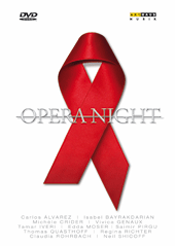
Opera Night
Some interesting repertory choices and the participation of some of today's most attractive singers make this particular "gala" evening of "walk on-sing-walk off" entertainment more consistently enjoyable than these affairs often are.
The evening is a fund-raiser for the German
AIDS foundation, and after a brief (and strangely awkward) filmed statement in English from
soprano Michèle Crider, the show gets underway with an exciting "Entry of the Guests" from
Tannhäuser, with Marcus Stenz leading the Opera Cologne orchestra and its excellent chorus (all
sporting the familiar red ribbon).
The contribution of the emcee, a "cabaret artist" named Konrad Beikircher, may damage the
enjoyment of some viewers. Clearly reading from notes, with an unmotivated chuckle behind
much of his spiel, the emcee's palaver should have been separately tracked for easy skipping.
Instead, the "fast forward" button will have to be exercised in order to avoid mostly old and
tiresome anecdotes and such gratuitous commentary as an unctuous trashing of the Forza libretto.
Perhaps in his native environment this gentleman puts on quite a show; here, the cameraman
pans the audience anxiously to find the occasional audience member breaking a smile.
The singing, fortunately, makes up for this annoyance. Thomas Quastoff appears first, with a
"Lied an den Abendstern" of rare handsomeness and sensitivity. Much later in the show he comes
back with a delightful rarity, "O sancta justitia" from Lortzing's Zar und Zimmerman. After
Quastoff's Wagner, the show then shifts to bel canto, with young tenor Saimur Pirgu delivering
an able "Una Furtiva Lagrima," his tone only lacking that mysterious charismatic quality that
tenors such as Rolando Villazon and Juan-Diego Florez possess. But Pirgu may yet attain that
status; towards show's end he sings a very sweet "Non ti scordar di me."
Vivica Genaux appears after Pirgu's Donizetti to give a demonstration of impeccable technique
in "Nacqui all'affanno" from Cenerentola, which Isabel Bayrakdarian has to follow. She imparts a
sense of drama into Semiramide's "Bel raggio lusinghier," though she is not in Genaux's class as
a Rossinian. Genaux is just as exciting later with a surprising choice, a zarzuela number about a
tarantula from Jerónimo Giménez.
Upstaging the females in the "hair" department, Carlos Alvarez's wild black lion's mane
impresses just as much as his forceful "Leonore, viens" from La Favorite. The vibrato will either
appeal or come across as a touch too heavy, depending on taste. Tamar Iveri's healthy soprano
may be a touch too strong to deliver a truly tender "Dove sono." Later in the program, however,
she does very well by the exquisite "Chi il bel sogno di Doretta" from Puccini's Rondine. Ms.
Crider, a reliable if unexciting singer, works earnestly through "Pace pace mio Dio." Her
"Summertime" (which also serves as the inexplicable "theme" of the gala) finds her approach
much too overbearing for a lullaby.
Neil Shicoff sings the two big Tosca tenor arias, with distractingly strenuous facial exertions.
The "Recondita armonia" doesn't quite come off, but "E lucevan le stelle" earns him one of the
evening's most lively audience responses. The tenor also seems to have found his way to
Pavarotti's hair colorist.
In the middle of the program Edda Moser and two young singers, Claudia Rohrbach and Regina
Richter, perform the Rosenkavalier trio. Unfortunately, Ms. Moser's experienced (to put it
kindly) voice doesn't blend well with the freshness of the two others. Once again, to put it
kindly.
The last solo appearance has Carlos Alvarez reappear for the rarest of the evening's repertory
choices, "Bless your beautiful hide" from the Gene de Paul score for Seven Brides for Seven
Brothers. Without necessarily forgoing his operatic training, Alvarez imbues the song with easy
masculine charm, making for a delightful performance.
Then most of the singers (Shicoff noticeably absent) trot on to perform "Tonight" from West
Side Story as an ensemble piece. Odd, but enjoyable nonetheless.
The disc also offers as bonus items a speech thankfully cut from the main DVD program, a short
documentary of some of the work the German AIDS foundation has done in South Africa, and a
bizarre trailer for this very gala. All in all, the ratio of fine performances to those less so and
some innovative repertory choices make this one of the better gala DVDs, if one can tolerate the
host.
Chris Mullins