23 Sep 2007
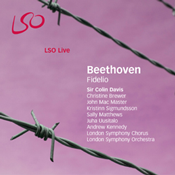
Brewer at her best in live “Fidelio”
It is not surprising that it was Beethoven’s Fidelio that was chosen to reconsecrate rebuilt opera houses in Vienna and Berlin in the years after World War Two.
The Sixteen continues its exploration of Henry Purcell’s Welcome Songs for Charles II. As with Robert King’s pioneering Purcell series begun over thirty years ago for Hyperion, Harry Christophers is recording two Welcome Songs per disc.
In February this year, Albanian soprano Ermonela Jaho made a highly lauded debut recital at Wigmore Hall - a concert which both celebrated Opera Rara’s 50th anniversary and honoured the career of the Italian soprano Rosina Storchio (1872-1945), the star of verismo who created the title roles in Leoncavallo’s La bohème and Zazà, Mascagni’s Lodoletta and Puccini’s Madama Butterfly.
Collapsology. Or, perhaps we should use the French word ‘Collapsologie’ because this is a transdisciplinary idea pretty much advocated by a series of French theorists - and apparently, mostly French theorists. It in essence focuses on the imminent collapse of modern society and all its layers - a series of escalating crises on a global scale: environmental, economic, geopolitical, governmental; the list is extensive.
Amongst an avalanche of new Mahler recordings appearing at the moment (Das Lied von der Erde seems to be the most favoured, with three) this 1991 Mahler Second from the 2nd Kassel MahlerFest is one of the more interesting releases.
If there is one myth, it seems believed by some people today, that probably needs shattering it is that post-war recordings or performances of Wagner operas were always of exceptional quality. This 1949 Hamburg Tristan und Isolde is one of those recordings - though quite who is to blame for its many problems takes quite some unearthing.
The voices of six women composers are celebrated by baritone Jeremy Huw Williams and soprano Yunah Lee on this characteristically ambitious and valuable release by Lontano Records Ltd (Lorelt).
As Paul Spicer, conductor of the Royal Birmingham Conservatoire Chamber Choir, observes, the worship of the Blessed Virgin Mary is as ‘old as Christianity itself’, and programmes devoted to settings of texts which venerate the Virgin Mary are commonplace.
Ethel Smyth’s last large-scale work, written in 1930 by the then 72-year-old composer who was increasingly afflicted and depressed by her worsening deafness, was The Prison – a ‘symphony’ for soprano and bass-baritone soloists, chorus and orchestra.
‘Hamilton Harty is Irish to the core, but he is not a musical nationalist.’
‘After silence, that which comes closest to expressing the inexpressible is music.’ Aldous Huxley’s words have inspired VOCES8’s new disc, After Silence, a ‘double album in four chapters’ which marks the ensemble’s 15th anniversary.
A song-cycle is a narrative, a journey, not necessarily literal or linear, but one which carries performer and listener through time and across an emotional terrain. Through complement and contrast, poetry and music crystallise diverse sentiments and somehow cohere variability into an aesthetic unity.
One of the nicest things about being lucky enough to enjoy opera, music and theatre, week in week out, in London’s fringe theatres, music conservatoires, and international concert halls and opera houses, is the opportunity to encounter striking performances by young talented musicians and then watch with pleasure as they fulfil those sparks of promise.
“It’s forbidden, and where’s the art in that?”
Dublin-born John F. Larchet (1884-1967) might well be described as the father of post-Independence Irish music, given the immense influenced that he had upon Irish musical life during the first half of the 20th century - as a composer, musician, administrator and teacher.
The English Civil War is raging. The daughter of a Puritan aristocrat has fallen in love with the son of a Royalist supporter of the House of Stuart. Will love triumph over political expediency and religious dogma?
Beethoven Symphony no 9 (the Choral Symphony) in D minor, Op. 125, and the Choral Fantasy in C minor, Op. 80 with soloist Kristian Bezuidenhout, Pablo Heras-Casado conducting the Freiburger Barockorchester, new from Harmonia Mundi.
A Louise Brooks look-a-like, in bobbed black wig and floor-sweeping leather trench-coat, cheeks purple-rouged and eyes shadowed in black, Barbara Hannigan issues taut gestures which elicit fire-cracker punch from the Mahler Chamber Orchestra.
‘Signor Piatti in a fantasia on themes from Beatrice di Tenda had also his triumph. Difficulties, declared to be insuperable, were vanquished by him with consummate skill and precision. He certainly is amazing, his tone magnificent, and his style excellent. His resources appear to be inexhaustible; and altogether for variety, it is the greatest specimen of violoncello playing that has been heard in this country.’
Baritone Roderick Williams seems to have been a pretty constant ‘companion’, on my laptop screen and through my stereo speakers, during the past few ‘lock-down’ months.
Melodramas can be a difficult genre for composers. Before Richard Strauss’s Enoch Arden the concept of the melodrama was its compact size – Weber’s Wolf’s Glen scene in Der Freischütz, Georg Benda’s Ariadne auf Naxos and Medea or even Leonore’s grave scene in Beethoven’s Fidelio.
It is not surprising that it was Beethoven’s Fidelio that was chosen to reconsecrate rebuilt opera houses in Vienna and Berlin in the years after World War Two.
The victory over National Socialism endorsed Beethoven’s black-white view of the contest between good and evil, affirming the belief that the latter had now been eradicated from the world for all time. This child-like optimism of Beethoven’s only opera, premiered in 1805 with Napoleon already in Vienna, was a perfect musical reflection of a faith that was soon to be proven naive.
As the Cold War divided Europe into two hostile camps a more sober approach to Beethoven’s idealism developed. A telling example was a Fidelio staged in Wupperthal in 1977. Following the ecstatic second-act duet “O namenlose Freude” the curtain fell and houselights were turned on. A narrator addressed the audience: “Here ends the part of the opera that can be presented on stage today. The producers doubt, however, that such an act of grace — the Minister as deus ex machina, which by chance liquidated terror at just one place in one time, can be shown as the joyous, reconciling climax.” Following “Leonore” Overture No. 3 the lights were dimmed and the curtain rose for a concert performance of the finale: the chorus stood on risers, the seven soloists were seated on a row of chairs before them in modern concert dress and stood — score in hand — for each entry.
Thirty years later Fidelio remains a challenge; those staging it face difficult choices in defining the message of the opera in terms relevant to a contemporary audience. This explains the special appeal — and perhaps the success — of Fidelio on discs, where only the music matters.
The LSO Live recording of a performance of the opera in London’s Barbican in May 2006 supports this view. Christine Brewer is ideal in the title role, for the American soprano — now 50 — meets the vocal demands of Beethoven’s devoted wife with ease. She has both the high and the low notes needed for the great “Abscheulicher” aria and sings its “hopeful” middle section with melting lyricism. (A British critic described her singing of the aria as “a rainbow through the clouds.’)
Admirable is the preparation that Brewer devotes to any role that she undertakes. She sang several “Fidelio’s” in concert before approaching this assignment and she had already recorded the opera for Chandos’ “Opera in English” series. She had sung it in concert at the Barbican under Charles Mackerras only a few months before this recording. And although Leonore is not a trouser role cut from the same cloth as Mozart’s Cherubino or Strauss’ Octavian, Brewer in disguise is marvelously feminine in her interrelationship with the other characters in the opera in this recording.
In an interview in England she defined Leonore as “a woman who does the right thing for the right reasons,” and this view is clearly audible in the focused conviction that she brings to the role here. Indeed, a masterpiece of balanced casting — Iceland’s Kristinn Sigmundsson (Rocco), Sally Matthews (Marzelline) and Andrew Kennedy (Jaquino) — makes the famous first-act quartet a shimmering example of ensemble singing.
Although Canadian John Mc Master is a tenor more Verdian than Wagnerian, he delivers a dramatic account of the mammoth “Dungeon” aria and manages to keep up with Brewer without noticeable strain in the duet “O namenlose Freude.” And Juha Uusitaio is a fiendishly Mephistophelean Don Pizarro.
Spoken dialogue has been only slightly trimmed, and the totally non-German cast is exemplary in its command of German.
Much credit for the coherent impact that the recording makes goes to octogenarian conductor Colin Davis, for whom the London Symphony plays on the level of Europe’s greatest orchestras. The affection that Davis lavishes on the performance places more weight upon the love story than upon the political perspective of “Fidelio.” There is little in the excellent sound of this LSO Live release that hints of a “live” performance.
Breaking with the tradition that began with Mahler’s insertion of “Leonore” Overture No. 3 before the finale, Davis — as is today common — omits the Overture and moves directly to the final scene that anticipates the sympathies expressed later in the fourth movement of Beethoven’s Ninth Symphony.
Given her success as Leonore in concert, it is strange the Brewer’s stage debut in the role at the San Francisco Opera in 2005 was disappointing. Michael Hampe’s unimaginative direction of a traditional production was partly responsible for the fact that the staging simply did not catch fire, but Brewer’s considerable girth was also a problem. She is a large woman who does not move easily when the going gets rough — as it does in the “Dungeon” scene in “Fidelio.”
Brewer’s next major assignment is the Dyer’s Wife in Richard Strauss “Frau ohne Schatten” at the Chicago Lyric Opera later in the fall.
A personal view
I saw my first Fidelio in Vienna’s historic Theater an der Wien, where the opera had had its premiere in 1805. (The Staatsoper on the Ringstrasse had not yet reopened.) The Leonore was Christel Goltz, a young singer who had begun her career in Dresden as a dancer. The next major Viennese Salome after Ljuba Welitsch, Goltz was an openly passionate Leonore, whose approach to the role anticipates today’s incarnation of Beethoven’s devoted wife by Finland’s Karita Mattila, seen on TV in the “Met” production of a few seasons ago.
As an established Wagnerian Brewer’s Leonore follows rather in the footsteps of Kirsten Flagstad, who performed the opera in the late years of her career. I recall a “Met” broadcast with her and today treasure the recording that she made of the opera under Wilhelm Furtwängler in Salzburg in 1953.
The most unusual Fidelio in my experience was a staging at Spoleto USA, the festival the Gian Carlo Menotti founded in Charleston, S.C., in 1977. The production directed by Germany’s Nikolaus Lehnhoff, came from 1960s’ Bremen, at that time a major center of the New Left in Europe. Lehnhoff stripped the opera completely of its spoken text and replaced it with a narrative written by Hans Magnus Enzensberger, Germany’s leading leftist poet and essayist at that time.
When I read about plans for the staging I could not feature Fidelio without its dialogue, but it worked brilliantly. (Perhaps my approval was influenced by the fact that Lehnhoff asked me to translate Enzensberger’s narration into English. It was a thrill to hear Fidelio performed with “my” words!) In an act hardly in keeping with the story of the opera Sweden’s Ulla Gustafsson, Leonore in the Spoleto staging, was mugged on her way home from an evening rehearsal.
A production that I wish I had heard was staged by a lesser German company in 1970, the Beethoven bicentennial year. I knew it only from reviews and no longer remember where it was performed. The director, a man well schooled in Bertold Brecht’s theater of alienation, included “Leonore” No. 3, but had it played with the curtain open while stage hands changed sets. When they had finished their work, they sat on the edge of the stage, feet dangling in the orchestra, and enjoyed sandwiches and beer. The opening-night audience was so offended that the curtain was closed at further performances.
Finally, an aspect of the opera that has concerned me since the “burn-baby-burn” days of the ‘60s. Fidelio — along with Mozart’s “Magic Flute” and Goethe’s “re-write” of Euripides’ “Iphigenia” — celebrates the age of classical humanism — of enlightened eudaemonism — that defined the values supposedly valid in the world today.
While in the other works the good, true and beautiful triumph because of their inherent strength, in the crucial moment in Fidelio Leonore pulls a gun. As Don Pizarro moves to murder Florestan, she throws herself between the two and sings — weapon in hand — “You’ll have to kill his wife first!” Only then does the off-stage trumpet sound, announcing the arrival of “der Herr Minister,” the deux ex machina who without Leonore’s singular bravery, would have arrived too late.
This is not to suggest that Beethoven was an advocate of violence, but it does offer a “take” on the Enlightenment that differs starkly from text-book presentations of the era. I fear only that a master of Regieoper will notice the gun and stage a Fidelio with the chorus drawn from the NRA.
Wes Blomster