23 Sep 2007
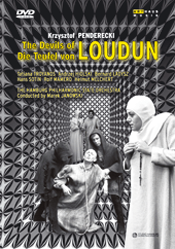
PENDERECKI: Die Teufel von Loudon
Of the operas composed in the latter half of the twentieth century, Krzysztof Penderecki’s Die Teufel von Loudon is a significant contribution to the repertoire.
The Sixteen continues its exploration of Henry Purcell’s Welcome Songs for Charles II. As with Robert King’s pioneering Purcell series begun over thirty years ago for Hyperion, Harry Christophers is recording two Welcome Songs per disc.
In February this year, Albanian soprano Ermonela Jaho made a highly lauded debut recital at Wigmore Hall - a concert which both celebrated Opera Rara’s 50th anniversary and honoured the career of the Italian soprano Rosina Storchio (1872-1945), the star of verismo who created the title roles in Leoncavallo’s La bohème and Zazà, Mascagni’s Lodoletta and Puccini’s Madama Butterfly.
Collapsology. Or, perhaps we should use the French word ‘Collapsologie’ because this is a transdisciplinary idea pretty much advocated by a series of French theorists - and apparently, mostly French theorists. It in essence focuses on the imminent collapse of modern society and all its layers - a series of escalating crises on a global scale: environmental, economic, geopolitical, governmental; the list is extensive.
Amongst an avalanche of new Mahler recordings appearing at the moment (Das Lied von der Erde seems to be the most favoured, with three) this 1991 Mahler Second from the 2nd Kassel MahlerFest is one of the more interesting releases.
If there is one myth, it seems believed by some people today, that probably needs shattering it is that post-war recordings or performances of Wagner operas were always of exceptional quality. This 1949 Hamburg Tristan und Isolde is one of those recordings - though quite who is to blame for its many problems takes quite some unearthing.
The voices of six women composers are celebrated by baritone Jeremy Huw Williams and soprano Yunah Lee on this characteristically ambitious and valuable release by Lontano Records Ltd (Lorelt).
As Paul Spicer, conductor of the Royal Birmingham Conservatoire Chamber Choir, observes, the worship of the Blessed Virgin Mary is as ‘old as Christianity itself’, and programmes devoted to settings of texts which venerate the Virgin Mary are commonplace.
Ethel Smyth’s last large-scale work, written in 1930 by the then 72-year-old composer who was increasingly afflicted and depressed by her worsening deafness, was The Prison – a ‘symphony’ for soprano and bass-baritone soloists, chorus and orchestra.
‘Hamilton Harty is Irish to the core, but he is not a musical nationalist.’
‘After silence, that which comes closest to expressing the inexpressible is music.’ Aldous Huxley’s words have inspired VOCES8’s new disc, After Silence, a ‘double album in four chapters’ which marks the ensemble’s 15th anniversary.
A song-cycle is a narrative, a journey, not necessarily literal or linear, but one which carries performer and listener through time and across an emotional terrain. Through complement and contrast, poetry and music crystallise diverse sentiments and somehow cohere variability into an aesthetic unity.
One of the nicest things about being lucky enough to enjoy opera, music and theatre, week in week out, in London’s fringe theatres, music conservatoires, and international concert halls and opera houses, is the opportunity to encounter striking performances by young talented musicians and then watch with pleasure as they fulfil those sparks of promise.
“It’s forbidden, and where’s the art in that?”
Dublin-born John F. Larchet (1884-1967) might well be described as the father of post-Independence Irish music, given the immense influenced that he had upon Irish musical life during the first half of the 20th century - as a composer, musician, administrator and teacher.
The English Civil War is raging. The daughter of a Puritan aristocrat has fallen in love with the son of a Royalist supporter of the House of Stuart. Will love triumph over political expediency and religious dogma?
Beethoven Symphony no 9 (the Choral Symphony) in D minor, Op. 125, and the Choral Fantasy in C minor, Op. 80 with soloist Kristian Bezuidenhout, Pablo Heras-Casado conducting the Freiburger Barockorchester, new from Harmonia Mundi.
A Louise Brooks look-a-like, in bobbed black wig and floor-sweeping leather trench-coat, cheeks purple-rouged and eyes shadowed in black, Barbara Hannigan issues taut gestures which elicit fire-cracker punch from the Mahler Chamber Orchestra.
‘Signor Piatti in a fantasia on themes from Beatrice di Tenda had also his triumph. Difficulties, declared to be insuperable, were vanquished by him with consummate skill and precision. He certainly is amazing, his tone magnificent, and his style excellent. His resources appear to be inexhaustible; and altogether for variety, it is the greatest specimen of violoncello playing that has been heard in this country.’
Baritone Roderick Williams seems to have been a pretty constant ‘companion’, on my laptop screen and through my stereo speakers, during the past few ‘lock-down’ months.
Melodramas can be a difficult genre for composers. Before Richard Strauss’s Enoch Arden the concept of the melodrama was its compact size – Weber’s Wolf’s Glen scene in Der Freischütz, Georg Benda’s Ariadne auf Naxos and Medea or even Leonore’s grave scene in Beethoven’s Fidelio.
Of the operas composed in the latter half of the twentieth century, Krzysztof Penderecki’s Die Teufel von Loudon is a significant contribution to the repertoire.
Commissioned by the director of the Hamburg Opera, Rolf Liebermann, Penderecki based his libretto for Die Teufel von Loudon on Erich Fried’s German translation of Robert Whiting’s 1964 drama The Devils of Loudon. That play is, in turn, based on Aldous Huxley’s 1952 historical study The Devils of Loudon. In the latter work Huxley explored a single event, the execution in 1634 of the French priest Urbain Grandier, who was actually accused and convicted of sorcery. From Huxley’s perspective, the execution is hardly an historic footnote, but a complex incident that involves the mingling of personal obsession and political intrigue, and Huxley’s prose certainly demonstrates its relevance for modern life. Such implications were not lost on Penderecki, who used this as the basis of his first opera, which was given its premiere in Hamburg in 1969. This DVD brings into print the 1969 television production of the opera that produced by Liebermann, just two years before Ken Russell released his film based on Whiting's play, which was entitled The Devils.
Liebermann's production is quite advanced for its time, because it is not a filmed opera, but a production conceived cinematically. Closeups, cross-cuts, fade-ins and fade-outs, flashbacks, and other effects are essential to the visual idiom and are used to underscore the opera. More than adding to the score or serving as an adornment of it, the cinematic elements are integral to Liebermann's film of Penderecki's opera. It is difficult to imagine, for example, the third scene of the second act (“Liebe Schwester in Christo”) with its superimposed image of the orgiastic scene in its fleeting effective rendered more effectively on stage. The closeup of Father Barré’s face in the same scene and its almost blurring closeup underscores his wonder at what was just related to him, with the cinematic rendering wholly in line with the musical content. These and other elements of the film are essential to understanding the work as presented in this idiom. Produced with the knowledge of the composer, this film also preserves an image of the opera that the composer sanctioned. It is wholly effective in its vivid imagery and authentic voice in conveying a sense of the opera as it was presented in its day and yet remains current through the idiom of film. With the cast essentially the same as the one that performed the work at its premiere, it is also an important historic document for this critical work. One of the important twentieth-century operas, Die Teufel von Loudon is a work that remains relevant on several counts.
Penderecki’s work is highly effective. His use of new sounds and modes of vocal expression fit his subject well and give it the voice it requires. The orchestral accompaniment not only supports the vocal lines of the libretto but also serve as a kind of commentary on it. Such is the case in the sixth scene of the second act, where the opening gesture in the orchestra sets the tone of the exchange that follows and the accompaniment reinforces the stage laughter that must not be missed at its end. In a sense, Penederecki’s conception of the orchestra resembles the one that Poulenc used a decade earlier in Dialogues des Carmélites, where the orchestra sometimes resembles a soundtrack for the action on stage. For both composers, the genre of opera provides a point of departure for their personal expression, and each created highly individual works. With Die Teufel von Loudon the resulting work is unique in its powerful depiction of charismatic hold Fr. Grandier had on the community of nuns who knew him, along with the ensuing madness and its consequences.
At the core of the drama is the exorcism effect on Sr. Jeanne, a horrific element that casts more guilt on the perpetrators and their audience than the character herself. In depicting Sr. Jeanne, Tatiana Troyanos created a convincing image, both physically and aurally. Her gaze is part of many scenes, and it embodies in various ways the mood that has been already expressed in the text and its accompanying music. The vocal idiom that Penderecki used in this work is effective in establishing the character of Sr. Jeanne and the others, each of whom is adept vocally. Troyanos stands out for her commandingly expressive performance, and various vocal and visual images of her almost define the opera. At the same time the tenor Andrzej Hiolski, who was involved with the premieres of Penderecki’s St. Luke Passion and Utrenja, created the role of Grandier as a multi-dimensional character. With the various faces of priest, seducer, victim, and ultimately martyr, the role of Grandier requires a dramatic intensity that almost challenges the musical demands of the role. Hiolski created the character with strength and sympathy, and this performance in the third act is virtuosic, with the image of Grandier at the stake remaining long after the film.
This film succeeds well in bringing opera into the medium of the cinema. Like a well-thought stage production, the capacity for visual imagery possible through film creates a level of presentation that is not in the score that serves the dramatic and musical content of Penderecki’s work. Liebermann’s cinematic vision enhances the presentation of Die Teufel von Loudon by not just recreating the work as it was staged, but using the medium to present the opera as film.
James L. Zychowicz