24 Oct 2007
Jan Neckers on Recently Reissued Historicals
I doubt many admirers of Leontyne Price will be tempted to buy this issue.
The Sixteen continues its exploration of Henry Purcell’s Welcome Songs for Charles II. As with Robert King’s pioneering Purcell series begun over thirty years ago for Hyperion, Harry Christophers is recording two Welcome Songs per disc.
In February this year, Albanian soprano Ermonela Jaho made a highly lauded debut recital at Wigmore Hall - a concert which both celebrated Opera Rara’s 50th anniversary and honoured the career of the Italian soprano Rosina Storchio (1872-1945), the star of verismo who created the title roles in Leoncavallo’s La bohème and Zazà, Mascagni’s Lodoletta and Puccini’s Madama Butterfly.
Collapsology. Or, perhaps we should use the French word ‘Collapsologie’ because this is a transdisciplinary idea pretty much advocated by a series of French theorists - and apparently, mostly French theorists. It in essence focuses on the imminent collapse of modern society and all its layers - a series of escalating crises on a global scale: environmental, economic, geopolitical, governmental; the list is extensive.
Amongst an avalanche of new Mahler recordings appearing at the moment (Das Lied von der Erde seems to be the most favoured, with three) this 1991 Mahler Second from the 2nd Kassel MahlerFest is one of the more interesting releases.
If there is one myth, it seems believed by some people today, that probably needs shattering it is that post-war recordings or performances of Wagner operas were always of exceptional quality. This 1949 Hamburg Tristan und Isolde is one of those recordings - though quite who is to blame for its many problems takes quite some unearthing.
The voices of six women composers are celebrated by baritone Jeremy Huw Williams and soprano Yunah Lee on this characteristically ambitious and valuable release by Lontano Records Ltd (Lorelt).
As Paul Spicer, conductor of the Royal Birmingham Conservatoire Chamber Choir, observes, the worship of the Blessed Virgin Mary is as ‘old as Christianity itself’, and programmes devoted to settings of texts which venerate the Virgin Mary are commonplace.
Ethel Smyth’s last large-scale work, written in 1930 by the then 72-year-old composer who was increasingly afflicted and depressed by her worsening deafness, was The Prison – a ‘symphony’ for soprano and bass-baritone soloists, chorus and orchestra.
‘Hamilton Harty is Irish to the core, but he is not a musical nationalist.’
‘After silence, that which comes closest to expressing the inexpressible is music.’ Aldous Huxley’s words have inspired VOCES8’s new disc, After Silence, a ‘double album in four chapters’ which marks the ensemble’s 15th anniversary.
A song-cycle is a narrative, a journey, not necessarily literal or linear, but one which carries performer and listener through time and across an emotional terrain. Through complement and contrast, poetry and music crystallise diverse sentiments and somehow cohere variability into an aesthetic unity.
One of the nicest things about being lucky enough to enjoy opera, music and theatre, week in week out, in London’s fringe theatres, music conservatoires, and international concert halls and opera houses, is the opportunity to encounter striking performances by young talented musicians and then watch with pleasure as they fulfil those sparks of promise.
“It’s forbidden, and where’s the art in that?”
Dublin-born John F. Larchet (1884-1967) might well be described as the father of post-Independence Irish music, given the immense influenced that he had upon Irish musical life during the first half of the 20th century - as a composer, musician, administrator and teacher.
The English Civil War is raging. The daughter of a Puritan aristocrat has fallen in love with the son of a Royalist supporter of the House of Stuart. Will love triumph over political expediency and religious dogma?
Beethoven Symphony no 9 (the Choral Symphony) in D minor, Op. 125, and the Choral Fantasy in C minor, Op. 80 with soloist Kristian Bezuidenhout, Pablo Heras-Casado conducting the Freiburger Barockorchester, new from Harmonia Mundi.
A Louise Brooks look-a-like, in bobbed black wig and floor-sweeping leather trench-coat, cheeks purple-rouged and eyes shadowed in black, Barbara Hannigan issues taut gestures which elicit fire-cracker punch from the Mahler Chamber Orchestra.
‘Signor Piatti in a fantasia on themes from Beatrice di Tenda had also his triumph. Difficulties, declared to be insuperable, were vanquished by him with consummate skill and precision. He certainly is amazing, his tone magnificent, and his style excellent. His resources appear to be inexhaustible; and altogether for variety, it is the greatest specimen of violoncello playing that has been heard in this country.’
Baritone Roderick Williams seems to have been a pretty constant ‘companion’, on my laptop screen and through my stereo speakers, during the past few ‘lock-down’ months.
Melodramas can be a difficult genre for composers. Before Richard Strauss’s Enoch Arden the concept of the melodrama was its compact size – Weber’s Wolf’s Glen scene in Der Freischütz, Georg Benda’s Ariadne auf Naxos and Medea or even Leonore’s grave scene in Beethoven’s Fidelio.
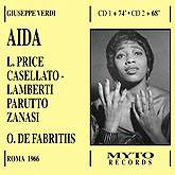
I doubt many admirers of Leontyne Price will be tempted to buy this issue.
After all there are two official recordings made in her prime and there are the widely popular live-recordings made at the Met (Bergonzi-Gorr-Solti); one even made the same year as this Rome-issue and it has the glorious voice of Franco Corelli as a bonus in the tenor role. Still Price-fans will miss out on a treat. She is in fabulous and firm voice: that unmistakably rich smoky sound domineering the whole evening. By the mid-sixties some Price-performances and even recordings were sometimes marred by her not being able or not wanting to produce a homogenous sound. She sometimes sounded as if she was experimenting with different kinds of vocal timbre so that several voices could be heard in one performance, even in one aria; all of them exciting but sometimes somewhat incompatible. She was not above growling parts of her role too. Nothing of that is to be heard in this recording: just an amazing outpouring of one of the most beautiful Verdian sounds to be heard on the scene. Her second aria is truly astounding, capped with an ethereal fine high C. The Roman house comes down and to its regret doesn’t get an encore though not for lack of trying.
None of the other singers come near though they are all interesting and didn’t have a big official recording career. Giorgio Lamberti was still very young at the time, only three years into his career. He has the true Italian sound and a vocal production that is best summed up as ‘trumpet’, reminding me of a legendary singer like Bernardo De Muro. Lamberti doesn’t commit mortal vocal sins like heavy sobbing but honesty compels me to write that he has no sense of the Verdian line, that he is just belting out the notes without any insight into his role: witness his lack of piano in the third act duet where he in has to take leave of Egypt. In the house the voice was probably fine but the unremitting penetrating sound tries the listener. Later on in his career he would have a better sense of legato, and would even succeed in giving us some pianissimi (I often heard him in the flesh; he still lives in my own Flanders) but these qualities were still to come. Mirella Parutto has a fruity mezzo and is a fine and convincing mezzo, as long as Price is not in the neighbourhood. Alas, the American soprano’s middle voice is bigger and more colourful and one hears Parutto pumping up the voice and straining for decibels. Mario Zanasi in one of his rare recordings shows off a big agreeable voice, though still singing in the verismo style in use at the Italian provincial houses. At ‘Dei Faraoni tu sei lo schiavo’ he clings interminably long to his top note, milking the house for applause. Veteran conductor De Fabritiis is fine most of the time, driving on his forces at a good Verdian speed. But now and then, mostly in the cabalettas, he gets a dose of stimulating substances (or he wants to show his singers who is the boss) and then he hurries along at a breakneck speed which must have made the singers curse him.
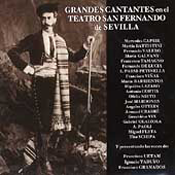 Grandes Cantantes en el Teatro San Fernando de Sevilla.
Lindoro MPCL-0802 [CD]
I’m sure vocal buffs of one of the most beautiful cities in Spain (indeed in the whole of Europe) will be pleased with a worthy souvenir of great historical singers who performed at their long lost beloved opera house of San Fernando. The house was built in the 1840’s and was renowned for the fine singers it attracted, especially just before and just after the first world war. Then it was the long road downhill until its demolition in 1973. Happily for the Sevillanos, the refurbishment of the whole city due to the world exhibition and the awful amount of money put into Spain by the European Union once more gave them an opera house, the Teatro de la Maestranza which opened in 1991. However I’m less sure that vocal buffs outside Sevilla will take up this CD. Famous singers on this CD like Capsir, Battistini, Tamagno, Lazaro, Cortis, Mardones, Fleta, Schipa etc. performed at the San Fernando and are duly incluked but I doubt very much collectors have waited for this CD to sample their voices.All of their recordings are to be found in earlier compilations or on solo albums by Preiser, Romophone, Bongiovanni or Spain’s Aria Recording. And several earlier issues are better pitched; the De Lucia record is a case in question, a tone too high. The redeeming feature of the CD is the introduction of some almost forgotten Spanish singers like Utam, Tabuyo and Granados; not all on the same level as their more famous countrymen and women but still good examples of their art and times. Perhaps a full CD with those and other lesser known performers would have found wider circulation among vocal record collectors.
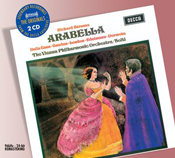 Richard Strauss: Arabella.
Lisa Della Casa (Arabella), Hilde Gueden (Zdenka), George London (Mandryka),
Anton Dermota (Matteo), Otto Edelman (graf Waldner), Ira Malaniuk (Adelaide),
Mimi Coertse (Fiakermilli). Wiener Philharmoniker conducted by Georg
Solti.
Decca 00289 475 7731 [2CDs]
Arabella may be the opera suffering most from surtitles. I remember an astonished lady, finally able to grasp every detail, who commented during the pause of a Ghent performance: “but this is an operetta.” Well, not quite. I doubt Messrs. Lehar and Kalman and Romberg would have accepted some of the sillier aspects of the libretto like the big guy falling in love with a portrait. But the structure of boy meets girl (first act), boy and girl quarrel (second act) and boy and girl nevertheless find happiness is indeed completely derived from Gypsy Princess, Countess Maritza and Naughty Marietta. Georg Solti however with his nervous and dramatic conducting makes the piece less sentimental than it can be and he has at his disposal an astounding cast. Most of them belong to the fabulous post-war ensemble of the Vienna State opera and they are able to sing and to record everything between Mozart and Lehar in a still unsurpassed way. The first thing that struck me was the sound. Though recorded in early stereo in 1958 it is still amazingly warm and fresh after half a century. Therefore nobody can discard this recording in the series The Originals because it sounds old and worn.
Moreover all of the singers are at the height of their powers. Della Casa’s voice in her signature role is shimmering with beauty, youth and freshness. She is strong when she rejects the attentions of unwanted suitors; she is warm and meltingly when she meets or speaks of ‘der Richtige’ and she easily rides the orchestral climaxes. I cannot imagine a better Zdenka than the boyish sound of Hilde Gueden which becomes appropriately sensuous when she once more becomes a girl in love. Solti takes care that she doesn’t linger on or scoop as she often did in her great operetta recordings with less stern conductors. A third rediscovery is the silvery coloratura of South-Africa’s most famous diva Mimi Coertse. She is sparkling and technically proficient and her small role is a plea to Decca to reissue her recitals. The male department is almost as strong. Anton Dermota as Matteo is far better than the average Matteo. It is an ungrateful role but Dermota with his experience of Mozart and his fine un-German somewhat grainy timbre succeeds in creating a sympathetic suitor. And then there is the singer whom many Americans (and others as well) will prefer as Mandryka and whom I have doubts about. For my personal taste the bass-baritone of George London is a bit too gruff, too throaty though he brings warmth to it in the third act. He doesn’t hector as Fischer-Dieskau does but there is less charm too. Mandryka may be rough from time to time but he is a nobleman. For me London is the relatively less than perfect singer in the recording but all in all, this budget issue is unbelievably fine and convincing and maybe the best around.
Jan Neckers