Recently in Recordings
The Sixteen continues its exploration of Henry Purcell’s Welcome Songs for Charles II. As with Robert King’s pioneering Purcell series begun over thirty years ago for Hyperion, Harry Christophers is recording two Welcome Songs per disc.
In February this year, Albanian soprano Ermonela Jaho made a highly lauded debut recital at Wigmore Hall - a concert which both celebrated Opera Rara’s 50th anniversary and honoured the career of the Italian soprano Rosina Storchio (1872-1945), the star of verismo who created the title roles in Leoncavallo’s La bohème and Zazà, Mascagni’s Lodoletta and Puccini’s Madama Butterfly.
Collapsology. Or, perhaps we should use the French word ‘Collapsologie’ because this is a transdisciplinary idea pretty much advocated by a series of French theorists - and apparently, mostly French theorists. It in essence focuses on the imminent collapse of modern society and all its layers - a series of escalating crises on a global scale: environmental, economic, geopolitical, governmental; the list is extensive.
Amongst an avalanche of new Mahler recordings appearing at the moment (Das Lied von der Erde seems to be the most favoured, with three) this 1991 Mahler Second from the 2nd Kassel MahlerFest is one of the more interesting releases.
If there is one myth, it seems believed by some people today, that probably needs shattering it is that post-war recordings or performances of Wagner operas were always of exceptional quality. This 1949 Hamburg Tristan und Isolde is one of those recordings - though quite who is to blame for its many problems takes quite some unearthing.
The voices of six women composers are celebrated by baritone Jeremy Huw Williams and soprano Yunah Lee on this characteristically ambitious and valuable release by Lontano Records Ltd (Lorelt).
As Paul Spicer, conductor of the Royal Birmingham Conservatoire Chamber Choir, observes, the worship of the Blessed Virgin Mary is as ‘old as Christianity itself’, and programmes devoted to settings of texts which venerate the Virgin Mary are commonplace.
Ethel Smyth’s last large-scale work, written in 1930 by the then 72-year-old composer who was increasingly afflicted and depressed by her worsening deafness, was The Prison – a ‘symphony’ for soprano and bass-baritone soloists, chorus and orchestra.
‘Hamilton Harty is Irish to the core, but he is not a musical nationalist.’
‘After silence, that which comes closest to expressing the inexpressible is music.’ Aldous Huxley’s words have inspired VOCES8’s new disc, After Silence, a ‘double album in four chapters’ which marks the ensemble’s 15th anniversary.
A song-cycle is a narrative, a journey, not necessarily literal or linear, but one which carries performer and listener through time and across an emotional terrain. Through complement and contrast, poetry and music crystallise diverse sentiments and somehow cohere variability into an aesthetic unity.
One of the nicest things about being lucky enough to enjoy opera, music and theatre, week in week out, in London’s fringe theatres, music conservatoires, and international concert halls and opera houses, is the opportunity to encounter striking performances by young talented musicians and then watch with pleasure as they fulfil those sparks of promise.
“It’s forbidden, and where’s the art in that?”
Dublin-born John F. Larchet (1884-1967) might well be described as the father of post-Independence Irish music, given the immense influenced that he had upon Irish musical life during the first half of the 20th century - as a composer, musician, administrator and teacher.
The English Civil War is raging. The daughter of a Puritan aristocrat has fallen in love with the son of a Royalist supporter of the House of Stuart. Will love triumph over political expediency and religious dogma?
Beethoven Symphony no 9 (the Choral Symphony) in D minor, Op. 125, and the Choral Fantasy in C minor, Op. 80 with soloist Kristian Bezuidenhout, Pablo Heras-Casado conducting the Freiburger Barockorchester, new from Harmonia Mundi.
A Louise Brooks look-a-like, in bobbed black wig and floor-sweeping leather trench-coat, cheeks purple-rouged and eyes shadowed in black, Barbara Hannigan issues taut gestures which elicit fire-cracker punch from the Mahler Chamber Orchestra.
‘Signor Piatti in a fantasia on themes from Beatrice di Tenda had also his triumph. Difficulties, declared to be insuperable, were vanquished by him with consummate skill and precision. He certainly is amazing, his tone magnificent, and his style excellent. His resources appear to be inexhaustible; and altogether for variety, it is the greatest specimen of violoncello playing that has been heard in this country.’
Baritone Roderick Williams seems to have been a pretty constant ‘companion’, on my laptop screen and through my stereo speakers, during the past few ‘lock-down’ months.
Melodramas can be a difficult genre for composers. Before Richard Strauss’s Enoch Arden the concept of the melodrama was its compact size – Weber’s Wolf’s Glen scene in Der Freischütz, Georg Benda’s Ariadne auf Naxos and Medea or even Leonore’s grave scene in Beethoven’s Fidelio.
Recordings
27 Nov 2007
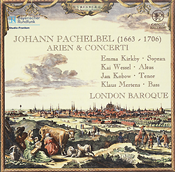
Johann Pachelbel. Arien & Concerti
Although few composers have been so closely associated with a single work, Johann Pachelbel, whose canon for three violins has achieved canonical ubiquity, was a prolific composer with a number of vocal works to his credit.
This present recording brings together a number of them written for both devotional use and secular occasions, such as weddings, name days, and salutes to patrons and teachers. Most are strophic airs for one or two singers and strings, the latter providing interludes that serve to punctuate and articulate the structural boundaries of the vocal setting. Occasionally the interludes are particularly rich in sonority—“Mein Leben, dessen Kreutz” and “Augen, streuet Perlen Tränen” use four violas, for instance—and often they are engagingly rollicking.
The concertos on the recording are through-composed works, affording more expressive range for singer and instrumentalist alike, intertwining both in equal measure of soloistic writing. In some instances the concertos are cantata-like with multiple sections, including triple-meter lilting airs, as in “Ach Herr, wie ist meiner Feinde so viel,” and the instrumental writing can be floridly soloistic, as in the scordatura violin part to “Christ ist erstanden.” Here, and in “Ach Herr, wie ist meiner Feinde so viel,” the unflaggingly stylish playing of Ingrid Seifert of London Baroque is impressively on display.
Somewhat singular among the arias and concertos is the aria “Mœcenas lebet noch,” a salute to a person whose likely high rank elicited the scoring for obligatto trumpet. Michael Maisch performs this part with a compelling degree of vocality, and the tunefulness of the aria has a gratifying lilt, a lilt captured with animated relish in many of the arias in the collection. If “Mœcenas lebet noch” is singular, nevertheless most of the arias are cut of the same cloth, and the similarity is underscored here by the repetition of the strophic form. Some of the arias survive with only one stanza of text, and given the uniformity of the style, one might wonder at their inclusion; fragments, they are of necessity brief, but in their brevity they also contribute little that is new. Archivally it is welcome to have them recorded, but programmatically they seem a bit anomalous.
The performers are an impressive assembly. Emma Kirkby continues to command the amazingly clear articulation that has characterized her singing for many decades, and the rapid passage work here is wonderfully fluent. Tenor Jan Kobow is strong and intense, though he also has some fine expressive forays into the soft range in “Wie nichtig, ach wie flüchtig.” The most memorable singing is from bass Klaus Mertens, whose rounded tone and flexible agility offers much to savor.
The collection Arien & Concerti provides many rewarding moments. Programmatically the generic similarity between the arias may suggest it is more a recording to sample than to listen to straight through, but the sampling (or the larger serving) will not fail to gratify.
Steven Plank