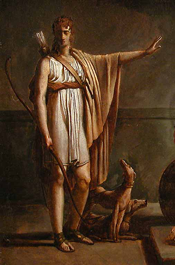
27 Jan 2008
TRAETTA: Ippolito ed Aricia
Ippolito ed Aricia: Tragedia in five acts.
Mozart and Salieri, an opera in one act consisting of two scenes.
Nicolai Rimsky-Korsakov (1844-1908), composer. Libretto derived from Alexander Puskhin's play of the same name.
First performance: 7 December 1898 in Moscow.
Ariadne auf Naxos, Oper with a prologue and one act. Music composed by Richard Strauss. Libretto by Hugo von Hofmannsthal.
La Vestale, a tragédie lyrique in three acts.
Boris Godunov, an opera in four acts with prologue
Modest Mussorgsky, composer. Libretto by the composer, based on Alexander Pushkin's drama Boris Godunov and Nikolai Karamazin's History of the Russian Empire
First performance: 8 February 1874 at the Mariinsky Theatre, St. Petersburg
Il Trovatore, dramma in four parts.
Only a few months following the premiere of Der Rosenkavalier, Hugo von Hofmannsthal proposed a new opera to Richard Strauss based on Molière’s comedy-ballet, Le Bourgeois gentilhomme (in German, Der Bürger als Edelmann).
Die Entführung aus dem Serail, Singspiel in 3 Acts.
Music composed by Wolfgang Amadeus Mozart (1756–1791). Libretto by Johann Gottlieb Stephanie the Younger, based on an earlier libretto by
Christoph Friedrich Bretzner.
Die Entführung aus dem Serail, Singspiel in 3 Acts.
Music composed by Wolfgang Amadeus Mozart (1756–1791). Libretto by Johann Gottlieb Stephanie the Younger, based on an earlier libretto by
Christoph Friedrich Bretzner.
Arabella: Lyrische Komödie in three acts
Die Entführung aus dem Serail, Singspiel in 3 Acts.
Music composed by Wolfgang Amadeus Mozart (1756–1791). Libretto by Johann Gottlieb Stephanie the Younger, based on an earlier libretto by
Christoph Friedrich Bretzner.
La Gioconda, dramma lirico in four acts.
Music composed by Amilcare Ponchielli (1834–1886). Libretto by Arrigo Boito (under the pseudonym Tobia Gorrio), based upon Victor Hugo's Angelo, Tyrant of Padua (1835).
Don Carlo, an opera in four acts. Music composed by Giuseppe Verdi (1813–1901). Libretto by Joseph Méry and Camille Du Locle after Friedrich von Schiller’s dramatic poem Don Carlos, Infant von Spanien. Revised version in four acts (French text revised by Du Locle, Italian translation by Achille de Lauzières and Angelo Zanardini).
Un ballo in maschera, a melodramma in three acts.
Music composed by Giuseppe Verdi. Libretto by Antonio Somma, based upon the work of Eugène Scribe Gustave III ou Le bal masqué (1833)
Medea: Melodramma tragico in three acts.
Die Tote Stadt, an opera in three acts.
Music composed by Erich Wolfgang Korngold (1897-1957). Libretto by Paul Schott (Julius and E. W. Korngold) after the novel Bruges la morte by Georges Rodenbach.
Some Details concerning the Revolution inaugurated by Rossini
Manon Lescaut, dramma lirico in quattro atti
Elektra: Tragedy in one act.
Lyric Opera of Chicago has announced both schedules and cast-lists for is Spring 2020 performances of Richard Wagner’s Ring Cycle. Given the series of individual productions already staged by the company since Fall 2016, that pave the way for the complete cycle, Lyric Opera of Chicago’s complete production should affirm the artistic might of the great composer.
“Diacono himself does not know what musical talent he possesses” – Mascagni
Ippolito ed Aricia: Tragedia in five acts.
Streaming Audio
Music composed by Tommaso Traetta. Libretto by Carlo Innocenzo Frugoni after Simon-Joseph Pellegrin’s Hippolyte et Aricie.
First Performance: 9 May 1759, Teatro Ducale, Parma
| Principal Characters: | |
| Theseus [Teseo], king of Athens | Tenor |
| Hippolytus [Ippolito], son of Theseus | Soprano/Castrato |
| Phaedra [Fedra], Theseus' wife, stepmother to Hippolytus | Soprano |
| Oenone [Enone], nurse and confidante of Phaedra | Soprano |
| Aricia, princess of the blood royal of Athens | Soprano |
| Diana, a goddess | Soprano |
Synopsis of Phèdre by Jean Racine based on Hippolytus by Euripides and Phaedra by Seneca:
Act I
Theseus, king of Athens, has disappeared during one of his expeditions. Hippolytus tells Theramenes of his intention to search for his father. But this is not the real reason he wishes to leave Troezen, where the court has been in residence for some time. Neither does he desire to avoid the persecution of his stepmother, Phaedra. His only motive is to escape the charms of Aricia, the only survivor of the royal family who formerly ruled Athens. He is in love with her, and his father has forbidden her to marry.
Oenone, Phaedra's nurse, announces her mistress, but Hippolytus wishes to avoid an unpleasant meeting, and departs. The queen's behavior, and her conversation with Oenone, betray her incestuous and forbidden love for Hippolytus. She wishes for death, but the sudden announcement of Theseus' death puts a new complexion on things. Free to indulge her passion, she gives up her suicide plan in order to arrange an alliance with Hippolytus against Aricia, to preserve her own son's right to the throne of Athens.
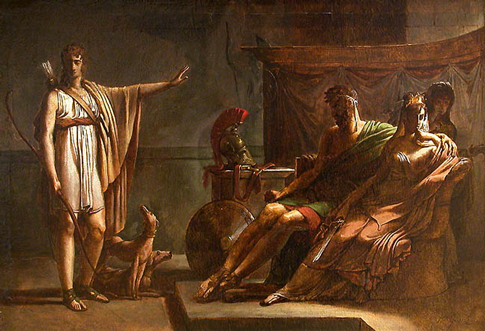 Phèdre et Hippolyte by Baron Pierre-Narcisse Guérin (1802)
Act II
Ismene, Aricia's confidante, announces Theseus' death to the young girl and in the same breath reveals her suspicion of Hippolytus' romantic feelings for Aricia. Incredulously the young girl listens to a revelation that enchants her, since she, in turn, has fallen in love with Hippolytus. Hippolytus soon confirms the confidante's speculation in a tender but awkward confession. The interview is interrupted by the announcement of Phaedra's arrival, but not before Aricia has timidly admitted her own feelings.
Phaedra comes in with the purported intention of pleading for her son. However, carried away by her passion, she forgets her original purpose and reveals her secret love. Crushed by Hippolytus' horrified reception of her declaration, she takes his sword to kill herself. As she rushes out, Theramenes comes in with a momentous rumor: Theseus may be alive. Hippolytus decides to investigate the rumor and to fight against Phaedra's claim to the throne and in defense of Aricia's rights.
Act III
Phaedra's confession has had an unexpected result. In spite of her humiliation, her hopes have been revived and she now urges a reluctant Oenone to plead her case with Hippolytus. However the situation changes drastically with the news of Theseus' return. At first Phaedra, panic-stricken, again threatens suicide, then yields to Oenone's perfidious plan to accuse Hippolytus of attempting to seduce her. When Theseus comes in, Phaedra departs with a cryptic hint. Hippolytus also leaves with a lame excuse.
Act IV
At the beginning of the scene, Oenone completes the slanderous accusation against Hippolytus introduced offstage. The credulous Theseus is completely deceived. When Hippolytus appears, Theseus wonders indignantly at his son's innocent appearance and greets him with immoderate accusations, culminating in a prayer to Neptune for revenge. Hippolytus, out of filial consideration, defends himself by pointing out his reputation for virtue and reminding Theseus of Phaedra's ancestry, and by confessing his love for Aricia. Theseus rejects the last argument as a mere ploy.
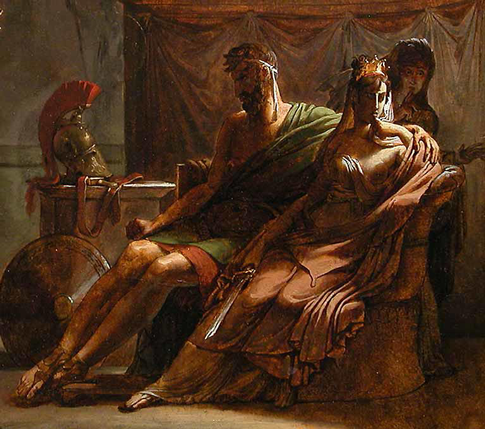 Detail from Phèdre et Hippolyte by Baron Pierre-Narcisse Guérin (1802)
Meanwhile, Phaedra, stricken by remorse, goes to see Theseus to plead for Hippolytus. But she changes her mind when Theseus unwittingly reveals to her that she has a successful rival. She becomes hysterical with jealously and rage. Finally, however, she repents and repudiates Oenone, the instigator and agent of her treachery.
Act V
Still refusing to clear his name, Hippolytus decides to flee but before leaving, arranges a rendezvous with Aricia so that they may wed. Immediately after his departure Theseus abruptly appears. In spite of her embarrassment, Aricia stands up to him and defends Hippolytus' innocence with such conviction that the king's certainty is shaken. He calls for Oenone and is even more deeply disturbed when a servant reveals Oenone's suicide and Phaedra's irrational behavior. Theseus, at last, is willing to reconsider his belief in his son's guilt, but it is too late. Theramenes comes in with the harrowing tale of Hippolytus' death. Phaedra arrives and clears Hippolytus, then dies of the effects of a poison she has taken earlier. Grief-stricken, Theseus vows to make full amends to his son's memory and to treat Aricia as his daughter. [Diana restores Hippolytus to life and reunites the couple.]*
[Synopsis Source: CliffsNotes]
Click here for the livret of Hippolyte & Aricie.
* Added by Pellegrin