06 Jul 2008
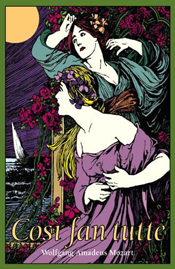
MOZART: Così fan tutte — Wien 2008
Così fan tutte, ossia La scuola degli amanti (K. 588). Opera buffa in two acts.
Mozart and Salieri, an opera in one act consisting of two scenes.
Nicolai Rimsky-Korsakov (1844-1908), composer. Libretto derived from Alexander Puskhin's play of the same name.
First performance: 7 December 1898 in Moscow.
Ariadne auf Naxos, Oper with a prologue and one act. Music composed by Richard Strauss. Libretto by Hugo von Hofmannsthal.
La Vestale, a tragédie lyrique in three acts.
Boris Godunov, an opera in four acts with prologue
Modest Mussorgsky, composer. Libretto by the composer, based on Alexander Pushkin's drama Boris Godunov and Nikolai Karamazin's History of the Russian Empire
First performance: 8 February 1874 at the Mariinsky Theatre, St. Petersburg
Il Trovatore, dramma in four parts.
Only a few months following the premiere of Der Rosenkavalier, Hugo von Hofmannsthal proposed a new opera to Richard Strauss based on Molière’s comedy-ballet, Le Bourgeois gentilhomme (in German, Der Bürger als Edelmann).
Die Entführung aus dem Serail, Singspiel in 3 Acts.
Music composed by Wolfgang Amadeus Mozart (1756–1791). Libretto by Johann Gottlieb Stephanie the Younger, based on an earlier libretto by
Christoph Friedrich Bretzner.
Die Entführung aus dem Serail, Singspiel in 3 Acts.
Music composed by Wolfgang Amadeus Mozart (1756–1791). Libretto by Johann Gottlieb Stephanie the Younger, based on an earlier libretto by
Christoph Friedrich Bretzner.
Arabella: Lyrische Komödie in three acts
Die Entführung aus dem Serail, Singspiel in 3 Acts.
Music composed by Wolfgang Amadeus Mozart (1756–1791). Libretto by Johann Gottlieb Stephanie the Younger, based on an earlier libretto by
Christoph Friedrich Bretzner.
La Gioconda, dramma lirico in four acts.
Music composed by Amilcare Ponchielli (1834–1886). Libretto by Arrigo Boito (under the pseudonym Tobia Gorrio), based upon Victor Hugo's Angelo, Tyrant of Padua (1835).
Don Carlo, an opera in four acts. Music composed by Giuseppe Verdi (1813–1901). Libretto by Joseph Méry and Camille Du Locle after Friedrich von Schiller’s dramatic poem Don Carlos, Infant von Spanien. Revised version in four acts (French text revised by Du Locle, Italian translation by Achille de Lauzières and Angelo Zanardini).
Un ballo in maschera, a melodramma in three acts.
Music composed by Giuseppe Verdi. Libretto by Antonio Somma, based upon the work of Eugène Scribe Gustave III ou Le bal masqué (1833)
Medea: Melodramma tragico in three acts.
Die Tote Stadt, an opera in three acts.
Music composed by Erich Wolfgang Korngold (1897-1957). Libretto by Paul Schott (Julius and E. W. Korngold) after the novel Bruges la morte by Georges Rodenbach.
Some Details concerning the Revolution inaugurated by Rossini
Manon Lescaut, dramma lirico in quattro atti
Elektra: Tragedy in one act.
Lyric Opera of Chicago has announced both schedules and cast-lists for is Spring 2020 performances of Richard Wagner’s Ring Cycle. Given the series of individual productions already staged by the company since Fall 2016, that pave the way for the complete cycle, Lyric Opera of Chicago’s complete production should affirm the artistic might of the great composer.
“Diacono himself does not know what musical talent he possesses” – Mascagni
Così fan tutte, ossia La scuola degli amanti (K. 588). Opera buffa in two acts.
Streaming Audio
Music composed by Wolfgang Amadeus Mozart (1756–1791). Libretto by Lorenzo Da Ponte.
First Performance: 26 January 1790, Burgtheater, Vienna.
| Principal Characters: | |
| Fiordiligi, a lady from Ferrara, living in Naples | Soprano |
| Dorabella, sister of Fiordiligi | Soprano |
| Guglielmo, an officer, Fiordiligi’s lover | Bass |
| Ferrando, an officer, Dorabella’s lover | Tenor |
| Despina, maidservant to the sisters | Soprano |
| Don Alfonso, an old philosopher | Bass |
Setting: 18th Century Naples
Synopsis:
Act I
It is early morning. Two young officers, Ferrando and Guglielmo, boast about the beauty and virtue of their sweethearts, the sisters Dorabella and Fiordiligi (“La mia Dorabella”). Don Alfonso, an older man and a friend of the two officers, insists that a woman's constancy is like the Arabian phoenix - everyone says it exists but no one has ever seen it (“È la fede delle femmine”). He proposes a wager of one hundred sequins that if they give him one day, and do everything he asks, he will prove the sisters are like all other women - fickle. The two young men willingly agree to Alfonso's terms and imagine with pleasure how they will spend their winnings (“Una bella serenata”).
Fiordiligi and Dorabella gaze blissfully at their miniature portraits of Guglielmo and Ferrando (“Ah, guarda sorella”), and imagine happily that they will soon be married. Alfonso's plan for the day begins when he arrives with terrible news: the young officers have been called away to their regiment. The two men appear, apparently heartbroken, and they all make elaborate farewells (“Sento, o dio”). As the soldiers leave, the two women and Alfonso wish them a safe journey (“Soave sia il vento”). Alfonso is delighted with his plot and feels certain of winning his wager.
As Despina complains about how much work she has to do around the house, Fiordiligi and Dorabella, upset by the departure of their fiancés, burst in. Dorabella vents her feelings (“Smanie implacabili”), but Despina's advice is to forget their old lovers with the help of new ones. All men are fickle, she says, and unworthy of a woman's fidelity (“In uomini, in soldati”). Her mistresses resent Despina's approach to love, and depart. Alfonso arrives to plan the next stage of his wager: he enlists Despina's help to introduce the girls to two exotic visitors, in fact Ferrando and Guglielmo in disguise, and is relieved when Despina does not recognize the two men. The sisters are scandalized to discover strange men in their house. The newcomers declare their admiration for the ladies, each wooing the other's girlfriend, according to Alfonso's design, but the girls reject them. Fiordiligi likens her constancy to a rock in a storm (“Come scoglio”). The men are confident of winning the bet, but Alfonso reminds them that the day is still young. Ferrando reiterates his passion for Dorabella (“Un'aura amorosa”), and the two go off to await Alfonso's further orders. Despina, still unaware of the men's identities, plans the afternoon with Alfonso.
As the sisters lament the absence of their lovers, the two “foreigners" stagger in, pretending to have poisoned themselves in despair over their rejection. The sisters call for Despina, who urges them to care for the men while she and Alfonso fetch a doctor. Despina re-enters disguised as a doctor and, with a special magnet, pretends to draw off the poison. She then demands that the girls nurse the patients as they recover. The men revive (“Dove son?”), and request kisses. As Fiordiligi and Dorabella waver under renewed protestations of love, the men begin to worry.
Act II
In the afternoon, Despina lectures her mistresses on their stubbornness and describes how a woman should handle men (“Una donna a quindici anni”). Dorabella is persuaded that there could be no harm in a little flirtation, and surprisingly, Fiordiligi agrees. They decide who will pair off with whom, and fitting perfectly into Alfonso's plan, each picks the other's original suitor (“Prenderò quel brunettino”).
Alfonso has arranged a romantic serenade for the sisters in the garden, and after delivering a short lesson in courtship, he and Despina leave the four young people together. Guglielmo, courting Dorabella, succeeds in replacing her portrait of Ferrando with a golden heart (“Il core vi dono”). Ferrando apparently has less luck with Fiordiligi (“Ah, lo veggio”); but when she is left alone, she guiltily admits he has touched her heart (“Per pietà”).
When they compare notes later, Ferrando is certain that they have won the wager. Guglielmo, although pleased at the report of Fiordiligi's faithfulness to him, is uncertain how to break the news of Dorabella's inconstancy to Ferrando. He shows his friend the portrait he took from Dorabella and Ferrando is furious. Guglielmo blames it all on women (“Donne mie, la fate a tanti!”), but his friend is not comforted (“Tradito, schernito”). Guglielmo asks Alfonso to pay him his half of the winnings, but Alfonso reminds him again that the day is not yet over.
Fiordiligi rebukes Dorabella for being fickle, but finally admits that in her heart she has succumbed to the stranger. Dorabella coaxes her to give way completely, saying love is a thief who rewards those who obey him and punishes all others (“È amore un ladroncello”). Left alone, Fiordiligi decides to run away and join Guglielmo at war, but Ferrando, pursuing the wager, tries one last time to seduce her and succeeds.
Guglielmo is furious, but Alfonso counsels forgiveness: that's the way women are, he claims, and a man who has been deceived can blame only himself (“Tutti accusan le donne”). As night falls, he promises to find a solution to their problems: he plans a double-wedding.
Despina runs in with a double-wedding plan of her own: the two sisters have agreed to marry the “foreigners,” and she is to find a notary for the ceremony. The scene is set for the marriage, and Alfonso arrives with the notary - Despina in another disguise. As Fiordiligi and Dorabella sign the contract, martial strains herald the return of the former lovers' regiment. In panic the two women hide their intended husbands and try to compose themselves for the arrival of Ferrando and Guglielmo. The two apparently joyful soldiers return, but soon become disturbed by the obvious discomfort of the ladies. When they discover the notary the sisters beg the two men to kill them. Ferrando and Guglielmo reveal to them the identities of the "foreigners.” Despina realizes that Alfonso had let her in on only half of the charade and tries to escape. Alfonso bids the lovers learn their lesson and, with a hymn to reason and enlightenment, the day comes to a close.
Commentary.
“Così has been seen as revealing a dark side to the Enlightenment, an anti-feminist sadism (Ford 1991). Yet by any showing the most admirable character is Fiordiligi. The girls develop more than the men. Dorabella at least learns to understand her own lightness; and ‘Fra gli amplessi’ suggests that Fiordiligi has matured through learning the power of sexuality. There is little sign that Guglielmo learns anything in the school for lovers, even that those who set traps deserve to get caught, although his vanity is wounded as deeply as his purse. Ferrando, however, comes to live as intensely as Fiordiligi, and may appear to have fallen in love with her. To suggest that they should marry (leaving Guglielmo for Dorabella) is, however, still less satisfactory than reversion to the original pairings. The conclusion represents not a solution but a way of bringing the action to a close with an artificiality so evident that no happy outcome can be predicted. The music creates this enigma, but cannot solve it.”
Julian Rushton: 'Così fan tutte', Grove Music Online (Accessed 11 June 2006).