17 Aug 2008
Karajan on DG, EMI
The 100th anniversary of his birth inevitably produces a flood of releases from the catalog of conductor Herbert von Karajan.
The Sixteen continues its exploration of Henry Purcell’s Welcome Songs for Charles II. As with Robert King’s pioneering Purcell series begun over thirty years ago for Hyperion, Harry Christophers is recording two Welcome Songs per disc.
In February this year, Albanian soprano Ermonela Jaho made a highly lauded debut recital at Wigmore Hall - a concert which both celebrated Opera Rara’s 50th anniversary and honoured the career of the Italian soprano Rosina Storchio (1872-1945), the star of verismo who created the title roles in Leoncavallo’s La bohème and Zazà, Mascagni’s Lodoletta and Puccini’s Madama Butterfly.
Collapsology. Or, perhaps we should use the French word ‘Collapsologie’ because this is a transdisciplinary idea pretty much advocated by a series of French theorists - and apparently, mostly French theorists. It in essence focuses on the imminent collapse of modern society and all its layers - a series of escalating crises on a global scale: environmental, economic, geopolitical, governmental; the list is extensive.
Amongst an avalanche of new Mahler recordings appearing at the moment (Das Lied von der Erde seems to be the most favoured, with three) this 1991 Mahler Second from the 2nd Kassel MahlerFest is one of the more interesting releases.
If there is one myth, it seems believed by some people today, that probably needs shattering it is that post-war recordings or performances of Wagner operas were always of exceptional quality. This 1949 Hamburg Tristan und Isolde is one of those recordings - though quite who is to blame for its many problems takes quite some unearthing.
The voices of six women composers are celebrated by baritone Jeremy Huw Williams and soprano Yunah Lee on this characteristically ambitious and valuable release by Lontano Records Ltd (Lorelt).
As Paul Spicer, conductor of the Royal Birmingham Conservatoire Chamber Choir, observes, the worship of the Blessed Virgin Mary is as ‘old as Christianity itself’, and programmes devoted to settings of texts which venerate the Virgin Mary are commonplace.
Ethel Smyth’s last large-scale work, written in 1930 by the then 72-year-old composer who was increasingly afflicted and depressed by her worsening deafness, was The Prison – a ‘symphony’ for soprano and bass-baritone soloists, chorus and orchestra.
‘Hamilton Harty is Irish to the core, but he is not a musical nationalist.’
‘After silence, that which comes closest to expressing the inexpressible is music.’ Aldous Huxley’s words have inspired VOCES8’s new disc, After Silence, a ‘double album in four chapters’ which marks the ensemble’s 15th anniversary.
A song-cycle is a narrative, a journey, not necessarily literal or linear, but one which carries performer and listener through time and across an emotional terrain. Through complement and contrast, poetry and music crystallise diverse sentiments and somehow cohere variability into an aesthetic unity.
One of the nicest things about being lucky enough to enjoy opera, music and theatre, week in week out, in London’s fringe theatres, music conservatoires, and international concert halls and opera houses, is the opportunity to encounter striking performances by young talented musicians and then watch with pleasure as they fulfil those sparks of promise.
“It’s forbidden, and where’s the art in that?”
Dublin-born John F. Larchet (1884-1967) might well be described as the father of post-Independence Irish music, given the immense influenced that he had upon Irish musical life during the first half of the 20th century - as a composer, musician, administrator and teacher.
The English Civil War is raging. The daughter of a Puritan aristocrat has fallen in love with the son of a Royalist supporter of the House of Stuart. Will love triumph over political expediency and religious dogma?
Beethoven Symphony no 9 (the Choral Symphony) in D minor, Op. 125, and the Choral Fantasy in C minor, Op. 80 with soloist Kristian Bezuidenhout, Pablo Heras-Casado conducting the Freiburger Barockorchester, new from Harmonia Mundi.
A Louise Brooks look-a-like, in bobbed black wig and floor-sweeping leather trench-coat, cheeks purple-rouged and eyes shadowed in black, Barbara Hannigan issues taut gestures which elicit fire-cracker punch from the Mahler Chamber Orchestra.
‘Signor Piatti in a fantasia on themes from Beatrice di Tenda had also his triumph. Difficulties, declared to be insuperable, were vanquished by him with consummate skill and precision. He certainly is amazing, his tone magnificent, and his style excellent. His resources appear to be inexhaustible; and altogether for variety, it is the greatest specimen of violoncello playing that has been heard in this country.’
Baritone Roderick Williams seems to have been a pretty constant ‘companion’, on my laptop screen and through my stereo speakers, during the past few ‘lock-down’ months.
Melodramas can be a difficult genre for composers. Before Richard Strauss’s Enoch Arden the concept of the melodrama was its compact size – Weber’s Wolf’s Glen scene in Der Freischütz, Georg Benda’s Ariadne auf Naxos and Medea or even Leonore’s grave scene in Beethoven’s Fidelio.
The 100th anniversary of his birth inevitably produces a flood of releases from the catalog of conductor Herbert von Karajan.
Others can continue the battles over his reputation as a figure in the political world of his time, both artistic and historical. For your reviewer, it’s simpler to listen to the recordings and respond to his achievements with a baton in hand.
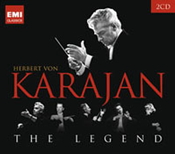 And a hand on the recording studio mixing knobs, or at least, a hand on the shoulders of those who had their actual hands there. The studio records under consideration -DG’s Opera Intermezzi and EMI’s compendium, Karajan the Legend - both reflect Karajan’s virtues and defects. The immaculate musicianship never wavers. In fact, so uniform is the style and interpretation that on the EMI set, composers as different as Debussy, Berlioz, and Schubert all seem like compositional cousins. Strings dominate, slick and thick. Tempos tend to a weighty trod, as if under the burden of the conductor’s profound vision. What that profound vision might be resists easy definition. In Bizet’s suite from “L’Arlésienne” on the EMI set, the dark colors make the piece sound like a very abbreviated Mahler symphony. On one hand, it sounds great. On the other - what has this to do with Bizet? The Bolero from this collection never seems to reach its climax, as it is tightly controlled by the conductor and starts almost inaudibly. Two CDs of excerpts (including symphony movements) with the conductor constantly in search of some ideal orchestral sound finally becomes a wearing experience.
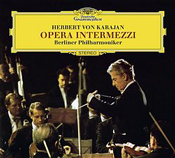 That same languid pace dominates many of the selections on the DG Opera Intermezzi disc. Your reviewer might retitle it “Opera Interminablezzi.” The prelude to Traviata reaches four and a half minutes, suggesting Violetta died not in a fever but in a narcoleptic swoon. Strings smother the pathos of Puccini’s intermezzi from Manon Lescaut and Suor Angelica. Would Mantovani have produced much that was different if he and his ensembles had recorded Mascagni and Cilea?
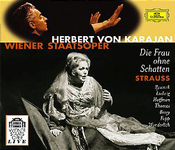 Now turn to the two DG sets from the archives of the Vienna State Opera. Karajan is a different man in the opera house, caught live. In both the Strauss and Beethoven, Karajan leads performances of energy, with a steady pulse and colorful detail. The Die Frau ohne Schatten really is a revelation. Karajan lightens the textures in many places, reminding a listener that this Strauss also composed Ariadne auf Naxos. Lovers of the opera - who tend to the cultish - will be dismayed at the cuts (and a change in scene order in act two). It’s their loss if they deny themselves the pleasures of this performance. Leonie Rysanek , the Empress, is in fine voice, and that means she is indomitable. Walter Berry and Christa Ludwig are the Dyer and his wife. Ludwig shows here - and also in the Fidelio - that she could handle the demands of a soprano role with intelligence, and as doesn’t happen all that often, the Dyer’s wife comes off as less of a harpy. Jess Thomas as the Emperor and Grace Hoffman as the Nurse provide fine support, and Lucia Popp, early in her career, turns up in two smaller roles, including that of the Falcon. Unfortunately, that role occurs either offstage or far backstage, and the mono sound, otherwise warm and clear, doesn’t capture those voices satisfactorily. Such are the variables in most live recordings, and the strengths of this one suggest forbearance will be rewarded.
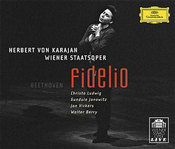
The Fidelio, however, has much more compromised sound, narrow and muted. In both overtures (Karajan plays the Leonore III before the final scene), the loud passages get too rambunctious, but the sound loses color with the volume adjusted. It’s unfortunate, because the performance otherwise has it all over Karajan’s later studio version, highlights from which your reviewer recently wrote about for OperaToday . Ludwig, as mentioned before, presents a great Leonore, handling the challenges of her big scene with skill and taste. The booklet note claims that Jon Vickers was indisposed, but the huskiness of his voice works well for the character of a starved, abused prisoner. And how about Gundula Janowitz and Waldemar Kmentt as Jaquino and Marzelline? They hold their own with the leads and Eberhard Waechter (Don Fernando) and Walter Berry (Don Pizarro). Oh for a better recording...
So the choice here is between the homogenized sound of the studio recordings and the imperfect audio but more inspired live performances. Forget “the legend,” go for the conductor.
Chris Mullins