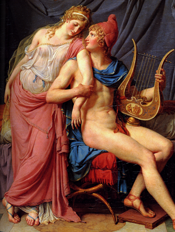
14 Sep 2008
STRAUSS: Die ägyptische Helena — Salzburg 2003
Die ägyptische Helena: Oper in two acts.
Mozart and Salieri, an opera in one act consisting of two scenes.
Nicolai Rimsky-Korsakov (1844-1908), composer. Libretto derived from Alexander Puskhin's play of the same name.
First performance: 7 December 1898 in Moscow.
Ariadne auf Naxos, Oper with a prologue and one act. Music composed by Richard Strauss. Libretto by Hugo von Hofmannsthal.
La Vestale, a tragédie lyrique in three acts.
Boris Godunov, an opera in four acts with prologue
Modest Mussorgsky, composer. Libretto by the composer, based on Alexander Pushkin's drama Boris Godunov and Nikolai Karamazin's History of the Russian Empire
First performance: 8 February 1874 at the Mariinsky Theatre, St. Petersburg
Il Trovatore, dramma in four parts.
Only a few months following the premiere of Der Rosenkavalier, Hugo von Hofmannsthal proposed a new opera to Richard Strauss based on Molière’s comedy-ballet, Le Bourgeois gentilhomme (in German, Der Bürger als Edelmann).
Die Entführung aus dem Serail, Singspiel in 3 Acts.
Music composed by Wolfgang Amadeus Mozart (1756–1791). Libretto by Johann Gottlieb Stephanie the Younger, based on an earlier libretto by
Christoph Friedrich Bretzner.
Die Entführung aus dem Serail, Singspiel in 3 Acts.
Music composed by Wolfgang Amadeus Mozart (1756–1791). Libretto by Johann Gottlieb Stephanie the Younger, based on an earlier libretto by
Christoph Friedrich Bretzner.
Arabella: Lyrische Komödie in three acts
Die Entführung aus dem Serail, Singspiel in 3 Acts.
Music composed by Wolfgang Amadeus Mozart (1756–1791). Libretto by Johann Gottlieb Stephanie the Younger, based on an earlier libretto by
Christoph Friedrich Bretzner.
La Gioconda, dramma lirico in four acts.
Music composed by Amilcare Ponchielli (1834–1886). Libretto by Arrigo Boito (under the pseudonym Tobia Gorrio), based upon Victor Hugo's Angelo, Tyrant of Padua (1835).
Don Carlo, an opera in four acts. Music composed by Giuseppe Verdi (1813–1901). Libretto by Joseph Méry and Camille Du Locle after Friedrich von Schiller’s dramatic poem Don Carlos, Infant von Spanien. Revised version in four acts (French text revised by Du Locle, Italian translation by Achille de Lauzières and Angelo Zanardini).
Un ballo in maschera, a melodramma in three acts.
Music composed by Giuseppe Verdi. Libretto by Antonio Somma, based upon the work of Eugène Scribe Gustave III ou Le bal masqué (1833)
Medea: Melodramma tragico in three acts.
Die Tote Stadt, an opera in three acts.
Music composed by Erich Wolfgang Korngold (1897-1957). Libretto by Paul Schott (Julius and E. W. Korngold) after the novel Bruges la morte by Georges Rodenbach.
Some Details concerning the Revolution inaugurated by Rossini
Manon Lescaut, dramma lirico in quattro atti
Elektra: Tragedy in one act.
Lyric Opera of Chicago has announced both schedules and cast-lists for is Spring 2020 performances of Richard Wagner’s Ring Cycle. Given the series of individual productions already staged by the company since Fall 2016, that pave the way for the complete cycle, Lyric Opera of Chicago’s complete production should affirm the artistic might of the great composer.
“Diacono himself does not know what musical talent he possesses” – Mascagni
Die ägyptische Helena: Oper in two acts.
Music composed by Richard Strauss. Libretto by Hugo von Hofmannsthal.
First Performance: 6 June 1928, Sächsisches Staatstheater Opernhaus, Dresden (revised version, Salzburg, Festspielhaus, 14 August 1933).
| Principal Roles: | |
| Helena [Helen] of Troy, wife of Menelaus | Soprano |
| Menelas [Menelaus], her husband | Tenor |
| Hermione, their daughter [role omitted in 1933 version] | Soprano |
| Aithra, a sorceress | Soprano |
| Altair, a nomad chieftain | Baritone |
| Da-ud, his son | Tenor |
| The Omniscient Seashell | Contralto |
| Two Servants of Aithra | Soprano, Mezzo-Soprano |
| Three Elves | Two Sopranos, Contralto |
Setting: Egypt, 1193-1184 B.C. (after the Trojan War)
Synopsis:
In the Egyptian palace of the sorceress Aithra, the omniscient mussel (an all-knowing sea-shell left by Aithra’s lover Poseidon) sights a ship bound for Sparta. On board is the raging Menelaus who is determined to kill Helen for her faithlessness and for causing the death of so many Greeks. A storm is conjured up and the couple are shipwrecked near the palace. Aithra, with the help of some magical lotus juice, convinces Menelaus that Helen of Troy was an illusion of the gods, that the real Helen was faithful, and that they should be sent on a second honeymoon to an oasis beneath the Atlas Mountains. Helen and Menelaus are entertained by a desert sheik and his son, but the foursome find themselves trapped in a symbolic re-enactment of events in Troy that led to the death of Paris. As a result of this tragic psychotherapy Helen realises that thanks to Aithra's potion she will always be living as an impostor. She and Menelaus take a draught of remembrance and embrace the reality of their former love, sealed by the appearance of her daughter Hermione.
[Synopsis Source: Boosey & Hawkes]