16 Nov 2008
PUCCINI: Madama Butterfly — Covent Garden 1957
Madama Butterfly, opera in two acts.
Mozart and Salieri, an opera in one act consisting of two scenes.
Nicolai Rimsky-Korsakov (1844-1908), composer. Libretto derived from Alexander Puskhin's play of the same name.
First performance: 7 December 1898 in Moscow.
Ariadne auf Naxos, Oper with a prologue and one act. Music composed by Richard Strauss. Libretto by Hugo von Hofmannsthal.
La Vestale, a tragédie lyrique in three acts.
Boris Godunov, an opera in four acts with prologue
Modest Mussorgsky, composer. Libretto by the composer, based on Alexander Pushkin's drama Boris Godunov and Nikolai Karamazin's History of the Russian Empire
First performance: 8 February 1874 at the Mariinsky Theatre, St. Petersburg
Il Trovatore, dramma in four parts.
Only a few months following the premiere of Der Rosenkavalier, Hugo von Hofmannsthal proposed a new opera to Richard Strauss based on Molière’s comedy-ballet, Le Bourgeois gentilhomme (in German, Der Bürger als Edelmann).
Die Entführung aus dem Serail, Singspiel in 3 Acts.
Music composed by Wolfgang Amadeus Mozart (1756–1791). Libretto by Johann Gottlieb Stephanie the Younger, based on an earlier libretto by
Christoph Friedrich Bretzner.
Die Entführung aus dem Serail, Singspiel in 3 Acts.
Music composed by Wolfgang Amadeus Mozart (1756–1791). Libretto by Johann Gottlieb Stephanie the Younger, based on an earlier libretto by
Christoph Friedrich Bretzner.
Arabella: Lyrische Komödie in three acts
Die Entführung aus dem Serail, Singspiel in 3 Acts.
Music composed by Wolfgang Amadeus Mozart (1756–1791). Libretto by Johann Gottlieb Stephanie the Younger, based on an earlier libretto by
Christoph Friedrich Bretzner.
La Gioconda, dramma lirico in four acts.
Music composed by Amilcare Ponchielli (1834–1886). Libretto by Arrigo Boito (under the pseudonym Tobia Gorrio), based upon Victor Hugo's Angelo, Tyrant of Padua (1835).
Don Carlo, an opera in four acts. Music composed by Giuseppe Verdi (1813–1901). Libretto by Joseph Méry and Camille Du Locle after Friedrich von Schiller’s dramatic poem Don Carlos, Infant von Spanien. Revised version in four acts (French text revised by Du Locle, Italian translation by Achille de Lauzières and Angelo Zanardini).
Un ballo in maschera, a melodramma in three acts.
Music composed by Giuseppe Verdi. Libretto by Antonio Somma, based upon the work of Eugène Scribe Gustave III ou Le bal masqué (1833)
Medea: Melodramma tragico in three acts.
Die Tote Stadt, an opera in three acts.
Music composed by Erich Wolfgang Korngold (1897-1957). Libretto by Paul Schott (Julius and E. W. Korngold) after the novel Bruges la morte by Georges Rodenbach.
Some Details concerning the Revolution inaugurated by Rossini
Manon Lescaut, dramma lirico in quattro atti
Elektra: Tragedy in one act.
Lyric Opera of Chicago has announced both schedules and cast-lists for is Spring 2020 performances of Richard Wagner’s Ring Cycle. Given the series of individual productions already staged by the company since Fall 2016, that pave the way for the complete cycle, Lyric Opera of Chicago’s complete production should affirm the artistic might of the great composer.
“Diacono himself does not know what musical talent he possesses” – Mascagni
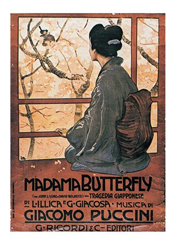
Madama Butterfly, opera in two acts.
Streaming Audio
Music composed by Giacomo Puccini. Libretto by Luigi Illica and Giuseppe Giacosa, based on the play Madame Butterfly by David Belasco.
First performance: 17 February 1904, La Scala, Milan.
Revised edition: 28 May 1904, Brescia.
Background:
Early in 1900, David Belasco, an American producer, needed a play with which to save a rather disastrous season, and finding possibilities in John Luther Long’s “Madame Butterfly,” he fashioned from it a drama in the short space of two weeks. His season was saved, for the play was a success, the all-night vigil making a particularly great appeal. Soon the play was produced in London, where the manager of Covent Garden saw it, and knowing that Puccini needed a successor to “La Tosca,” he wired him. Puccini came to London immediately, and was charmed with “Madame Butterfly” as an operatic possibility, even though, it is said, he did not at that time understand a word of English.
At its first performance the opera was a distinct failure. Perhaps the strangeness of a Japanese setting antagonized the audience; the second act, moreover, with its miniature all-night watch, so successful in the drama, became too long in the opera. The opera was withdrawn, Puccini made a few slight changes, and through necessity ruthlessly interrupted the vigil, making two parts of the second act. Produced three months later at Brescia, Madame Butterfly was a success, and since that day has become one of the most popular of operas.
While much of this success is due to the dramatically conceived play, much more is due to Puccini’s music. For the sake of local color the composer has introduced a number of genuine Japanese melodies—melodies that he was enabled to obtain exactly from Victor records made in Japan. Puccini also shows that he was aware of musical progress in the rest of the world, when, for instance, at the entrance of Butterfly, lie effectively makes extensive use of augmented triads after the fashion first brought into prominence by Debussy. In the more emotional parts of his opera, however, lie is thoroughly Italian and Puccinian in style.
| Principal Characters: | |
| Madame Butterfly (Cio-Cio-San) | Soprano |
| Suzuki, Cio-Cio-San’s servant | Mezzo-Soprano |
| B. F. Pinkerton, Lieutenant, U.S. Navy | Tenor |
| Kate Pinkerton, his American wife | Mezzo-Soprano |
| Sharpless, U.S. Consul at Nagasaki | Baritone |
| Goro, a marriage broker | Tenor |
| Prince Yamadori, suitor for Cio-Cio-San | Baritone |
| The Bonze, Cio-Cio San’s uncle | Bass |
Setting: Nagasaki, Japan, circa 1904.
Synopsis:
Act I
Scene—Exterior of Pinkerton’s House at Nagasaki
It is all vastly amusing! This matchbox of a house and its sliding panels, or shosi, in place of walls, neat and ingenious devices; and ridiculously inexpensive! Pinkerton, Lieutenant in the United Stales Navy, is charmed and amused as the self-important matrimonial agent, Goro, shows him over the little house he is to make his home during a not-too-prolonged stay in Japan. Presently Sharpless, United States Consul, turns up. Pinkerton tells him delightedly about the beautiful Japanese girl by whom he has been captivated, and whom he is to marry Japanese fashion for nine hundred and ninety-nine years, but with the privilege of annulling the marriage any month. The consul has a dim suspicion that the experiment may turn out more seriously than his friend anticipates, but Pinkerton will not listen to hints of tragedy. “Whisky?” proposes the Naval Lieutenant. Having filled their glasses the men drink to the toast “America forever!” then to the folks at home and to the time when Pinkerton will have a “real” wedding back in “God’s country.”
The two men stand looking out over the glorious scenery, so different from the homeland that to an American it is a make-believe world. From the foot of the hill girlish voices are heard, gradually drawing nearer. The music pulsates glowingly while the girls chatter about the beauty of the day and the flowers. Among them is Cio-Cio-San, “Madame Butterfly,” and to Pinkerton this little creature in her kimono is a butterfly indeed. Her voice soars above the others in broad, lyric phrases while she sings of the ecstasy of her love.
As the music reaches its climax the girls appear on the terrace and prostrate themselves before the “augustness” of Pinkerton. Sharpless enters into a conversation with Butterfly and learns that since the death of her father she has had to support herself and mother by becoming a Geisha.
The bride’s relatives, great numbers of them, now arrive. While the guests are all busied with the refreshments, Pinkerton amusedly watches Butterfly, who draws from her capacious sleeves her possessions . . . such trifles as handkerchiefs, a jar of carmine, a fan . . . and with great solemnity a long sheath. The officious Goro whispers an explanation to Pinkerton . . . the dagger was sent to her father by the Mikado . . . and he was obedient, Goro adds grimly. Thus is Pinkerton reminded that he is in the land given to seppuku, or “hara-kiri,” a condemned gentleman’s privilege to die by his own hand. Butterfly also shows him her ottoke, images of her forefathers; but she confides to Pinkerton that she has been to the Mission and adopted his religion, innocently adding that she will try to be frugal for she knows that he has paid for her the whole sum of a hundred yen. She declares that for his sake she is willing to forget race, kindred and ancestors; to prove this last, she throws away their images.
Goro commands silence and the quaint ceremony of signing the marriage contract takes place. The gaiety of congratulations is suddenly interrupted, for Cio-Cio-San’s uncle rushes in, violently enraged. Being a Bonze, or Japanese priest, he has learned that Butterfly has forsaken the faith of her ancestors upon marrying this foreigner. Therefore, he curses her with threats of eternal punishment, all her relatives likewise denounce her, for in deserting her gods she has likewise deserted her people! All rush away in horror leaving Butterfly weeping bitterly. Pinkerton consoles her, and in the thought of his love she is again happy. Night falls over the scene and they sing of their happiness together.
Act II
Scene—The Interior of Butterfly’s House
Part 1
Beyond the room one can see the garden with cherries in blossom, bright in the spring sunshine, but the wall panels being only partly open, the room remains in semi-darkness. Before an image of Buddha kneels Suzuki. Occasionally she rings a handbell while she prays that Butterfly’s weeping may be ended. Butterfly, who is standing motionless near a screen, tells her that the gods of Japan are lazy—her husband’s God will answer her more quickly. Although the money that Pinkerton left is almost gone. Butterfly is still so firm in her belief that her husband will return, that she commands the doubting Suzuki to say that he will. Suzuki complies in spite of her tears.
Greatly touched at this, Butterfly, to reassure herself as well as Suzuki, affirms her belief (in a famous aria), that some day (Un bel di) a great ship will appear far in the horizon . . . the boom of cannon will announce its arrival in the harbor . . . they will see him coming from a distance . . . climbing the hill. Butterfly will hide for a moment to tease him. . . he will call for her by the old names of endearment. . . so let fears be banished, Butterfly declares, utterly carried away by the joy of her anticipation, for he will return, she knows it!
At the moment she has finished this declaration of her trust, Sharpless appears. Goro, who has conducted him here, waits outside. “Madame Butterfly,” he calls. “Madame B. F. Pinkerton, beg pardon!” the wife corrects, then turning and recognizing her visitor, greets him cheerfully. He has a letter from Pinkerton, he tells her. She is the most happy of women, she replies, and then without waiting for Sharpless to read she asks him when the robins build their nests in America . . . for, she continues, Pinkerton had said that he would come back in the happy season when the robins return . . . now, for the third time the robins are building their nests. Sharpless, in his embarrassment, is forced to reply that he never studied ornithology. Goro laughs outright at this. The marriage-broker now presents Yamadori, a wealthy suitor, who, though he has had many consorts and divorced them all, says that he is madly in love with Butterfly and will swear eternal faithfulness to her. She repulses him and his proffered wealth, for she is married to an American, and in his country people remain faithful! Broker and suitor disposed of, Sharpless attempts to resume reading the letter; everything he reads is interpreted by Butterfly into some happy assurance that her husband will soon return. The consul has not the heart to go on, he asks Butterfly what she would do if Pinkerton were never to come back to her. As if struck by a death-blow Butterfly gravely replies that she might again become a Geisha or she might kill herself. Sharpless is horrified and advises her to marry Yamadori. This greatly insults Butterfly . . . ordering Suzuki to bring in “Trouble,” the name she has bestowed on her little son, she points to the child in agitated pride, and exclaims “And this? Can such as this be forgotten?” She asks Sharpless to write to her husband and tell him what a beautiful son he has. Thus does the consul learn to his surprise that unknown to Pinkerton there is a child. In true motherly joy, her attention concentrated entirely on little “Trouble,” she bids him not to believe the bad man when he says that father will not return, but leave them to wander through the streets for a living.
Sharpless leaves, fearful for the future. Soon after he has gone a cannon shot is heard booming from over the harbor, announcing the arrival of an American warship. With the help of a telescope Butterfly spells out its name—“Abraham Lincoln,” Pinkerton’s ship!
So, then, the agony of waiting is over! He has come with the robins—her lover, her husband, her adored one! In a moment the two women are feverishly rushing to the garden lo gather cherry blossoms to deck the house. They sing the joyous “Duet of the Flowers”, throbbing with the excitement and exultation of the rejoicing Butterfly, who then hastens to put on the wedding dress she wore on that day long ago, so that she may greet her lover as he first knew her. Little “Trouble,” too, is arrayed in his finest.
Night has been falling; the servant closes the shosi and brings in several Japanese lanterns which cast a dim glow over the darkened room. But they must await Pinkerton’s return . . . be ready to welcome him. In her anxious, joyful expectancy Butterfly has pierced three little holes through the wall so that they may watch for him. “Trouble” sits before one, supported by cushions; at another kneels Suzuki; close up against a third stands Butterfly, rigid and motionless . . . watching . . . waiting . . . A wonderful melody first heard during the reading of the letter, floats across the scene, softly hummed from a distance. “Trouble” soon nods, then falls asleep . . . next Suzuki . . . Butterfly keeps her vigil alone.
Part 2
The grey light of dawn begins to enter the room. Butterfly still stands, motionless, watching; Suzuki and “Trouble” still sleep, profoundly. The lanterns become even more dim while the day grows brighter; like the morning sunlight the music sparkles with vagrant Japanese melodies. Suzuki having awakened and begged her to lie down to rest awhile, Butterfly takes little “Trouble” and goes with him into an inner room. No sooner has she gone than Sharpless and Pinkerton arrive. Suzuki is overjoyed at seeing them, but they motion her to keep silent. She points out how Butterfly has decorated the house, and tells how she waited all night. The servant, on opening the shosi, exclaims in surprise for she notices a strange woman in the garden. Fearfully she asks who it is. Pinkerton’s wife, Sharpless explains. Suzuki cries out in grief.
Sharpless asks Suzuki to prepare Butterfly for this bitter revelation and tells her that the American woman has come to adopt the child. Pinkerton. overwhelmed with remorse, leaves the house after asking Sharpless to console Butterfly the best he can. A moment later Butterfly rushes in joyfully expecting to find Pinkerton. Instead she sees Sharpless, a foreign woman, and Suzuki in tears. She begins to realize the heartless truth. She asks if he is alive, her voice hushed with expectant fear. Only Suzuki’s broken “yes” is needed, and she knows that she has been deserted. Mrs. Pinkerton expresses her helpless sympathy, and asks to take the child. Butterfly, having listened in pathetic dignity, replies that only to Pinkerton will she yield her son . . . she will be ready in half an hour. Sharpless and Mrs. Pinkerton take their leave; Butterfly orders Suzuki to go into another room with the child.
Then she takes from its sheath the dagger with which her father had fulfilled the law of his people, and reads the inscription written upon its blade: “To die with honor when one can no longer live with honor.” She raises the knife to her throat. At that instant, the door opens and little “Trouble” runs to her with outstretched arms. She drops the knife, impetuously seizes the child and covers him with kisses. Having bade him a heart-rending farewell, she gives her son a doll and an American flag, urges him to play with them, then gently bandages his eyes. Again she takes the dagger, goes behind the screen. A moment later the blade is heard falling to the floor. Butterfly staggers forward groping her way to her child, takes its hand, and smiles feebly. She scarcely has strength to give her son one final embrace, then falls beside him, dead.
Pinkerton is heard calling her name. A moment later he rushes into the room followed by Sharpless. He kneels beside Butterfly sobbing with grief and shame; Sharpless takes the child and turns away.
The orchestra thunders out a solemn Japanese melody . . . over and above the very last note of that melody there sounds a poignant, questioning chord, as though this tragedy were not yet, nor ever would be, ended.
[Adapted from The Victrola Book of the Opera (Victor Talking Machine Company, 1929).]
Click here for the complete libretto, including alternate versions.