14 Dec 2008
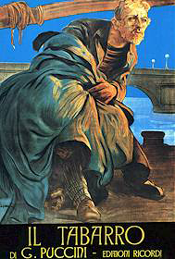
PUCCINI: Il Tabarro — La Scala 2008
Il Tabarro [The Cloak]: Opera in one act (no.1 of Il Trittico).
Mozart and Salieri, an opera in one act consisting of two scenes.
Nicolai Rimsky-Korsakov (1844-1908), composer. Libretto derived from Alexander Puskhin's play of the same name.
First performance: 7 December 1898 in Moscow.
Ariadne auf Naxos, Oper with a prologue and one act. Music composed by Richard Strauss. Libretto by Hugo von Hofmannsthal.
La Vestale, a tragédie lyrique in three acts.
Boris Godunov, an opera in four acts with prologue
Modest Mussorgsky, composer. Libretto by the composer, based on Alexander Pushkin's drama Boris Godunov and Nikolai Karamazin's History of the Russian Empire
First performance: 8 February 1874 at the Mariinsky Theatre, St. Petersburg
Il Trovatore, dramma in four parts.
Only a few months following the premiere of Der Rosenkavalier, Hugo von Hofmannsthal proposed a new opera to Richard Strauss based on Molière’s comedy-ballet, Le Bourgeois gentilhomme (in German, Der Bürger als Edelmann).
Die Entführung aus dem Serail, Singspiel in 3 Acts.
Music composed by Wolfgang Amadeus Mozart (1756–1791). Libretto by Johann Gottlieb Stephanie the Younger, based on an earlier libretto by
Christoph Friedrich Bretzner.
Die Entführung aus dem Serail, Singspiel in 3 Acts.
Music composed by Wolfgang Amadeus Mozart (1756–1791). Libretto by Johann Gottlieb Stephanie the Younger, based on an earlier libretto by
Christoph Friedrich Bretzner.
Arabella: Lyrische Komödie in three acts
Die Entführung aus dem Serail, Singspiel in 3 Acts.
Music composed by Wolfgang Amadeus Mozart (1756–1791). Libretto by Johann Gottlieb Stephanie the Younger, based on an earlier libretto by
Christoph Friedrich Bretzner.
La Gioconda, dramma lirico in four acts.
Music composed by Amilcare Ponchielli (1834–1886). Libretto by Arrigo Boito (under the pseudonym Tobia Gorrio), based upon Victor Hugo's Angelo, Tyrant of Padua (1835).
Don Carlo, an opera in four acts. Music composed by Giuseppe Verdi (1813–1901). Libretto by Joseph Méry and Camille Du Locle after Friedrich von Schiller’s dramatic poem Don Carlos, Infant von Spanien. Revised version in four acts (French text revised by Du Locle, Italian translation by Achille de Lauzières and Angelo Zanardini).
Un ballo in maschera, a melodramma in three acts.
Music composed by Giuseppe Verdi. Libretto by Antonio Somma, based upon the work of Eugène Scribe Gustave III ou Le bal masqué (1833)
Medea: Melodramma tragico in three acts.
Die Tote Stadt, an opera in three acts.
Music composed by Erich Wolfgang Korngold (1897-1957). Libretto by Paul Schott (Julius and E. W. Korngold) after the novel Bruges la morte by Georges Rodenbach.
Some Details concerning the Revolution inaugurated by Rossini
Manon Lescaut, dramma lirico in quattro atti
Elektra: Tragedy in one act.
Lyric Opera of Chicago has announced both schedules and cast-lists for is Spring 2020 performances of Richard Wagner’s Ring Cycle. Given the series of individual productions already staged by the company since Fall 2016, that pave the way for the complete cycle, Lyric Opera of Chicago’s complete production should affirm the artistic might of the great composer.
“Diacono himself does not know what musical talent he possesses” – Mascagni
Il Tabarro [The Cloak]: Opera in one act (no.1 of Il Trittico).
Streaming Audio
Music composed by Giacomo Puccini. Libretto by Giuseppe Adami based on Didier Gold’s play La houppelande.
First Performance: 14 December 1918, Metropolitan Opera, New York
| Principal Roles: | |
| Michele, a barge-owner (age 50) | Baritone |
| Giorgetta, Michele’s wife (age 25) | Soprano |
| Luigi, a stevedore (age 20) | Tenor |
| Il ‘Tinca,’ a stevedore (age 35) | Tenor |
| Il ‘Talpa,’ a stevedore (age 55) | Bass |
| La Frugola, Talpa’s wife | Mezzo-Soprano |
Setting: A bank of the river Seine, Paris, 1910
Synopsis:
The stevedores relax with a drink and dance after the day's work. Michele is moody, aware that Giorgetta no longer returns his love. Frugola comes to collect her husband Talpa. Luigi's reflections on the futility of existence cause the others to relate their dreams of happiness: Frugola's in a cottage with her cat, Giorgetta's in Paris instead of on the dreary barge. She and Luigi realise that they came from the same village near Paris and recall its pleasures.
Luigi and Giorgetta arrange an assignation for later that night, but then he surprises her by asking Michele to leave him in Rouen on the next trip. He explains to Giorgetta that he cannot bear to share her with her husband, but agrees to come on board when she lights a match as a signal. Michele asks Giorgetta why she no longer loves him and both reflect sadly on how their lives have changed since the death of their child. She evades his question and goes inside, while he broods over the likelihood that she has a lover, dismissing Luigi as a possibility because of his request to go to Rouen.
He lights his pipe and Luigi, believing this to be the signal, comes on board. Michele forces him to admit his love for Giorgetta, then strangles him and hides the body under his cloak. He invites Giorgetta to protect herself from the night air under his cloak as she used to, flinging it open to reveal Luigi's body.
[Synopsis Source: Opera~Opera]