28 Dec 2008
PUCCINI: Gianni Schicchi — La Scala 2008
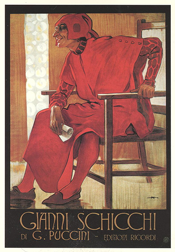
Gianni Schicchi: Opera in one act (no. 3 of Il trittico)
Mozart and Salieri, an opera in one act consisting of two scenes.
Nicolai Rimsky-Korsakov (1844-1908), composer. Libretto derived from Alexander Puskhin's play of the same name.
First performance: 7 December 1898 in Moscow.
Ariadne auf Naxos, Oper with a prologue and one act. Music composed by Richard Strauss. Libretto by Hugo von Hofmannsthal.
La Vestale, a tragédie lyrique in three acts.
Boris Godunov, an opera in four acts with prologue
Modest Mussorgsky, composer. Libretto by the composer, based on Alexander Pushkin's drama Boris Godunov and Nikolai Karamazin's History of the Russian Empire
First performance: 8 February 1874 at the Mariinsky Theatre, St. Petersburg
Il Trovatore, dramma in four parts.
Only a few months following the premiere of Der Rosenkavalier, Hugo von Hofmannsthal proposed a new opera to Richard Strauss based on Molière’s comedy-ballet, Le Bourgeois gentilhomme (in German, Der Bürger als Edelmann).
Die Entführung aus dem Serail, Singspiel in 3 Acts.
Music composed by Wolfgang Amadeus Mozart (1756–1791). Libretto by Johann Gottlieb Stephanie the Younger, based on an earlier libretto by
Christoph Friedrich Bretzner.
Die Entführung aus dem Serail, Singspiel in 3 Acts.
Music composed by Wolfgang Amadeus Mozart (1756–1791). Libretto by Johann Gottlieb Stephanie the Younger, based on an earlier libretto by
Christoph Friedrich Bretzner.
Arabella: Lyrische Komödie in three acts
Die Entführung aus dem Serail, Singspiel in 3 Acts.
Music composed by Wolfgang Amadeus Mozart (1756–1791). Libretto by Johann Gottlieb Stephanie the Younger, based on an earlier libretto by
Christoph Friedrich Bretzner.
La Gioconda, dramma lirico in four acts.
Music composed by Amilcare Ponchielli (1834–1886). Libretto by Arrigo Boito (under the pseudonym Tobia Gorrio), based upon Victor Hugo's Angelo, Tyrant of Padua (1835).
Don Carlo, an opera in four acts. Music composed by Giuseppe Verdi (1813–1901). Libretto by Joseph Méry and Camille Du Locle after Friedrich von Schiller’s dramatic poem Don Carlos, Infant von Spanien. Revised version in four acts (French text revised by Du Locle, Italian translation by Achille de Lauzières and Angelo Zanardini).
Un ballo in maschera, a melodramma in three acts.
Music composed by Giuseppe Verdi. Libretto by Antonio Somma, based upon the work of Eugène Scribe Gustave III ou Le bal masqué (1833)
Medea: Melodramma tragico in three acts.
Die Tote Stadt, an opera in three acts.
Music composed by Erich Wolfgang Korngold (1897-1957). Libretto by Paul Schott (Julius and E. W. Korngold) after the novel Bruges la morte by Georges Rodenbach.
Some Details concerning the Revolution inaugurated by Rossini
Manon Lescaut, dramma lirico in quattro atti
Elektra: Tragedy in one act.
Lyric Opera of Chicago has announced both schedules and cast-lists for is Spring 2020 performances of Richard Wagner’s Ring Cycle. Given the series of individual productions already staged by the company since Fall 2016, that pave the way for the complete cycle, Lyric Opera of Chicago’s complete production should affirm the artistic might of the great composer.
“Diacono himself does not know what musical talent he possesses” – Mascagni
Gianni Schicchi: Opera in one act (no. 3 of Il trittico)
Streaming Audio
Music composed by Giacomo Puccini. Libretto by Giovacchino Forzano after lines 43-45 of Canto XXX of Dante’s Inferno.
First Performance: 14 December 1918, Metropolitan Opera House, New York.
| Principal Roles: | |
| Gianni Schicchi (aged 50) | Baritone |
| Lauretta, his daughter (aged 21) | Soprano |
| Zita, cousin of Buoso Donati (aged 60) | Contralto |
| Rinuccio, Zita’s nephew (aged 24) | Tenor |
| Gherardo, Buoso’s nephew (aged 40) | Tenor |
| Nella, Gherardo’s wife (aged 34) | Soprano |
| Gherardino, their son (aged 7) | Contralto |
| Betto di Signa, Buoso’s brother-in-law (of uncertain age) | Bass |
| Simone, cousin of Buoso (aged 70) | Bass |
| Marco, Simone’s son (aged 45) | Baritone |
| La Ciesca, Marco’s wife (aged 38) | Mezzo-Soprano |
| Maestro Spinelloccio, a doctor | Bass |
| Ser Amantio di Nicolao, a notary | Baritone |
| Pinellino, a cobbler | Bass |
| Guccio, a dyer | Bass |
Setting: Florence, 1299
Synopsis:
Buoso Donati has died in bed. His relatives mourn melodramatically, until they hear the rumor that he has left all his money to the local monastery. They frantically search for the will. Rinuccio finds it, but refuses to release it to his aunt Zita until she agrees to his terms. If the will is favorable to them, she must allow him to marry Schicchi's daughter, Lauretta. Schicchi is looked down on by the Donati family since he is a relatively new arrival in Florence. Zita consents (she does not care whom Rinuccio marries so long as the will leaves them rich), and reads the will, as Rinuccio quietly sends for Schicchi. When the will confirms the rumor, everyone is furious. They refuse to allow Rinuccio to marry, and angrily turn down his suggestion that Schicchi, who is known for his clever schemes, can aid them.
Schicchi and Lauretta arrive to a cold reception. Schicchi, seeing how downcast the relatives are, uncharitably assumes that Donati must be better. He is informed otherwise, and attempts to console the relatives by mentioning their inheritances. Zita, touched to the quick by Schicchi's condolences, angrily explains the situation, and refuses to hear of a marriage. Rinuccio begs Schicchi to help. However, Schicchi, angered by his reception, refuses to help such people. He is persuaded to try by his daughter (O mio babbino caro). Schicchi reads the will, and proclaims that nothing can be done. But then, he has a thought, and Schicchi sends his daughter away so that she may be innocent of the knowledge of what he will suggest. Schicchi first orders the body to be moved to another room, and tells the women to make up the bed. He ensures that no one else knows of the death — but before he can explain, Donati's doctor arrives. The doctor is prevented from entering by the relatives, while Schicchi imitates Donati's voice, telling the doctor that Donati is feeling better. The doctor departs, praising his own skill. Schicchi explains: Schicchi will impersonate Donati and dictate a new will.
Rinuccio goes to get the notary. The relatives agree on the division of the property, except for Donati's mule (the best in Tuscany), mills, and house. They agree to let Schicchi decide who will inherit those items, but, one by one, they return to promise him a reward if he selects that person. Schicchi agrees to each bribe — but then reminds all of the penalty for forgery — loss of a hand and permanent exile from Florence. The notary arrives, with the witnesses. Schicchi dictates a very modest funeral, a minuscule sum to the monastery, and the agreed-upon division, as the relatives speak approvingly. But one by one, Schicchi grants the mule, mills, and house to himself, to the relatives' outrage. After the notary leaves, he throws everyone out, and they are helpless to do anything except grab what they can on the way out the door. Now that Schicchi can give Lauretta a dowry, there is no obstacle to her marriage to Rinuccio. The lovers embrace, as Schicchi watches, moved. Schicchi turns to the audience and asks if this was not a fine use of Donati's money. He then requests the audience's indulgence, even if he did not receive Dante's, pleading extenuating circumstances.
[Synopsis Source: Wikipedia]