01 Mar 2009
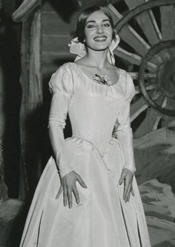
BELLINI: La sonnambula — La Scala 1957
La sonnambula, Melodramma in due atti
Mozart and Salieri, an opera in one act consisting of two scenes.
Nicolai Rimsky-Korsakov (1844-1908), composer. Libretto derived from Alexander Puskhin's play of the same name.
First performance: 7 December 1898 in Moscow.
Ariadne auf Naxos, Oper with a prologue and one act. Music composed by Richard Strauss. Libretto by Hugo von Hofmannsthal.
La Vestale, a tragédie lyrique in three acts.
Boris Godunov, an opera in four acts with prologue
Modest Mussorgsky, composer. Libretto by the composer, based on Alexander Pushkin's drama Boris Godunov and Nikolai Karamazin's History of the Russian Empire
First performance: 8 February 1874 at the Mariinsky Theatre, St. Petersburg
Il Trovatore, dramma in four parts.
Only a few months following the premiere of Der Rosenkavalier, Hugo von Hofmannsthal proposed a new opera to Richard Strauss based on Molière’s comedy-ballet, Le Bourgeois gentilhomme (in German, Der Bürger als Edelmann).
Die Entführung aus dem Serail, Singspiel in 3 Acts.
Music composed by Wolfgang Amadeus Mozart (1756–1791). Libretto by Johann Gottlieb Stephanie the Younger, based on an earlier libretto by
Christoph Friedrich Bretzner.
Die Entführung aus dem Serail, Singspiel in 3 Acts.
Music composed by Wolfgang Amadeus Mozart (1756–1791). Libretto by Johann Gottlieb Stephanie the Younger, based on an earlier libretto by
Christoph Friedrich Bretzner.
Arabella: Lyrische Komödie in three acts
Die Entführung aus dem Serail, Singspiel in 3 Acts.
Music composed by Wolfgang Amadeus Mozart (1756–1791). Libretto by Johann Gottlieb Stephanie the Younger, based on an earlier libretto by
Christoph Friedrich Bretzner.
La Gioconda, dramma lirico in four acts.
Music composed by Amilcare Ponchielli (1834–1886). Libretto by Arrigo Boito (under the pseudonym Tobia Gorrio), based upon Victor Hugo's Angelo, Tyrant of Padua (1835).
Don Carlo, an opera in four acts. Music composed by Giuseppe Verdi (1813–1901). Libretto by Joseph Méry and Camille Du Locle after Friedrich von Schiller’s dramatic poem Don Carlos, Infant von Spanien. Revised version in four acts (French text revised by Du Locle, Italian translation by Achille de Lauzières and Angelo Zanardini).
Un ballo in maschera, a melodramma in three acts.
Music composed by Giuseppe Verdi. Libretto by Antonio Somma, based upon the work of Eugène Scribe Gustave III ou Le bal masqué (1833)
Medea: Melodramma tragico in three acts.
Die Tote Stadt, an opera in three acts.
Music composed by Erich Wolfgang Korngold (1897-1957). Libretto by Paul Schott (Julius and E. W. Korngold) after the novel Bruges la morte by Georges Rodenbach.
Some Details concerning the Revolution inaugurated by Rossini
Manon Lescaut, dramma lirico in quattro atti
Elektra: Tragedy in one act.
Lyric Opera of Chicago has announced both schedules and cast-lists for is Spring 2020 performances of Richard Wagner’s Ring Cycle. Given the series of individual productions already staged by the company since Fall 2016, that pave the way for the complete cycle, Lyric Opera of Chicago’s complete production should affirm the artistic might of the great composer.
“Diacono himself does not know what musical talent he possesses” – Mascagni
La sonnambula, Melodramma in due atti
Streaming Audio
Music composed by Vincenzo Bellini (1801–1835). Libretto by Felice Romani, based on La Sonnambule ou L’arrivée d’un nouveau Seigneur (1827) by Eugène Scribe.
First Performance: 6 March 1831 at Teatro Carcano, Milan.
Principal Characters:
| Il Conte Rodolfo, Signore del Villaggio | Bass |
| Teresa, Molinara | Mezzo-Soprano |
| Amina, Orfanella raccolta da Teresa, fidanzata ad Elvino | Soprano |
| Elvino, ricco possidente del Villaggio | Tenor |
| Lisa, Ostessa amante di Elvino | Soprano |
| Alessio, Contadino, amante di Lisa | Bass |
| Un Notaro | Tenor |
The Scene: A village in Switzerland.
Synopsis:
Act I
A village with a mill on one side and an inn on the other.
It is a festive occasion in the village square. That afternoon Elvino and Amina, an orphan raised by Teresa, are to sign a marriage contract. All but Lisa, the innkeeper’s daughter, celebrate. Lisa is in love with Elvino. She is consoled by Alessio, a villager who wants to marry Lisa. The notary arrives, followed by Elvino. Elvino has visted his mother’s tomb to pray for her blessing of the marriage. He gives Amina his mother’s ring, together with a bouquet of violets.
A stranger arrives. He is traveling to the castle. As he looks about, he recognizes the mill, the fountain, the wood and the farm. As night begins to fall, the villagers become fearful. Teresa explains to the stranger that a strange ghost wanders through the village wrapped in a white sheet, spreading terror everywhere. Incredulous, the stranger nevertheless accepts Lisa’s invitation to stay at the inn. The stranger greets Amina and tells her that he hopes her husband will love her “as I would love you,” much to the annoyance of Elvino.
A room in the inn.
Lisa comes to the stranger’s room. She addresses him as Count, for he is Count Rodolfo, the son of the deceased lord of the castle. Lisa makes it clear to the Count that she is available, of which the Count is quite willing to take advantage. There is a sudden noise. Lisa runs out of the room, dropping her handkerchief in the process. Amina comes in through the window. Wrapped in a white sheet, she is walking in her sleep. She is dreaming of tomorrow’s wedding ceremony and speaks to the Count as if he were Elvino.
As the entire village gathers to give the Count a hearty welcome, the Count escapes through the window to avoid being caught with a woman in his room. Everyone is surprised to find Amina sleeping on the sofa. Elvino, having been informed by Lisa, becomes extremely jealous. Amina awakes. She cannot explain her presence in the Count’s room and, despite her pleas, Elvino calls off the wedding. Dismayed, Teresa picks up the handkerchief dropped by Lisa.
Act II
A shadowy valley between the village and the Castle.
A group of villagers is enroute to the Castle to ask the Count to exonerate Amina. Amina and Teresa, who are among them, and stop at Elvino’s estate, where they find Elvino venting his grief. Amina again expresses her innocence, which Elvino refuses to accept. When the villagers return, they proclaim that the Count has exonerated Amina completely. Elvino will have none of it. Furious, he tears the ring from Amina’s finger.
The village square.
As Alessio tries to convice Lisa that Elvino will never marry her, others announce that Lisa is his chosen bride. The Count confirms Amina’s innocence, explaining that she is a sleepwalker. No one believes him. Realizing that Elvino is about to marry Lisa, she produces the handkerchief that she found in the Count’s room. Lisa blushes, much to the despair of Elvino. Just then, Amina, who is sleepwalking again, comes out the window of the mill and walks along the edge of the roof above the revolving wheel. Seeing that she is in grave danger, the Count orders everyone to be silent. Amina awakens unscathed and in the arms of Elvino. He realizes that she is innocent. The entire village celebrates.