22 Mar 2009
WAGNER: Das Rheingold — Rome 1968
Vorabend (preliminary evening) of Der Ring des Nibelungen, in four scenes.
Mozart and Salieri, an opera in one act consisting of two scenes.
Nicolai Rimsky-Korsakov (1844-1908), composer. Libretto derived from Alexander Puskhin's play of the same name.
First performance: 7 December 1898 in Moscow.
Ariadne auf Naxos, Oper with a prologue and one act. Music composed by Richard Strauss. Libretto by Hugo von Hofmannsthal.
La Vestale, a tragédie lyrique in three acts.
Boris Godunov, an opera in four acts with prologue
Modest Mussorgsky, composer. Libretto by the composer, based on Alexander Pushkin's drama Boris Godunov and Nikolai Karamazin's History of the Russian Empire
First performance: 8 February 1874 at the Mariinsky Theatre, St. Petersburg
Il Trovatore, dramma in four parts.
Only a few months following the premiere of Der Rosenkavalier, Hugo von Hofmannsthal proposed a new opera to Richard Strauss based on Molière’s comedy-ballet, Le Bourgeois gentilhomme (in German, Der Bürger als Edelmann).
Die Entführung aus dem Serail, Singspiel in 3 Acts.
Music composed by Wolfgang Amadeus Mozart (1756–1791). Libretto by Johann Gottlieb Stephanie the Younger, based on an earlier libretto by
Christoph Friedrich Bretzner.
Die Entführung aus dem Serail, Singspiel in 3 Acts.
Music composed by Wolfgang Amadeus Mozart (1756–1791). Libretto by Johann Gottlieb Stephanie the Younger, based on an earlier libretto by
Christoph Friedrich Bretzner.
Arabella: Lyrische Komödie in three acts
Die Entführung aus dem Serail, Singspiel in 3 Acts.
Music composed by Wolfgang Amadeus Mozart (1756–1791). Libretto by Johann Gottlieb Stephanie the Younger, based on an earlier libretto by
Christoph Friedrich Bretzner.
La Gioconda, dramma lirico in four acts.
Music composed by Amilcare Ponchielli (1834–1886). Libretto by Arrigo Boito (under the pseudonym Tobia Gorrio), based upon Victor Hugo's Angelo, Tyrant of Padua (1835).
Don Carlo, an opera in four acts. Music composed by Giuseppe Verdi (1813–1901). Libretto by Joseph Méry and Camille Du Locle after Friedrich von Schiller’s dramatic poem Don Carlos, Infant von Spanien. Revised version in four acts (French text revised by Du Locle, Italian translation by Achille de Lauzières and Angelo Zanardini).
Un ballo in maschera, a melodramma in three acts.
Music composed by Giuseppe Verdi. Libretto by Antonio Somma, based upon the work of Eugène Scribe Gustave III ou Le bal masqué (1833)
Medea: Melodramma tragico in three acts.
Die Tote Stadt, an opera in three acts.
Music composed by Erich Wolfgang Korngold (1897-1957). Libretto by Paul Schott (Julius and E. W. Korngold) after the novel Bruges la morte by Georges Rodenbach.
Manon Lescaut, dramma lirico in quattro atti
Elektra: Tragedy in one act.
Una cosa rara, ossia Bellezza ed onestà. Dramma giocoso in two acts.
Music composed by Vicente Martín y Soler (1754–1806). Libretto by Lorenzo Da Ponte from the comedy La luna de la Sierra by Luis Vélez de Guevara.
Hamlet: Opéra in five acts. Music composed by Ambroise Thomas. Libretto by Michel Carré and Jules Barbier after The Tragedy of Hamlet, Prince of Denmark by William Shakespeare.
Das Liebesverbot: Grosse komische Oper in two acts.
Vorabend (preliminary evening) of Der Ring des Nibelungen, in four scenes.
Streaming Audio
Music and libretto by Richard Wagner (1813 - 1883)
First Performance: 22 September 1869, Königlich Hof- und Nationaltheater, München
| Principal Roles: | |
| Gods | |
| Wotan | Bass-Baritone |
| Donner | Bass-Baritone |
| Froh | Tenor |
| Loge | Tenor |
| Fricka | Mezzo-Soprano |
| Freia | Soprano |
| Erda | Contralto |
| Nieblungs | |
| Alberich | Bass-Baritone |
| Mime | Tenor |
| Giants | |
| Fasolt | Bass-Baritone |
| Fafner | Bass |
| Rhinemaidens | |
| Woglinde | Soprano |
| Wellgunde | Soprano |
| Flosshilde | Mezzo-Soprano |
Prelude and Scene I
The Setting: At the bottom of the Rhine.
Introductory Stage Instructions:
Greenish twilight, lighter above, darker below. The upper part of the scene is filled with moving water, which restlessly streams from right to left. Towards the bottom the waters resolve themselves into a fine mist, so that the space, to a man’s height from the stage, seems free from the water which floats like a train of clouds over the gloomy depths. Every-where are steep points of rock jutting up from the depths and enclosing the whole stage; all the ground is broken up into a wild confusion of jagged pieces, so that there is no level place, while on all sides darkness indicates other deeper fissures.
Synopsis:
Woglinde, Wellgunde and Flosshilde-the three seductive Rhinedaughters charged with protecting the Rhine gold-are swimming in the Rhine River. As they frolic in the water, Alberich the Nibelung, an ugly dwarf from the centre of the earth, approaches the water. He begins to flirt with the maidens, who tease and taunt him. Alberich becomes more and more frustrated as one by one the maidens reject him. A beam of light illuminates the Rhine gold, stopping Alberich's pursuit and drawing his full attention. Woglinde tells him that only a man who renounces love can steal the gold. The Rhinedaughters allow Alberich to get between them and the gold. He tricks the maidens, steals the gold and scurries away.
Scene II
The Setting: An open space on a mountain height
Introductory Stage Instructions:
The dawning day lights up with growing brightness a castle with glittering pinnacles, which stands on the top of a cliff in the background. Between this cliff and the foreground a deep valley through which the Rhine flows is supposed.
Wotan and Fricka asleep.
Synopsis:
Wotan, chief of the gods, lays sleeping, and his wife Fricka, goddess of marriage and fidelity, wakes him. A magnificent castle has appeared across the valley: Valhalla, the new home of the gods. Wotan has promised to give Fricka's sister Freia, goddess of youth and love, to the giants Fafner and Fasolt as reward for building the castle. Wotan tells his wife nevertheless not to worry; he would never harm the goddess who gives them all their youth and immortality through her golden apples. Freia appears, and in an attempt to escape the giants, calls for protection from her brothers, Donner, god of thunder, and Froh, god of the rainbow. Wotan tells Fricka and Freia that his ally Loge, demigod of fire, has a plan. Loge arrives, and tells the assembled crowd that although he has found no solution to their troubles, he does have news: Alberich has stolen the Rhine gold and will use it to forge a Ring that will give him absolute power over the entire world - including the gods. Wotan sees the gold as a way to pay the giants. Fasolt and Fafner agree to give Wotan until nightfall to bring them the Rhine gold, but until then, they will hold the terrified Freia hostage. The gods begin to feel weak as soon as Freia and her golden apples are taken away. Loge and Wotan depart, planning to surprise Alberich at his home in Nibelheim and take the gold from him.
Scene III
The Setting: Nibelheim.
Introductory Stage Instructions:
Alberich drags the shrieking Mime from a side cleft.
Synopsis:
Alberich has created a Ring from the Rhine gold and has used it to enslave the Nibelung - including his brother Mime - in his gold mine. Mime has crafted a golden cap for Alberich, a Tarnhelm, that can make him invisible and able to change shape at will. Alberich wrests the Tarnhelm from Mime and puts it on, becoming invisible. He taunts Mime, then leaves to lord his power over others. Wotan and Loge arrive, speaking with the cowed Mime. Alberich appears, brandishing the Ring, and taunts Wotan and Loge with threats of domination. Loge plays along with his taunts, tricking him into becoming first a dragon, then a toad. While Alberich is in toad form, Wotan and Loge trap him.
Scene IV
The Setting: Open space on mountain heights.
Introductory Stage Instructions:
The prospect is shrouded in pale mist, as at the end of the second scene.
Synopsis:
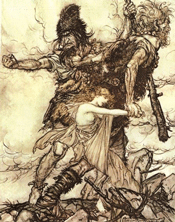
Bringing Alberich back to Valhalla, Wotan and Loge force him to hand over all the treasures, including Tarnhelm and the Ring, as ransom for his release. When Wotan takes the Ring from Alberich's hand and places it on his own, Alberich curses the wearer of the Ring to death, and others to envy. As Alberich leaves, Fasolt and Fafner return, bearing Freia. As Donner, Froh and Fricka gather, Fasolt tells Wotan that the reward for returning Freia must be large enough to hide her from his view. Wotan agrees, and the gold, including the Tarnhelm, is placed in front of Freia. Fafner and Fasolt examine the pile of gold and notice a small hole near Freia's eye. The Ring will fit the hole perfectly, but Wotan refuses to give it up. Erda, the Goddess of the Earth, rises from the ground and warns Wotan to give up the Ring and the curse that accompanies it. She tells Wotan that the world as he knows it will soon end. Wotan agrees to give up the Ring and completes the bargain. As Fasolt and Fafner gather their treasure, they begin to fight over the Ring. Fafner slays his brother and departs, taking the gold as he leaves. As the gods prepare to enter Valhalla, demigod Loge remains on earth in the form of fire. As he watches their entry into Valhalla, he states that he is ashamed to be involved with a group that deems itself so powerful it cannot fail, and wonders what the future will hold for the gods. In the distance, the Rhinedaughters lament the loss of their gold.