12 Apr 2009
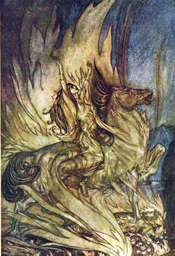
WAGNER: Götterdämmerung — Rome 1968
Götterdämmerung: Third day of Der Ring des Nibelungen in a prologue and three acts.
Mozart and Salieri, an opera in one act consisting of two scenes.
Nicolai Rimsky-Korsakov (1844-1908), composer. Libretto derived from Alexander Puskhin's play of the same name.
First performance: 7 December 1898 in Moscow.
Ariadne auf Naxos, Oper with a prologue and one act. Music composed by Richard Strauss. Libretto by Hugo von Hofmannsthal.
La Vestale, a tragédie lyrique in three acts.
Boris Godunov, an opera in four acts with prologue
Modest Mussorgsky, composer. Libretto by the composer, based on Alexander Pushkin's drama Boris Godunov and Nikolai Karamazin's History of the Russian Empire
First performance: 8 February 1874 at the Mariinsky Theatre, St. Petersburg
Il Trovatore, dramma in four parts.
Only a few months following the premiere of Der Rosenkavalier, Hugo von Hofmannsthal proposed a new opera to Richard Strauss based on Molière’s comedy-ballet, Le Bourgeois gentilhomme (in German, Der Bürger als Edelmann).
Die Entführung aus dem Serail, Singspiel in 3 Acts.
Music composed by Wolfgang Amadeus Mozart (1756–1791). Libretto by Johann Gottlieb Stephanie the Younger, based on an earlier libretto by
Christoph Friedrich Bretzner.
Die Entführung aus dem Serail, Singspiel in 3 Acts.
Music composed by Wolfgang Amadeus Mozart (1756–1791). Libretto by Johann Gottlieb Stephanie the Younger, based on an earlier libretto by
Christoph Friedrich Bretzner.
Arabella: Lyrische Komödie in three acts
Die Entführung aus dem Serail, Singspiel in 3 Acts.
Music composed by Wolfgang Amadeus Mozart (1756–1791). Libretto by Johann Gottlieb Stephanie the Younger, based on an earlier libretto by
Christoph Friedrich Bretzner.
La Gioconda, dramma lirico in four acts.
Music composed by Amilcare Ponchielli (1834–1886). Libretto by Arrigo Boito (under the pseudonym Tobia Gorrio), based upon Victor Hugo's Angelo, Tyrant of Padua (1835).
Don Carlo, an opera in four acts. Music composed by Giuseppe Verdi (1813–1901). Libretto by Joseph Méry and Camille Du Locle after Friedrich von Schiller’s dramatic poem Don Carlos, Infant von Spanien. Revised version in four acts (French text revised by Du Locle, Italian translation by Achille de Lauzières and Angelo Zanardini).
Un ballo in maschera, a melodramma in three acts.
Music composed by Giuseppe Verdi. Libretto by Antonio Somma, based upon the work of Eugène Scribe Gustave III ou Le bal masqué (1833)
Medea: Melodramma tragico in three acts.
Die Tote Stadt, an opera in three acts.
Music composed by Erich Wolfgang Korngold (1897-1957). Libretto by Paul Schott (Julius and E. W. Korngold) after the novel Bruges la morte by Georges Rodenbach.
Manon Lescaut, dramma lirico in quattro atti
Elektra: Tragedy in one act.
Una cosa rara, ossia Bellezza ed onestà. Dramma giocoso in two acts.
Music composed by Vicente Martín y Soler (1754–1806). Libretto by Lorenzo Da Ponte from the comedy La luna de la Sierra by Luis Vélez de Guevara.
Hamlet: Opéra in five acts. Music composed by Ambroise Thomas. Libretto by Michel Carré and Jules Barbier after The Tragedy of Hamlet, Prince of Denmark by William Shakespeare.
Das Liebesverbot: Grosse komische Oper in two acts.
Götterdämmerung: Third day of Der Ring des Nibelungen in a prologue and three acts.
Streaming Audio
Music and libretto by Richard Wagner.
First Performance: Bayreuth, Festspielhaus, 17 August 1876
| Principal Roles: | |
| Siegfried | Tenor |
| Gunther | Bass-Baritone |
| Alberich | Bass-Baritone |
| Hagen | Bass |
| Brünnhilde | Soprano |
| Gutrune | Soprano |
| Waltraute | Mezzo-Soprano |
| First Norn | Contralto |
| Secon Norn | Mezzo-Soprano |
| Third Norn | Soprano |
| Woglinde, Rhinemaidens | Soprano |
| Wellgunde | Soprano |
| Fosshilde | Mezzo-Soprano |
Synopsis:
Prologue
The Valkyrie’s rock at night
The three norns, spinning their rope of fate, relate how the world ash tree has withered since Wotan cut his spear from it and the spring at its base has dried up. He had the tree chopped down and the branches piled round Valhalla, ready for the final conflagration. The norns’ rope frays and they cannot see the end of the story of the stolen gold and the curse. The rope breaks and the Norns’ wisdom is at an end.
Siegfried leaves Brünnhilde to seek new adventures. He gives her the ring and she gives him her horse Grane. He sets off towards the Rhine.
Act I
Scene 1. The hall of the Gibichungs on the Rhine
Hagen advises Gunther that both he and his sister Gutrune should marry. He proposes Brünnhilde for Gunther and Siegfried for Gutrune, telling her that Siegfried will be sure to fall in love with her after he has drunk a magic potion, but not mentioning that it is a draught of forgetfulness, necessary to make Siegfried forget Brünnhilde. Siegfried will help Gunther win Brünnhilde, since only he can break through the wall of fire, and will receive Gutrune as his reward.
Siegfried arrives at Gunther’s court and is welcomed warmly. Gutrune offers him the drink and he forgets Brünnhilde, falls in love with Gutrune and agrees to help Gunther win Brünnhilde, using the Tarnhelm to make himself look like Gunther. Gunther and Siegfried swear blood-brotherhood but Hagen abstains. Siegfried and Gunther set off to win Brünnhilde and Hagen remains on watch, brooding over his plans to win the ring.
Scene 2. The Valkyrie’s rock
Brünnhilde is visited by her sister valkyrie Waltraute. She tells how she has found love and happiness, but Waltraute sadly tells her how Wotan, his spear shattered, has returned to Valhalla and sits there inactive. The only thing that can free the world from Alberich’s curse is for the ring to be returned to the Rhinemaidens, but Brünnhilde refuses to surrender Siegfried’s parting gift and Waltraute leaves sorrowfully.
Siegfried’s horn seems to announce the returning hero, but the man who bursts through the flames is a stranger. The disguised Siegfried drags the ring from Brünnhilde’s finger and claims her as Gunther’s bride. He follows her into the cave, preparing to spend the night there, with his sword between them, to keep faith with Gunther.
Act II
In front of the Gibichung hall, near the Rhine
Alberich crouches in front of thie sleeping Hagen, urging the destruction of Siegfried. Hagen swears that his schemes to win back the ring are working. Siegfried suddenly materialises, telling Hagen that Gunther is returning with Brünnhilde as his bride. Hagen summons the vassals and orders them to begin preparations for the wedding feast.
Gunther arrives with Brünnhilde and announces the double wedding. Brünnhilde is aghast to find that Siegfried does not recognise her and astonished to see on his finger the ring she thinks Gunther took from her. Gunther, knowing nothing about this, is puzzled also and Siegfried says he got the ring from Fafner’s treasure. Hagen declares that Siegfried must have taken it from Gunther by fraud.
Brünnhilde declares that Siegfried is her husband but he explains that he laid the sword between them, thinking that she is accusing him of usurping Gunther’s rights. He swears on the point of Hagen’s spear that he did not break faith with Gunther and Brünnhilde swears that he is lying.
Siegfried and Gutrune go into the hall and Hagen offers to avenge Brünnhilde’s wrongs. She tells him how Siegfried can be killed: when she made him invulnerable by means of her magic arts she left his back unprotected, knowing he would never turn his back on an enemy.
Gunther, at first objecting because he has sworn blood-brotherhood with Siegfried, is eventually persuaded by Hagen, who adds the lure of the ring to arguments that Gunther’s honor is at stake. They plan to kill Siegfried on a hunt and blame a wild boar for his death. Brünnhilde and Gunther vow vengeance while Hagen vows to regain the ring.
Act III
Scene 1. A valley on the Rhine
Siegfried, unsuccessful in his hunting, encounters the Rhinemaidens and they ask him for the ring. At first he refuses, then yields; but when they warn him that it will bring him ill luck he disdains the threat and keeps it.
The rest of the hunting party appears. Hagen invites Siegfried to tell his history. With promptings from Hagen, he runs through his life story to the point where he killed Mime, when Hagen offers him a drink which contains an antidote to the forgetfulness potion and he goes on to relate his winning of Brünnhilde, to the horror of Gunther. Hagen spears Siegfried through the back. Siegfried addresses a last ecstatic greeting to Brünnhilde and dies. His body is carried away by Gunther’s men.
Scene 2. The hall of the Gibichungs at night
Gutrune is uneasy. Siegfried’s body is brought in and Hagen tells Gutrune he was killed by a wild boar, but she does not believe him and accuses Gunther. He blames Hagen, who then admits to the deed. They quarrel over the ring and Hagen kills Gunther. Siegfried’s hand rises accusingly as Hagen tries to take the ring, and he falls back in horror.
Brünnhilde claims her right as Siegfried’s true wife to mourn him. She orders a funeral pyre to be built. All that has happened is now clear to her, and she knows what has to be done, telling the Rhinemaidens to take the ring from the ashes after the fire has burnt down. It will then be purified from the curse. She rides Grane into the flames. The Rhine overflows and the Rhinemaidens take back the ring, dragging Hagen to his death as he tries to stop them. In the distance Valhalla bursts into flames and is consumed, along with the gods.
[Synopsis Source: Opera~Opera]