18 Oct 2009
BERLIOZ: Béatrice et Bénédict — Paris 2009
Béatrice et Bénédict: Opéra comique in two acts
Mozart and Salieri, an opera in one act consisting of two scenes.
Nicolai Rimsky-Korsakov (1844-1908), composer. Libretto derived from Alexander Puskhin's play of the same name.
First performance: 7 December 1898 in Moscow.
Ariadne auf Naxos, Oper with a prologue and one act. Music composed by Richard Strauss. Libretto by Hugo von Hofmannsthal.
La Vestale, a tragédie lyrique in three acts.
Boris Godunov, an opera in four acts with prologue
Modest Mussorgsky, composer. Libretto by the composer, based on Alexander Pushkin's drama Boris Godunov and Nikolai Karamazin's History of the Russian Empire
First performance: 8 February 1874 at the Mariinsky Theatre, St. Petersburg
Il Trovatore, dramma in four parts.
Only a few months following the premiere of Der Rosenkavalier, Hugo von Hofmannsthal proposed a new opera to Richard Strauss based on Molière’s comedy-ballet, Le Bourgeois gentilhomme (in German, Der Bürger als Edelmann).
Die Entführung aus dem Serail, Singspiel in 3 Acts.
Music composed by Wolfgang Amadeus Mozart (1756–1791). Libretto by Johann Gottlieb Stephanie the Younger, based on an earlier libretto by
Christoph Friedrich Bretzner.
Die Entführung aus dem Serail, Singspiel in 3 Acts.
Music composed by Wolfgang Amadeus Mozart (1756–1791). Libretto by Johann Gottlieb Stephanie the Younger, based on an earlier libretto by
Christoph Friedrich Bretzner.
Arabella: Lyrische Komödie in three acts
Die Entführung aus dem Serail, Singspiel in 3 Acts.
Music composed by Wolfgang Amadeus Mozart (1756–1791). Libretto by Johann Gottlieb Stephanie the Younger, based on an earlier libretto by
Christoph Friedrich Bretzner.
La Gioconda, dramma lirico in four acts.
Music composed by Amilcare Ponchielli (1834–1886). Libretto by Arrigo Boito (under the pseudonym Tobia Gorrio), based upon Victor Hugo's Angelo, Tyrant of Padua (1835).
Don Carlo, an opera in four acts. Music composed by Giuseppe Verdi (1813–1901). Libretto by Joseph Méry and Camille Du Locle after Friedrich von Schiller’s dramatic poem Don Carlos, Infant von Spanien. Revised version in four acts (French text revised by Du Locle, Italian translation by Achille de Lauzières and Angelo Zanardini).
Un ballo in maschera, a melodramma in three acts.
Music composed by Giuseppe Verdi. Libretto by Antonio Somma, based upon the work of Eugène Scribe Gustave III ou Le bal masqué (1833)
Medea: Melodramma tragico in three acts.
Die Tote Stadt, an opera in three acts.
Music composed by Erich Wolfgang Korngold (1897-1957). Libretto by Paul Schott (Julius and E. W. Korngold) after the novel Bruges la morte by Georges Rodenbach.
Manon Lescaut, dramma lirico in quattro atti
Elektra: Tragedy in one act.
Una cosa rara, ossia Bellezza ed onestà. Dramma giocoso in two acts.
Music composed by Vicente Martín y Soler (1754–1806). Libretto by Lorenzo Da Ponte from the comedy La luna de la Sierra by Luis Vélez de Guevara.
Hamlet: Opéra in five acts. Music composed by Ambroise Thomas. Libretto by Michel Carré and Jules Barbier after The Tragedy of Hamlet, Prince of Denmark by William Shakespeare.
Das Liebesverbot: Grosse komische Oper in two acts.
Béatrice et Bénédict: Opéra comique in two acts
Streaming Audio
Music composed by Hector Berlioz. Libretto by the composer after William Shakespeare’s Much Ado about Nothing.
First Performance: 9 August 1862, Theater der Stadt, Baden-Baden.
| Principal Roles: | |
| Héro | Soprano |
| Béatrice | Mezzo-Soprano |
| Bénédict | Tenor |
| Don Pedro | Bass |
| Claudio | Baritone |
| Somarone | Bass |
| Ursule | Contralto |
| Léonato | Spoken |
Time and Place: Messina, Sicily, 16th Century.
Synopsis:
Act I
The townspeople of Messina prepare to celebrate the arrival of Don Pedro, general of the Sicilian army, who is returning from victory in battle. He is to be received, along with some of his officers, at the residence of Leonato, governor of Messina. A messenger brings news that the soldiers are about to arrive and Leonato assures his daughter Hero that Claudio is among them. Beatrice inquires sarcastically about Benedict, so Leonato (her uncle) explains that there is a “merry war” between the two.
Hero is in love with Claudio and is overjoyed at his return while Beatrice and Benedict resume their disdainful sparring.
Benedict, who had assumed Claudio was a confirmed bachelor like himself, cannot believe that now he admits to being in love with Hero and plans to marry her. Don Pedro and Claudio tease Benedict by suggesting that he, too, should consider marriage. He ridicules the notion of wedded bliss, saying that if he is ever so weak as to succumb, they should put a sign on his house: “Here you may see Benedict, the married man.”
Don Pedro decides that he will contrive a way to turn the war between Beatrice and Benedict into a love match.
Somarone rehearses the nuptial song he has written for the bridal couple, prompting Benedict into an outburst of regret that Claudio has joined the company of lovers. He hides from Don Pedro and Claudio but they spot him, giving them the chance to have him overhear a conversation with Leonato in which they talk about Beatrice being fiercely in love with Benedict. These words, said in apparent sincerity, work their magic: Benedict declares to himself that he will requite Beatrice’s love.
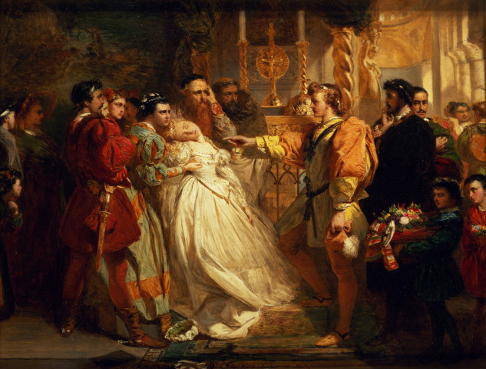 Claudio, deceived by Don John, accuses Hero (Much Ado about Nothing), by Marcus Stone, 1861
Hero and Ursula, her lady in waiting, have played the same trick on Beatrice that the men played on Benedict. It is a beautiful night for Hero to reflect on her feelings of love.
Act II
The wedding festivities are in full swing, and Somarone improvises a song in honor of Sicilian wines. All are enjoying themselves except Beatrice, who is in a state of agitation; the trick has worked. She remembers that after Benedict left for battle she had nightmares about him coming to harm. She admits to herself that she loves him.
Hero and Ursula join Beatrice and all three share Hero’s joy on her wedding morning.
Benedict finds Beatrice and makes his feelings known to her, but she is unable to cope and the wedding celebration interrupts them. Claudio and Hero reveal love poems that Beatrice and Benedict have written about each other, so they both admit their love and agree to a truce—until tomorrow.
[Synopsis Source: Houston Grand Opera]