11 Oct 2009
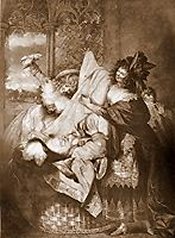
NICOLAI: Die lustigen Weiber von Windsor — Berlin 1943
Die lustigen Weiber von Windsor (The Merry Wives of Windsor), a comical-fantastical opera in three acts with dance.
Mozart and Salieri, an opera in one act consisting of two scenes.
Nicolai Rimsky-Korsakov (1844-1908), composer. Libretto derived from Alexander Puskhin's play of the same name.
First performance: 7 December 1898 in Moscow.
Ariadne auf Naxos, Oper with a prologue and one act. Music composed by Richard Strauss. Libretto by Hugo von Hofmannsthal.
La Vestale, a tragédie lyrique in three acts.
Boris Godunov, an opera in four acts with prologue
Modest Mussorgsky, composer. Libretto by the composer, based on Alexander Pushkin's drama Boris Godunov and Nikolai Karamazin's History of the Russian Empire
First performance: 8 February 1874 at the Mariinsky Theatre, St. Petersburg
Il Trovatore, dramma in four parts.
Only a few months following the premiere of Der Rosenkavalier, Hugo von Hofmannsthal proposed a new opera to Richard Strauss based on Molière’s comedy-ballet, Le Bourgeois gentilhomme (in German, Der Bürger als Edelmann).
Die Entführung aus dem Serail, Singspiel in 3 Acts.
Music composed by Wolfgang Amadeus Mozart (1756–1791). Libretto by Johann Gottlieb Stephanie the Younger, based on an earlier libretto by
Christoph Friedrich Bretzner.
Die Entführung aus dem Serail, Singspiel in 3 Acts.
Music composed by Wolfgang Amadeus Mozart (1756–1791). Libretto by Johann Gottlieb Stephanie the Younger, based on an earlier libretto by
Christoph Friedrich Bretzner.
Arabella: Lyrische Komödie in three acts
Die Entführung aus dem Serail, Singspiel in 3 Acts.
Music composed by Wolfgang Amadeus Mozart (1756–1791). Libretto by Johann Gottlieb Stephanie the Younger, based on an earlier libretto by
Christoph Friedrich Bretzner.
La Gioconda, dramma lirico in four acts.
Music composed by Amilcare Ponchielli (1834–1886). Libretto by Arrigo Boito (under the pseudonym Tobia Gorrio), based upon Victor Hugo's Angelo, Tyrant of Padua (1835).
Don Carlo, an opera in four acts. Music composed by Giuseppe Verdi (1813–1901). Libretto by Joseph Méry and Camille Du Locle after Friedrich von Schiller’s dramatic poem Don Carlos, Infant von Spanien. Revised version in four acts (French text revised by Du Locle, Italian translation by Achille de Lauzières and Angelo Zanardini).
Un ballo in maschera, a melodramma in three acts.
Music composed by Giuseppe Verdi. Libretto by Antonio Somma, based upon the work of Eugène Scribe Gustave III ou Le bal masqué (1833)
Medea: Melodramma tragico in three acts.
Die Tote Stadt, an opera in three acts.
Music composed by Erich Wolfgang Korngold (1897-1957). Libretto by Paul Schott (Julius and E. W. Korngold) after the novel Bruges la morte by Georges Rodenbach.
Manon Lescaut, dramma lirico in quattro atti
Elektra: Tragedy in one act.
Una cosa rara, ossia Bellezza ed onestà. Dramma giocoso in two acts.
Music composed by Vicente Martín y Soler (1754–1806). Libretto by Lorenzo Da Ponte from the comedy La luna de la Sierra by Luis Vélez de Guevara.
Hamlet: Opéra in five acts. Music composed by Ambroise Thomas. Libretto by Michel Carré and Jules Barbier after The Tragedy of Hamlet, Prince of Denmark by William Shakespeare.
Das Liebesverbot: Grosse komische Oper in two acts.
Die lustigen Weiber von Windsor (The Merry Wives of Windsor), a comical-fantastical opera in three acts with dance.
Music composed by Otto Nicolai (1810-1849). Libretto by Salomon Hermann von Mosenthal after the play of the same name by William Shakespeare.
First performance: 9 March 1849 at Königliches Opernhaus, Berlin.
Principal Characters
| Sir John Falstaff | Bass |
| Herr Fluth | Baritone |
| Herr Reich | Bass |
| Fenton | Tenor |
| Junker Spärlich | Tenor |
| Dr. Cajus | Bass |
| Frau Fluth | Soprano |
| Frau Reich | Mezzo-soprano |
| Anna Reich | Soprano |
Time and Place
Windsor (England) during the reign of Henry V (1413-1422).
Summary
Act I
Scene One
Setting: A court.
Frau Fluth informs her friend, Frau Reich, that she has received a letter from the fat knight, Sir John Falstaff. Mrs. Reich received the same letter. Outraged, they plot revenge against Falstaff. They leave.
Herr Fluth and Herr Reich enter along with two would-be suitors of Anna Reich, Junker Spärlich and Dr. Cajus. The penniless Fenton enters proclaiming his love for Anna and asks for her hand. He is summarily rejected.
Scene Two
Setting: Herr Fluth’s home.
Frau Fluth awaits Falstaff. She and Frau Reich have sent an anonymous note to Herr Fluth informing him of the meeting with Falstaff. A large basket is brought in. A frightened Falstaff is later stuffed into the basket and dumped into the Thames.
Act II
Scene One
Setting: A tavern.
Disguised as one Herr Bach, Herr Fluth visits Falstaff at the Garter Inn. He seeks Falstaff’s assistance in gaining the favor of Frau Fluth. Fluth discovers that Falstaff had been at his home the previous day and that Frau Fluth had invited him to visit her again that afternoon.
Scene Two
Setting: A garden.
Junker Spärlich and Dr. Cajus plan to meet Anna during her daily walk. When Fenton appears, they hide. Anna and Fenton reaffirm their love for one another.
Scene Three
Setting: Frau Fluth’s room.
When Falstaff arrives, Frau Reich tells him that Herr Fluth is approaching. The women disguise Falstaff as an old woman, a relative of Frau Fluth’s maid. Herr Fluth has forbidden her presence in his home and beats her mercilessly. He then searches for Falstaff without success.
Act III
Scene One
Setting: Herr Reich’s home.
The wives have informed their husbands of Falstaff’s letters. Herr Fluth has been forgiven his unwarranted jealousy. They devise another trick to play against Falstaff. There is to be a masquerade. Falstaff is to meet the wives costumed as Herne, the legendary hunter. Frau Reich gives Anna a costume of a red elf to wear so that Dr. Cajus will recognize her. After Frau Reich leaves, Herr Reich enters with a green elf costume for Anna to wear so that Junker Spärlich will recognize her. Anna decides to give the costumes to Dr. Cajus and Junker Spärlich to wear. She will run off with Fenton.
Scene Two
Setting: Windsor Forest.
The townspeople, disguised as spooks and spirits, await Falstaff. Falstaff appears as Herne with large antlers on his head. Frau Reich and Frau Fluth arrive. When the ghosts approach, the wives run away. Terrified, Falstaff tries to hide. However, he is pinched, stabbed and mocked. Falstaff repents. The masqueraders reveal themselves. All are in merriment.