30 Nov 2009
THOMAS: Hamlet — London 2003
Hamlet: Opéra in five acts.
Music composed by Ambroise Thomas. Libretto by Michel Carré and Jules Barbier after The Tragedy of Hamlet, Prince of Denmark by William Shakespeare.
Mozart and Salieri, an opera in one act consisting of two scenes.
Nicolai Rimsky-Korsakov (1844-1908), composer. Libretto derived from Alexander Puskhin's play of the same name.
First performance: 7 December 1898 in Moscow.
Ariadne auf Naxos, Oper with a prologue and one act. Music composed by Richard Strauss. Libretto by Hugo von Hofmannsthal.
La Vestale, a tragédie lyrique in three acts.
Boris Godunov, an opera in four acts with prologue
Modest Mussorgsky, composer. Libretto by the composer, based on Alexander Pushkin's drama Boris Godunov and Nikolai Karamazin's History of the Russian Empire
First performance: 8 February 1874 at the Mariinsky Theatre, St. Petersburg
Il Trovatore, dramma in four parts.
Only a few months following the premiere of Der Rosenkavalier, Hugo von Hofmannsthal proposed a new opera to Richard Strauss based on Molière’s comedy-ballet, Le Bourgeois gentilhomme (in German, Der Bürger als Edelmann).
Die Entführung aus dem Serail, Singspiel in 3 Acts.
Music composed by Wolfgang Amadeus Mozart (1756–1791). Libretto by Johann Gottlieb Stephanie the Younger, based on an earlier libretto by
Christoph Friedrich Bretzner.
Die Entführung aus dem Serail, Singspiel in 3 Acts.
Music composed by Wolfgang Amadeus Mozart (1756–1791). Libretto by Johann Gottlieb Stephanie the Younger, based on an earlier libretto by
Christoph Friedrich Bretzner.
Arabella: Lyrische Komödie in three acts
Die Entführung aus dem Serail, Singspiel in 3 Acts.
Music composed by Wolfgang Amadeus Mozart (1756–1791). Libretto by Johann Gottlieb Stephanie the Younger, based on an earlier libretto by
Christoph Friedrich Bretzner.
La Gioconda, dramma lirico in four acts.
Music composed by Amilcare Ponchielli (1834–1886). Libretto by Arrigo Boito (under the pseudonym Tobia Gorrio), based upon Victor Hugo's Angelo, Tyrant of Padua (1835).
Don Carlo, an opera in four acts. Music composed by Giuseppe Verdi (1813–1901). Libretto by Joseph Méry and Camille Du Locle after Friedrich von Schiller’s dramatic poem Don Carlos, Infant von Spanien. Revised version in four acts (French text revised by Du Locle, Italian translation by Achille de Lauzières and Angelo Zanardini).
Un ballo in maschera, a melodramma in three acts.
Music composed by Giuseppe Verdi. Libretto by Antonio Somma, based upon the work of Eugène Scribe Gustave III ou Le bal masqué (1833)
Medea: Melodramma tragico in three acts.
Die Tote Stadt, an opera in three acts.
Music composed by Erich Wolfgang Korngold (1897-1957). Libretto by Paul Schott (Julius and E. W. Korngold) after the novel Bruges la morte by Georges Rodenbach.
Some Details concerning the Revolution inaugurated by Rossini
Manon Lescaut, dramma lirico in quattro atti
Elektra: Tragedy in one act.
Lyric Opera of Chicago has announced both schedules and cast-lists for is Spring 2020 performances of Richard Wagner’s Ring Cycle. Given the series of individual productions already staged by the company since Fall 2016, that pave the way for the complete cycle, Lyric Opera of Chicago’s complete production should affirm the artistic might of the great composer.
“Diacono himself does not know what musical talent he possesses” – Mascagni
Hamlet: Opéra in five acts.
Music composed by Ambroise Thomas. Libretto by Michel Carré and Jules Barbier after The Tragedy of Hamlet, Prince of Denmark by William Shakespeare.
Streaming Audio
First Performance: 9 March 1868, Paris, Opéra.
| Principal Roles: | |
| Hamlet | Baritone |
| Claudius, roi de Danemark | Bass |
| L’ombre du Feu Roi | Bass |
| Polonius, grand chambellan | Bass |
| Laerte, fils de Polonius | Tenor |
| Gertrude, reine de Danemark et mère d’Hamlet | Mezzo-Soprano |
| Ophélie, fille de Polonius | Soprano |
Synopsis:
Act I
Scene 1. A hall in the castle of Elsinore
Claudius is acclaimed King of Denmark and he and his Queen Gertrude receive the good wishes of the court. Hamlet broods that although it is only two months since the death of his father, his mother has already married her husband’s brother, Claudius.
Ophelia is grieved at his melancholy and reproaches him for neglecting her. He swears that he does truly love her, and for her sake renounces his plan of leaving the court. Laertes, about to leave for Norway on a mission from the king, comes to bid his sister Ophelia and Hamlet farewell. He commits Ophelia to Hamlet’s care.
To the derision of the carousing courtiers, Marcellus and Horatio announce that they have seen the ghost of the late king. They are looking for Hamlet to inform him.
Scene 2. The battlements of the castle
Hamlet joins Horatio and Marcellus. The ghost appears and reveals to Hamlet that he was poisoned while sleeping by his brother. Hamlet swears revenge.
Act II
Scene 1. A room in the castle
Ophelia is disturbed by Hamlet’s strange coldness. He appears but does not speak to her, confirming her worst fears. She begs the queen to let her retire to a convent, but the queen wishes her to stay, hoping that she may discover the cause of Hamlet’s distracted state and cure him.
The king tells the queen that Hamlet is mad, but she fears that his strange conduct may indicate that he has discovered their guilty secret. The king assures her that Hamlet knows nothing and tries to calm her as she becomes hysterical, having a vision of their murdered victim rising to accuse them.
Hamlet appears, rejects the king’s request to call him father, feigns madness briefly, then announces the arrival of a troupe of actors. Hamlet intends to have them perform a play which will recreate the circumstances of his father’s murder. He welcomes them with a drinking song.
Scene 2. A hall in the castle
The court gathers to see the play. Hamlet tells Horatio to observe the king. As the play is performed Hamlet describes the action. As the murder is committed the king orders the play stopped. Hamlet pretends madness, accusing the king wildly, to the horror of the court, including even Horatio and Marcellus.
Act III
A room in the castle
Hamlet, angry at himself for his failure to kill the king, watches him at prayer and holds back again, as he wishes to catch him with his sins unabsolved. The king, weighed down by his guilt, calls Polonius and Hamlet realises that Ophelia’s father was an accomplice in the crime.
The queen brings Ophelia to Hamlet, intending to have their wedding performed; but Hamlet, distressed by his awareness of her father’s treachery, spurns Ophelia. The queen reproaches Hamlet, only to be accused by him of complicity in the murder. Unseen by the queen, the ghost appears again. Hamlet, now calmer, bids his mother goodnight.
Act IV
Open country, near a lake
Ophelia, driven mad by her despair, joins merrymaking peasants. She tells them she is married to Hamlet, distributes flowers and sings a song to the wili who, according to her, resides in the lake. She is accidently drowned.
Act V
A graveyard
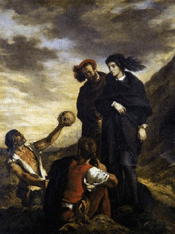
Hamlet watches two gravediggers at work singing about the transience of earthly pleasures — except drinking. He has fled the court to escape being murdered, leaving Horatio to attend to his plans, and is aware of Ophelia’s madness, but not of her death.
He is joined by Laertes, who is aware of her death and blames Hamlet for his lack of care for her. He succeeds in provoking Hamlet to a duel but they are interrupted by Ophelia’s funeral cortege. Hamlet wishes to kill himself but the appearance of the ghost reminds him of his vow. He kills Claudius and then joins Ophelia in death.
[In the original version of the opera, Hamlet is acclaimed king at the end.]
[Synopsis Source: Opera~Opera]