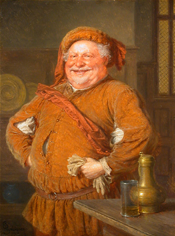
13 Dec 2009
VERDI: Falstaff — Wales 2008
Falstaff: Commedia lirica in three acts.
Mozart and Salieri, an opera in one act consisting of two scenes.
Nicolai Rimsky-Korsakov (1844-1908), composer. Libretto derived from Alexander Puskhin's play of the same name.
First performance: 7 December 1898 in Moscow.
Ariadne auf Naxos, Oper with a prologue and one act. Music composed by Richard Strauss. Libretto by Hugo von Hofmannsthal.
La Vestale, a tragédie lyrique in three acts.
Boris Godunov, an opera in four acts with prologue
Modest Mussorgsky, composer. Libretto by the composer, based on Alexander Pushkin's drama Boris Godunov and Nikolai Karamazin's History of the Russian Empire
First performance: 8 February 1874 at the Mariinsky Theatre, St. Petersburg
Il Trovatore, dramma in four parts.
Only a few months following the premiere of Der Rosenkavalier, Hugo von Hofmannsthal proposed a new opera to Richard Strauss based on Molière’s comedy-ballet, Le Bourgeois gentilhomme (in German, Der Bürger als Edelmann).
Die Entführung aus dem Serail, Singspiel in 3 Acts.
Music composed by Wolfgang Amadeus Mozart (1756–1791). Libretto by Johann Gottlieb Stephanie the Younger, based on an earlier libretto by
Christoph Friedrich Bretzner.
Die Entführung aus dem Serail, Singspiel in 3 Acts.
Music composed by Wolfgang Amadeus Mozart (1756–1791). Libretto by Johann Gottlieb Stephanie the Younger, based on an earlier libretto by
Christoph Friedrich Bretzner.
Arabella: Lyrische Komödie in three acts
Die Entführung aus dem Serail, Singspiel in 3 Acts.
Music composed by Wolfgang Amadeus Mozart (1756–1791). Libretto by Johann Gottlieb Stephanie the Younger, based on an earlier libretto by
Christoph Friedrich Bretzner.
La Gioconda, dramma lirico in four acts.
Music composed by Amilcare Ponchielli (1834–1886). Libretto by Arrigo Boito (under the pseudonym Tobia Gorrio), based upon Victor Hugo's Angelo, Tyrant of Padua (1835).
Don Carlo, an opera in four acts. Music composed by Giuseppe Verdi (1813–1901). Libretto by Joseph Méry and Camille Du Locle after Friedrich von Schiller’s dramatic poem Don Carlos, Infant von Spanien. Revised version in four acts (French text revised by Du Locle, Italian translation by Achille de Lauzières and Angelo Zanardini).
Un ballo in maschera, a melodramma in three acts.
Music composed by Giuseppe Verdi. Libretto by Antonio Somma, based upon the work of Eugène Scribe Gustave III ou Le bal masqué (1833)
Medea: Melodramma tragico in three acts.
Die Tote Stadt, an opera in three acts.
Music composed by Erich Wolfgang Korngold (1897-1957). Libretto by Paul Schott (Julius and E. W. Korngold) after the novel Bruges la morte by Georges Rodenbach.
Some Details concerning the Revolution inaugurated by Rossini
Manon Lescaut, dramma lirico in quattro atti
Elektra: Tragedy in one act.
Lyric Opera of Chicago has announced both schedules and cast-lists for is Spring 2020 performances of Richard Wagner’s Ring Cycle. Given the series of individual productions already staged by the company since Fall 2016, that pave the way for the complete cycle, Lyric Opera of Chicago’s complete production should affirm the artistic might of the great composer.
“Diacono himself does not know what musical talent he possesses” – Mascagni
Falstaff: Commedia lirica in three acts.
Streaming Audio
Music composed by Giuseppe Verdi (1813-1901). Libretto by Arrigo Boito after The Merry Wives of Windsor and King Henry IV by William Shakespeare.
First Performance: 9 February 1893, Teatro alla Scala, Milan.
| Principal Characters: | |
| Sir John Falstaff | Baritone |
| Ford, husband of Alice | Baritone |
| Fenton | Tenor |
| Dr.Caius | Tenor |
| Bardolfo and Pistola, followers of Falstaff | Tenors |
| Mrs. Alice Ford | Soprano |
| Nannetta, daughter of Alice | Soprano |
| Mrs. Quickly | Mezzo-Soprano |
| Mrs. Meg Page | Mezzo-Soprano |
Setting: Windsor, during the reign of Henry IV of England
Synopsis
Act I.
A room at the Garter Inn. Falstaff is surrounded by his servants Bardolfo, Pistola and the innkeeper, when Dr. Caius arrives and accuses him of robbery, but the excited doctor is soon ejected. Falstaff hands letters to his servants for delivery to Mistress Ford and to Mistress Page. The letters, which purport of Falstaff’s love for the respectable women, are intended to seduce them (although he is really seducing them for the money). Bardolfo and Pistola refuse, however, claiming that ‘honor’ prevents them from obeying his orders. Sending the letters by a page instead, Falstaff confronts his servants (’Che dunque l’onore? Una parola!’ — ‘What, then, is honor? A word!‘) and chases them out of his sight.
Change of scene: Ford’s garden. Alice and Meg have received Falstaff’s letters, both of identical contents. They exchange them, and in conjunction with Mistress Quickly, resolve to punish the knight. The three are also none too pleased with Master Ford, who is intending to give his daughter Nannetta in marriage to Dr. Caius. This, they resolve, will not happen. Meanwhile, Ford has been apprised of the letters by Bardolfo and Pistola. All three are athirst for vengeance. A brief love duet between Fenton and Nannetta follows; the women return home and, through Mistress Quickly, a maid, invite Falstaff to an assignation. The men also arrive upon the scene, and Bardolfo and Pistola are persuaded to introduce Ford to Falstaff under an assumed name.
Act II.
Same room as in the first scene of Act I. Bardolfo and Pistola (now in the pay of Ford), pretending to beg for forgiveness for past transgressions, announce to their master the arrival of Mistress Quickly, who delivers the invitation. Ford is now introduced as Signor Fontana, who offers money to the fat knight to intercede for him with Mistress Ford. Falstaff agrees with pleasure, and while he attires himself in splendid array in his chamber, Ford is consumed with jealousy (’È sogno o realtà?’ — ‘Is it a dream or reality?‘).
Change of scene: A room in Ford’s house. As Mistress Quickly announces the coming of Falstaff, Mistress Ford has a large clothes basket placed in readiness. Falstaff’s attempts to seduce the lady are cut short as Mistress Quickly reports the arrival of Mistress Page, and the knight is compelled to conceal himself behind a screen. When the angry Ford with his friends appear to capture Falstaff, the latter hides in the basket. In the meantime, a love scene between Fenton and Nannetta takes place behind the screen, and the men returning, hear the sound of a kiss; they think to entrap Falstaff, but find Fenton, who is ordered by Ford to leave. When the men again proceed with the search, the women order the wash basket to be thrown into the ditch, where Falstaff is compelled to endure the jeers of the crowd.
Act III.
Before the inn. Falstaff, in a gloomy mood, curses the sorry state of the world. Some mulled wine, however, soon improves his mood. The fat knight again receives an invitation through Dame Quickly, which is overheard by the men. After Falstaff, dubious at first, has promised to go to Herne’s Oak dressed as the Black Huntsman, the place of meeting, he enters the house with Dame Quickly, and the men concoct a plan for his punishment. Dr. Caius is promised the hand of Nannetta, and is told of her disguise. The plot is overheard by Dame Quickly.
Change of scene: At Herne’s Oak in Windsor Park. A moonlit midnight. The women disguise Fenton as a monk, and arrange that he shall spoil the plans of Dr. Caius. Falstaff’s love scene with Mistress Ford is interrupted by the announcement that witches are approaching, and the men disguised as elves and fairies thrash Falstaff soundly. When their vengeance is satisfied, Dr. Caius finds that he has captured Bardolfo instead of Nannetta in the garb of a fairy queen, but Fenton and Nannetta, with the consent of Ford, are joined in wedlock. Falstaff, pleased to find himself not the only dupe, proclaims in a fugue that the whole world is a joke (Tutto nel mondo è burla).