30 Jan 2010
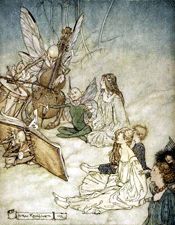
PURCELL: The Fairy-Queen
The Fairy-Queen: Semi-opera in five acts.
Mozart and Salieri, an opera in one act consisting of two scenes.
Nicolai Rimsky-Korsakov (1844-1908), composer. Libretto derived from Alexander Puskhin's play of the same name.
First performance: 7 December 1898 in Moscow.
Ariadne auf Naxos, Oper with a prologue and one act. Music composed by Richard Strauss. Libretto by Hugo von Hofmannsthal.
La Vestale, a tragédie lyrique in three acts.
Boris Godunov, an opera in four acts with prologue
Modest Mussorgsky, composer. Libretto by the composer, based on Alexander Pushkin's drama Boris Godunov and Nikolai Karamazin's History of the Russian Empire
First performance: 8 February 1874 at the Mariinsky Theatre, St. Petersburg
Il Trovatore, dramma in four parts.
Only a few months following the premiere of Der Rosenkavalier, Hugo von Hofmannsthal proposed a new opera to Richard Strauss based on Molière’s comedy-ballet, Le Bourgeois gentilhomme (in German, Der Bürger als Edelmann).
Die Entführung aus dem Serail, Singspiel in 3 Acts.
Music composed by Wolfgang Amadeus Mozart (1756–1791). Libretto by Johann Gottlieb Stephanie the Younger, based on an earlier libretto by
Christoph Friedrich Bretzner.
Die Entführung aus dem Serail, Singspiel in 3 Acts.
Music composed by Wolfgang Amadeus Mozart (1756–1791). Libretto by Johann Gottlieb Stephanie the Younger, based on an earlier libretto by
Christoph Friedrich Bretzner.
Arabella: Lyrische Komödie in three acts
Die Entführung aus dem Serail, Singspiel in 3 Acts.
Music composed by Wolfgang Amadeus Mozart (1756–1791). Libretto by Johann Gottlieb Stephanie the Younger, based on an earlier libretto by
Christoph Friedrich Bretzner.
La Gioconda, dramma lirico in four acts.
Music composed by Amilcare Ponchielli (1834–1886). Libretto by Arrigo Boito (under the pseudonym Tobia Gorrio), based upon Victor Hugo's Angelo, Tyrant of Padua (1835).
Don Carlo, an opera in four acts. Music composed by Giuseppe Verdi (1813–1901). Libretto by Joseph Méry and Camille Du Locle after Friedrich von Schiller’s dramatic poem Don Carlos, Infant von Spanien. Revised version in four acts (French text revised by Du Locle, Italian translation by Achille de Lauzières and Angelo Zanardini).
Un ballo in maschera, a melodramma in three acts.
Music composed by Giuseppe Verdi. Libretto by Antonio Somma, based upon the work of Eugène Scribe Gustave III ou Le bal masqué (1833)
Medea: Melodramma tragico in three acts.
Die Tote Stadt, an opera in three acts.
Music composed by Erich Wolfgang Korngold (1897-1957). Libretto by Paul Schott (Julius and E. W. Korngold) after the novel Bruges la morte by Georges Rodenbach.
Some Details concerning the Revolution inaugurated by Rossini
Manon Lescaut, dramma lirico in quattro atti
Elektra: Tragedy in one act.
Lyric Opera of Chicago has announced both schedules and cast-lists for is Spring 2020 performances of Richard Wagner’s Ring Cycle. Given the series of individual productions already staged by the company since Fall 2016, that pave the way for the complete cycle, Lyric Opera of Chicago’s complete production should affirm the artistic might of the great composer.
“Diacono himself does not know what musical talent he possesses” – Mascagni
The Fairy-Queen: Semi-opera in five acts.
Streaming Audio
Music composed by Henry Purcell. Libretto anonymously adapted from William Shakespeare’s A Midsummer Night’s Dream.
First Performance: 2 May 1692, Queen’s Theatre, Dorset Garden, London.
| Roles: | |
| Drunken Poet | Bass |
| First Fairy | Soprano |
| Second Fairy | Soprano |
| Night | Soprano |
| Mystery | Soprano |
| Secrecy | Countertenor |
| Sleep | Bass |
| Corydon | Bass |
| Mopsa | Soprano/Countertenor |
| Nymph | Soprano |
| 3 Attendants to Oberon | 1 Soprano, 2 Countertenors |
| Phoebus | Tenor |
| Spring | Soprano |
| Summer | Countertenor |
| Autumn | Tenor |
| Winter | Bass |
| Juno | Soprano |
| Chinese Man | Countertenor |
| Chinese Woman, Daphne | Soprano |
| Hymen | Bass |
Synopsis:
Act 1
The first scene set to music occurs after Titania has left Oberon, following an argument over the ownership of a little Indian boy. Two of her fairies sing of the delights of the countryside (“Come, come, come, come, let us leave the town”). A drunken, stuttering poet enters, singing “Fill up the bowl”. The stuttering has led many to believe the scene is based on the habits of Thomas d’Urfey. However, it may also be poking fun at Elkanah Settle, who stuttered as well and was long thought to be the librettist, due to an error in his 1910 biography.
The fairies mock the drunken poet and drive him away.
Act 2
It begins after Oberon has ordered Puck to anoint the eyes of Demetrius with the love-juice. Titania and her fairies merrily revel (“Come all ye songsters of the sky”), and Night (“See, even Night”), Mystery (“I am come to lock all fast”), Secrecy (“One charming night”) and Sleep (“Hush, no more, be silent all”) lull them asleep and leave them to pleasant dreams.
Act 3
Titania has fallen in love with Bottom (now equipped with his ass’ head), much to Oberon’s gratification. A Nymph sings of the pleasures and torments of love (“If love’s a sweet passion”) and after several dances, Titania and Bottom are entertained by the foolish, loving banter of two haymakers, Corydon and Mopsa.
Act 4
It begins after Titania has been freed from her enchantment, commencing with a brief divertissement to celebrate Oberon’s birthday (“Now the Night”, and the abovementioned “Let the fifes and the clarions”), but for the most part it is a masque of the god Phoebus (“When the cruel winter”) and the Four Seasons (Spring; “Thus, the ever grateful spring”, Summer; ”Here’s the Summer”, Autumn; “See my many coloured fields”, and Winter; ”Now Winter comes slowly”).
Act 5
After Theseus has been told of the lovers’s adventures in the wood, it begins with the goddess Juno singing an epithalamium, “Thrice happy lovers”, followed by a woman who sings the well–known “The Plaint” (“O let me weep”). A Chinese man and woman enter singing several songs about the joys of their world. (“Thus, the gloomy world”, “Thus happy and free” and “Yes, Xansi”). Two other Chinese women summon Hymen, who sings in praise of married bliss, thus uniting the wedding theme of A Midsummer Night’s Dream, with the celebration of William and Mary’s anniversary.
[Synopsis Source: Wikipedia]
Click here for the complete libretto.
Click here for the complete text of A Midsummer Night’s Dream.
Prelude to The Fairy Queen — Orchestra of the Age of Enlightenment Conducted by William Christie: