![Prospero and Miranda by William Maw Egley (c. 1850) [Source: Wikipedia]](http://www.operatoday.com/prospero_miranda.png)
07 Feb 2010
MARTIN: Der Sturm
Der Sturm: Opera in three acts
Mozart and Salieri, an opera in one act consisting of two scenes.
Nicolai Rimsky-Korsakov (1844-1908), composer. Libretto derived from Alexander Puskhin's play of the same name.
First performance: 7 December 1898 in Moscow.
Ariadne auf Naxos, Oper with a prologue and one act. Music composed by Richard Strauss. Libretto by Hugo von Hofmannsthal.
La Vestale, a tragédie lyrique in three acts.
Boris Godunov, an opera in four acts with prologue
Modest Mussorgsky, composer. Libretto by the composer, based on Alexander Pushkin's drama Boris Godunov and Nikolai Karamazin's History of the Russian Empire
First performance: 8 February 1874 at the Mariinsky Theatre, St. Petersburg
Il Trovatore, dramma in four parts.
Only a few months following the premiere of Der Rosenkavalier, Hugo von Hofmannsthal proposed a new opera to Richard Strauss based on Molière’s comedy-ballet, Le Bourgeois gentilhomme (in German, Der Bürger als Edelmann).
Die Entführung aus dem Serail, Singspiel in 3 Acts.
Music composed by Wolfgang Amadeus Mozart (1756–1791). Libretto by Johann Gottlieb Stephanie the Younger, based on an earlier libretto by
Christoph Friedrich Bretzner.
Die Entführung aus dem Serail, Singspiel in 3 Acts.
Music composed by Wolfgang Amadeus Mozart (1756–1791). Libretto by Johann Gottlieb Stephanie the Younger, based on an earlier libretto by
Christoph Friedrich Bretzner.
Arabella: Lyrische Komödie in three acts
Die Entführung aus dem Serail, Singspiel in 3 Acts.
Music composed by Wolfgang Amadeus Mozart (1756–1791). Libretto by Johann Gottlieb Stephanie the Younger, based on an earlier libretto by
Christoph Friedrich Bretzner.
La Gioconda, dramma lirico in four acts.
Music composed by Amilcare Ponchielli (1834–1886). Libretto by Arrigo Boito (under the pseudonym Tobia Gorrio), based upon Victor Hugo's Angelo, Tyrant of Padua (1835).
Don Carlo, an opera in four acts. Music composed by Giuseppe Verdi (1813–1901). Libretto by Joseph Méry and Camille Du Locle after Friedrich von Schiller’s dramatic poem Don Carlos, Infant von Spanien. Revised version in four acts (French text revised by Du Locle, Italian translation by Achille de Lauzières and Angelo Zanardini).
Un ballo in maschera, a melodramma in three acts.
Music composed by Giuseppe Verdi. Libretto by Antonio Somma, based upon the work of Eugène Scribe Gustave III ou Le bal masqué (1833)
Medea: Melodramma tragico in three acts.
Die Tote Stadt, an opera in three acts.
Music composed by Erich Wolfgang Korngold (1897-1957). Libretto by Paul Schott (Julius and E. W. Korngold) after the novel Bruges la morte by Georges Rodenbach.
Some Details concerning the Revolution inaugurated by Rossini
Manon Lescaut, dramma lirico in quattro atti
Elektra: Tragedy in one act.
Lyric Opera of Chicago has announced both schedules and cast-lists for is Spring 2020 performances of Richard Wagner’s Ring Cycle. Given the series of individual productions already staged by the company since Fall 2016, that pave the way for the complete cycle, Lyric Opera of Chicago’s complete production should affirm the artistic might of the great composer.
“Diacono himself does not know what musical talent he possesses” – Mascagni
Der Sturm: Opera in three acts
Streaming Audio
Music composed by Frank Martin. Libretto by the composed based upon William Shakespeare’s The Tempest as translated by A. W. Schlegel.
First performance: 17 June 1956, Wiener Staatsoper, Vienna.
| Roles: | |
| Prospero, the usurped Duke of Milan | Baritone |
| Miranda, Prospero’s daughter | Soprano |
| Ariel, an airy spirit | Dancer |
| Caliban, enslaved by Prospero | Bass |
| Alonso, the King of Naples | Bass |
| Sebastian, Alonso’s brother | Bass |
| Antonio, the usurping Duke of Milan and Prospero’s brother | Tenor |
| Ferdinand, Alonso’s son | Tenor |
| Gonzalo, counsellor to Prospero and Miranda | Bass-Baritone |
| Adrian, a lord | Tenor |
| Trinculo, jester | Tenor |
| Stephano, a drunken butler | Baritone |
| Boatswain | Baritone |
| Master of the ship | Speaker |
| Iris, Ceres and Juno spirits | Dancers |
Synopsis of play:
The magician Prospero, rightful Duke of Milan, and his daughter, Miranda, have been stranded for twelve years on an island after Prospero’s jealous brother Antonio—helped by Alonso, the King of Naples—deposed him and set him adrift with the then three-year-old Miranda. Gonzalo, the King’s counsellor, had secretly supplied their boat with plenty of food, water, clothes and the most-prized books from Prospero’s library. Possessing magic powers due to his great learning, Prospero is reluctantly served by a spirit, Ariel, whom Prospero had rescued from a tree in which he had been trapped by the Algerian witch Sycorax. Prospero maintains Ariel’s loyalty by repeatedly promising to release the “airy spirit” from servitude. Sycorax had been banished to this island, and had died before Prospero’s arrival. Her son, Caliban, a deformed monster and the only non-spiritual inhabitant before the arrival of Prospero, was initially adopted and raised by him. He taught Prospero how to survive on the island, while Prospero and Miranda taught Caliban religion and their own language. Following Caliban’s attempted rape of Miranda, he had been compelled by Prospero to serve as the sorcerer’s slave, carrying wood and gathering berries and “pig nuts” (acorns). In slavery, Caliban has come to view Prospero as a usurper and has grown to resent him and his daughter. Prospero and Miranda in turn view Caliban with contempt and disgust.
The play opens as Prospero, having divined that his brother, Antonio, is on a ship passing close by the island, has raised a tempest which causes the ship to run aground. Also on the ship are Antonio’s friend and fellow conspirator, King Alonso of Naples, Alonso’s brother and son (Sebastian and Ferdinand), and Alonso’s advisor, Gonzalo. All these passengers are returning from the wedding of Alonso’s daughter Claribel with the King of Tunis. Prospero, by his spells, contrives to separate the survivors of the wreck into several groups. Alonso and Ferdinand are separated and believe one another to be dead.
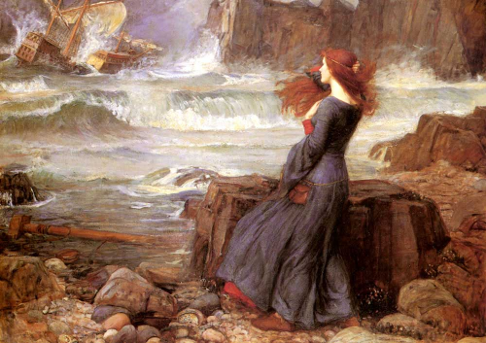 Miranda — The Tempest by John William Waterhouse (1916) [Source: Wikipedia]
Three plots then alternate through the play. In one, Caliban falls in with Stephano and Trinculo, two drunkards, whom he believes to have come from the moon. They attempt to raise a rebellion against Prospero, which ultimately fails. In another, Prospero works to establish a romantic relationship between Ferdinand and Miranda; the two fall immediately in love, but Prospero worries that “too light winning [may] make the prize light”, and compels Ferdinand to become his servant, pretending that he regards him as a spy. In the third subplot, Antonio and Sebastian conspire to kill Alonso and Gonzalo so that Sebastian can become King. They are thwarted by Ariel, at Prospero’s command. Ariel appears to the “three men of sin” (Alonso, Antonio and Sebastian) as a harpy, reprimanding them for their betrayal of Prospero. Prospero manipulates the course of his enemies’ path through the island, drawing them closer and closer to him.
In the conclusion, all the main characters are brought together before Prospero, who forgives Alonso. He also forgives Antonio and Sebastian, but warns them against further betrayal. Ariel is charged to prepare the proper sailing weather to guide Alonso and his entourage (including Prospero himself and Miranda) back to the Royal fleet and then to Naples, where Ferdinand and Miranda will be married. After discharging this task, Ariel will finally be free. Prospero pardons Caliban, who is sent to prepare Prospero’s cell, to which Alonso and his party are invited for a final night before their departure. Prospero indicates that he intends to entertain them with the story of his life on the island. Prospero has resolved to break and bury his staff, and “drown” his book of magic, and in his epilogue, shorn of his magic powers, he invites the audience to set him free from the island with their applause.
[Synopsis source: Wikipedia]
Click here for the complete libretto.
Prospero’s Epilogue — Dietrich Fischer-Dieskau as Prospero: